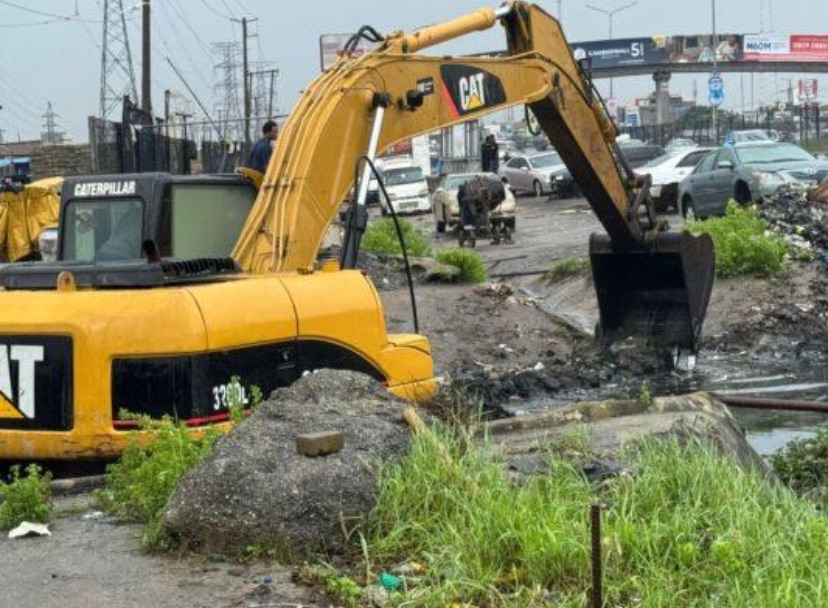

The Lagos State Government has announced the immediate demolition of illegal buildings and structures blocking drainage channels and canal rights of way in Agungi, Ajiran, and Ikota. The move is part of a broader effort to address recurring flooding that has affected many residents in these communities following heavy rainfall.
The announcement was made in a statement shared on the Lagos State Government’s official Facebook page. According to the government, the enforcement exercise will focus on reopening blocked drainage channels and removing all structures built illegally on waterways and drainage alignments.
The decision follows recent flooding across several parts of Lagos, which has disrupted movement, damaged properties, and raised concerns about the effectiveness of existing drainage systems.
The Commissioner for the Environment and Water Resources, Tokunbo Wahab, revealed the plan after inspecting key drainage projects and flood control infrastructure in Lekki, Agungi, Ikota, and Ajiran. His visit was prompted by repeated complaints of flooding in Agungi despite the completion of major drainage projects more than two years ago.
During the inspection, officials discovered that a major drainage outlet at Ajiran had been blocked. According to Wahab, a land-owning family illegally obstructed the channel leading stormwater into the Lagos Lagoon. He explained that the drainage system was designed to allow floodwater flow naturally into the lagoon, but the blockage had prevented water from draining properly, increasing the risk of flooding in nearby communities.
The commissioner directed that the blocked drainage channel be reopened immediately, stressing that public safety takes priority. He emphasized that while the government respects legitimate land ownership and Certificates of Occupancy, no individual or community has the right to block public drainage systems or natural waterways.
Wahab also explained that the drainage channel running through Chevron Drive serves as the main route for stormwater from Agungi and Ajiran into the Lagos Lagoon. Any obstruction along this route, he said, weakens the drainage network and leaves residents exposed to severe flooding despite the government’s investment in flood control projects.
The inspection also extended to Megamond Estate in Ikota, where officials discovered that developers had reclaimed part of the Ikota River and started construction without obtaining the necessary environmental and drainage approvals. The commissioner disclosed that enforcement notices had earlier been issued to the developers, but they failed to comply. As a result, all illegal structures built on reclaimed waterways will be demolished.
The government reminded developers that projects located on wetlands or near water bodies must obtain Environmental Impact Assessment (EIA) approval and, where necessary, Wetland Clearance from the Ministry of the Environment and Water Resources before construction begins.
Wahab reaffirmed that Lagos State will continue to remove illegal developments that violate environmental regulations. He also urged residents to avoid dumping refuse into gutters and drainage channels, as blocked drains contribute significantly to flooding during heavy rainfall.
The government’s action is part of a wider flood management strategy that includes restoring wetlands, protecting canals, installing flood control equipment, improving drainage infrastructure, and enforcing building regulations. Authorities believe these measures, combined with stronger compliance by developers and residents, will help reduce flooding and improve environmental safety across Lagos as the rainy season continues.