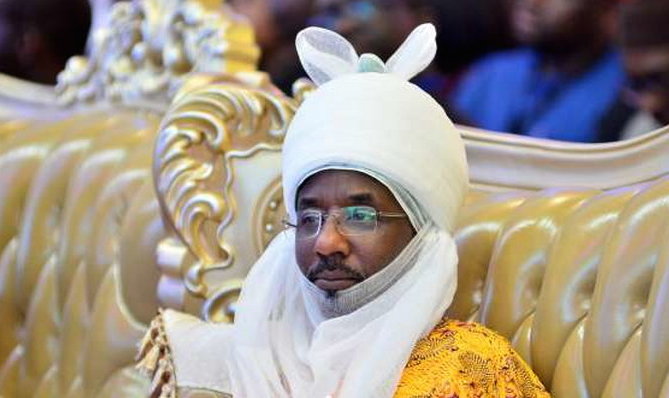

Former Central Bank of Nigeria (CBN) Governor Muhammadu Sanusi II has urged West African leaders to postpone the planned launch of the ECO single currency, warning that introducing a common currency without strong economic foundations could undermine regional integration and damage investor confidence.
Speaking at a policy dialogue organised by the National Institute for Legislative and Democratic Studies (NILDS) on Thursday, the Emir of Kano argued that a successful monetary union can only emerge after member states establish sound fiscal discipline, macroeconomic stability, and credible institutions.
Sanusi said the proposed ECO should be viewed as the culmination of regional economic integration rather than its starting point. According to him, launching the currency amid weak economies, rising public debt, persistent inflation, and fragile institutions would expose the bloc to significant financial instability from the outset.
“We are treating the currency as the first step, but it must be the final step at the top of a pyramid,” Sanusi said, stressing that ECOWAS members must first meet binding fiscal convergence targets, including sustainable budget deficits, manageable debt levels, and aligned inflation rates before adopting a common monetary policy.
He noted that the regional bloc has repeatedly missed its self-imposed deadlines for the ECO, including the 2020 and 2024 targets, while making limited progress toward satisfying the economic benchmarks required for a viable currency union. Fiscal deficits in several member states remain above the agreed 3% of gross domestic product (GDP) threshold, while debt-servicing costs continue to consume an increasing share of government revenues.
Sanusi also highlighted Nigeria’s outsized influence within ECOWAS, noting that Africa’s largest economy accounts for roughly 60% of the bloc’s GDP and nearly 70% of its population. As a result, he warned that Nigeria’s current macroeconomic challenges, including foreign exchange liquidity constraints, elevated inflation, subsidy-related fiscal pressures, and exchange-rate volatility, could become structural weaknesses embedded within the ECO itself.
Beyond economic fundamentals, the former CBN governor pointed to growing political divisions within West Africa, particularly the widening split between ECOWAS and the Alliance of Sahel States (AES). He argued that a successful monetary union depends not only on economic convergence but also on deep political trust, institutional coordination, and sustained policy alignment among participating countries.
For investors and policymakers, Sanusi’s remarks reinforce concerns that the timeline for the ECO may require another postponement. Analysts say his intervention is likely to intensify calls for ECOWAS leaders to prioritise domestic economic reforms, fiscal consolidation, and stronger regional institutions before pursuing monetary integration.
Sanusi concluded that without meaningful structural reforms and genuine political cohesion, the ECO risks becoming a symbolic project rather than a credible currency capable of promoting regional trade, investment, and long-term economic prosperity.