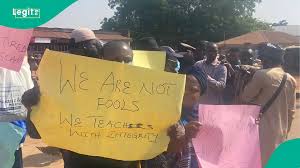

Primary school teachers in the Yala Local Government Area of Cross River State took to the streets on Friday, March 27, 2026, to protest the non-payment of their salaries for September 2025, January 2026, and February 2026. The demonstrators, carrying placards with various inscriptions, marched through major roads before concluding their protest at the council secretariat, where they also decried instances of selective and short-payment.
The structural and economic consequence of this dispute has created a deep divide between the labor force and local authorities. Spokesperson for the teachers, Mr. Peter Okpe, alleged that salary disbursements have been “politicized,” claiming that only a fraction of the over 300 teachers were paid in full. According to Okpe, some teachers received as little as N3,000 to N7,000 as their monthly take-home pay, while others allegedly secured their wages only after intervening through “godfathers” or high-ranking officials. He warned that if these arrears are not cleared, teachers may refuse to resume classes for the upcoming school term.
Analytically, the impact on “Administrative Accountability and Ghost Worker Audits” remains a point of intense friction. The State Commissioner for Education, Prof. Stephen Odey, dismissed the teachers’ claims, asserting that the government does not owe any worker in the state. Instead, he attributed the non-payment to absenteeism during mandatory verification exercises. Odey maintained that those missing from the payroll were simply not at their duty posts when auditors visited, suggesting that the issues are self-inflicted by those refusing to “subject themselves to authority.”
The impact on “Systemic Technical Failures” offers a third perspective on the crisis. Mr. Emmanuel Onah, Press Secretary to the Yala Council Chairman, attributed the irregularities to a massive “system glitch” occurring in September 2025. He claimed that while some teachers were unpaid, others were erroneously credited with amounts as high as N1 million. Onah alleged that the refusal of overpaid staff to come forward for corrections has stalled the resolution process, though he noted that salaries for October through December 2025 were processed without incident.
Furthermore, the conflicting narratives between the Council’s “technical glitch” excuse and the Ministry’s “absenteeism” allegation suggest a lack of coordination in the government’s response. While the teachers maintain they are being victimized and underpaid, the administration insists the state is current on its financial obligations. The resolution of this deadlock is critical to preventing a total collapse of primary education services in the region.
The long-term outlook for Yala’s education sector depends on a transparent reconciliation of the payroll data. Until the “system glitch” is rectified and the results of the verification exercises are harmonized, the threat of an indefinite strike remains high. For the pupils of Cross River, the outcome of this March 2026 protest will determine whether their classrooms remain open in the coming months.