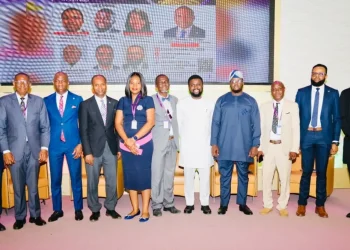
The European Union has pledged to deepen bilateral ties with Nigeria across security, trade, and key economic sectors, citing growing global uncertainty and the need for partners committed to a rules-based international system to strengthen cooperation. The commitment was made by Mrs Kaja Kallas, High Representative of the EU for Foreign Affairs and Security Policy, during a meeting with President Bola Tinubu at his Lagos residence on Monday.
Kallas said discussions focused on expanding cooperation in security, trade, investment, and critical raw materials, describing Nigeria as a “like-minded partner” with whom the EU shares fundamental values. “We are very like-minded partners, the European Union and Nigeria, and today we explored new ways to collaborate across key sectors,” she said. She noted that the evolving global geopolitical environment made it necessary for partners that value the international rules-based system to work more closely together.
The security dimension of the partnership carries particular weight given the deteriorating conditions in the Sahel and the spillover effects into Nigeria’s northern borders. Kallas indicated that both sides discussed opportunities to deepen engagement in cybersecurity and broader security cooperation to address emerging threats. “We are looking at enhanced cooperation in security and cybersecurity, where we believe there is significant potential for stronger collaboration,” she said. The EU has been a significant partner in Nigeria’s counter-insurgency efforts, providing training, intelligence support, and development assistance aimed at stabilising conflict-affected regions.
On the economic front, the EU’s interest in critical raw materials aligns with Nigeria’s push to diversify its economy beyond oil and gas. Nigeria holds significant deposits of lithium, tin, limestone, and other minerals essential for the global energy transition and technology manufacturing. For the EU, which has identified critical raw materials as a strategic priority to reduce dependence on concentrated suppliers, Nigeria represents a potential partner in building more resilient supply chains. Kallas noted that investment and trade remained areas where there is “scope for more collaboration, particularly in areas that support sustainable growth.”
The meeting also touched on the broader trade relationship between Nigeria and the EU, which remains Nigeria’s largest trading partner. The Economic Partnership Agreement between the EU and the Economic Community of West African States (ECOWAS) has been a framework for trade relations, though implementation has been uneven. Renewed engagement at the highest level suggests both sides are seeking to move beyond existing frameworks toward more dynamic cooperation that reflects current economic realities.
President Tinubu reaffirmed Nigeria’s commitment to strengthening its relationship with the EU across multiple sectors, expressing appreciation for the bloc’s continued support in development, security, and economic cooperation. He said Nigeria remained open to partnerships that would promote shared prosperity, stability, and sustainable development. The meeting was attended by National Security Adviser Malam Nuhu Ribadu and Minister of Budget and National Planning Abubakar Bagudu.
The timing of the EU’s high-level engagement is significant. With global geopolitical alignments shifting and competition for influence in Africa intensifying, both Nigeria and the EU have strategic interest in reinforcing their partnership. For Nigeria, deepening ties with the EU offers an alternative to over-reliance on any single external partner, consistent with the non-aligned foreign policy tradition. For the EU, Nigeria’s demographic weight, economic size, and democratic credentials make it an indispensable partner in the region.
The focus on cybersecurity is also noteworthy. As Nigeria’s digital economy expands, cyber threats have become a growing concern for both public institutions and private sector operators. EU expertise in cybersecurity governance, incident response, and capacity building could support Nigeria’s efforts to secure its digital infrastructure and strengthen the resilience of its financial and telecommunications systems.
The visit by Kallas, the EU’s top diplomat, signals a sustained commitment to engagement with Nigeria at a time when other Western partners have shown inconsistent engagement with the continent. As Nigeria pursues the economic reforms under the Renewed Hope agenda, deepening trade and investment ties with the EU could support efforts to attract foreign capital, expand non-oil exports, and create jobs. The challenge will be translating high-level political commitments into concrete commercial outcomes and measurable improvements in security cooperation.