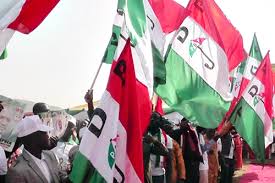

The Peoples Democratic Party (PDP) has launched a blistering counter-attack against the All Progressives Congress (APC), labeling the ruling party’s rhetoric as “delusional propaganda.” In a statement released on Monday, March 16, 2026, the PDP National Publicity Secretary, Ini Ememobong, responded to claims by his APC counterpart, Felix Morka, who recently asserted that the PDP had effectively ceased to function as a viable political entity due to systemic internal dysfunction.
The structural and political consequence of this war of words is underscored by a dramatic shift in Nigeria’s gubernatorial landscape. The PDP has been significantly diminished by a continuous wave of defections; following the recent exit of Zamfara State Governor Dauda Lawal to the APC, the PDP is now left with only two governors—in Oyo and Bauchi states. Conversely, the APC has consolidated its dominance, now controlling 31 of the 36 states. Despite these numbers, Ememobong argued that the APC’s growth is artificial, fueled by “force and inducement” rather than genuine popular support.
Analytically, the PDP is attempting to pivot the narrative from its internal depletion to the national economic climate. Ememobong insisted that while the APC may be “capturing” politicians, it is losing the citizenry due to the “untold hardship” triggered by President Bola Tinubu’s economic policies. He further alleged that the APC’s membership registers are being artificially populated by copying databases from state empowerment programs, suggesting that the ruling party lacks authentic grassroots depth despite its massive territorial control.
The impact on “Democratic Discourse and Political Rhetoric” took a particularly sharp turn in the statement, with the PDP invoking historical parallels to Nazi Germany. Ememobong compared Morka’s defense of the administration to the propaganda tactics of Joseph Goebbels, warning that such strategies “ultimately consume their proponents.” This escalation in rhetoric reflects the high stakes of the 2026 political calendar as the opposition attempts to frame the APC’s expansion as a “mortal threat to democracy” and a “political genocide” against the Nigerian middle and lower classes.
Furthermore, the PDP cited the recent disruption of a “City Boys” event in Owerri as a precursor to widespread public resistance against the ruling party. By positioning itself as the voice of the “ruined” Nigerian, the PDP is betting that public dissatisfaction with inflation and policy reforms will outweigh the APC’s overwhelming control of state machinery. The party maintains that its relevance remains intact so long as it continues to provide a platform for those alienated by the current administration.
The long-term outlook for the PDP appears increasingly precarious as it faces a “two-governor” reality in a 36-state federation. However, the party’s strategy focuses on surviving until the 2027 electoral cycle by branding the APC as an “infamous” administration in the history books. For the Nigerian electorate, the debate remains centered on whether the PDP can translate its criticism of “Tinubu’s maladministration” into a functional, “smart” platform that can compete with the APC’s near-total institutional dominance.