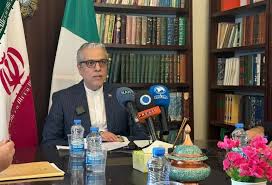

In a diplomatic effort to address rising anxiety over the U.S.-Israel-Iran military standoff, the Islamic Republic of Iran has formally assured the Nigerian government that all Nigerian citizens residing within its borders remain safe. The assurance was delivered on Thursday, March 5, 2026, by the Iranian Ambassador to Nigeria, Amb. Mahdavi Raja, during a press conference in Abuja. The envoy emphasized that despite the escalating regional tensions, there have been no reports of harm or disruption to Nigerians living in major hubs such as Tehran and Qom.
The structural and legal consequence of Iran’s military posture was a focal point of the Ambassador’s briefing. Raja characterized Iran’s recent activities as strictly defensive measures conducted in accordance with Article 51 of the United Nations Charter, which outlines the right to self-defense. He maintained that these operations are targeted exclusively at military installations and do not pose a threat to civilian populations or the thousands of foreign nationals, including Nigerian students and professionals, currently in the country.
Analytically, the timing of this standoff adds a layer of complexity to the domestic environment in Iran. The escalation coincides with the holy month of Ramadan and the Iranian New Year, Nowruz. Amb. Raja noted that despite these significant cultural and religious observances occurring under challenging security circumstances, the state has prioritized the well-being of foreign residents. He urged Nigerians abroad to remain calm and adhere to official local guidance, asserting that the daily lives of expatriates remain largely unaffected.
The impact on “Diplomatic Stability and Diaspora Protection” involves active coordination between Abuja and Tehran. While the Nigerian government is closely monitoring the situation and has issued travel advisories for the Gulf region, the Nigerians in Diaspora Commission (NiDCOM) is working with embassy officials to provide real-time support. Ambassador Raja reiterated that Iran remains committed to its long-standing economic ties with Nigeria, particularly in the sectors of energy, agriculture, and education, which he expects to continue without interruption.
Furthermore, the envoy called upon the international community to recognize what he termed Iran’s “legitimate right” to defend its territory while simultaneously advocating for regional peace. By holding this briefing, the Iranian mission aims to preempt panic and discourage a mass exodus of skilled Nigerian personnel, who play a role in the ongoing trade and educational exchange programs between the two nations.
The long-term outlook for Nigerians in the Middle East depends heavily on whether the current standoff transitions into a broader conflict or de-escalates through diplomatic channels. For now, the Iranian government’s “Priority of Safety” pledge serves as a formal guarantee to the Nigerian state. As NiDCOM continues to track the safety of the diaspora, the focus remains on maintaining open lines of communication to ensure that if the security situation shifts, Nigerian citizens can be accounted for and protected.