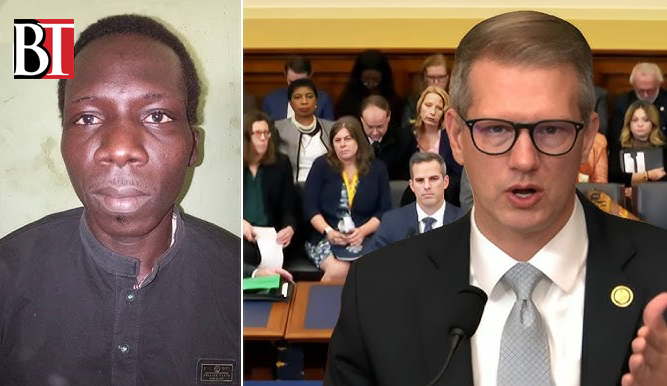

A major diplomatic flashpoint has emerged between Nigeria and the United States, placing a specific Nigerian citizen’s fate at the centre of potential military and security cooperation. U.S. Federal Lawmaker Riley Moore has explicitly demanded the immediate release of Sunday Jackson, a Nigerian farmer convicted of homicide, as a non-negotiable condition for Washington to begin a new military partnership with Abuja.
Moore’s demand follows recent productive discussions between the U.S. government and a Nigerian delegation led by the National Security Adviser, Nuhu Ribadu, aimed at boosting cooperation to stem the tide of internal killings and insecurity. However, the American lawmaker stressed that concrete action on human rights and rule of law must precede deeper military ties.
The fate of Sunday Jackson has become a human rights lightning rod. In 2015, Jackson, a 29-year-old farmer and student in Adamawa State, was fatally attacked by an armed herdsman, Buba Ardo Bawuro, who drove his cattle onto Jackson’s farmland to feed on his crops. When challenged, the herdsman stabbed the farmer twice. A wounded Jackson managed to seize the knife and stab Bawuro in return, leading to the herdsman’s death.
Despite the clear case for self-defence, Jackson was arrested, tried for culpable homicide, and sentenced to death by hanging in 2021 by a Yola High Court judge. The judge dismissed the self-defence argument, asserting that Jackson could have fled after disarming the herdsman. The judgment was subsequently affirmed by the Supreme Court, exhausting his legal appeals. Jackson remains on death row, his only prospect for freedom lying in a state pardon granted by the Adamawa State governor. For the U.S., Jackson’s continued detention is viewed as an emblem of flawed justice and impunity in Nigeria’s security and legal sectors.
The lawmaker coupled the demand for Jackson’s release with a call for Abuja to actively cooperate in disarming what he termed “the radical Muslim Fulani militants terrorising the Middle Belt.” Moore condemned the recent abduction of schoolgirls and teachers in Northern Nigeria, emphasizing that tackling insecurity, particularly the long-running farmer-herder conflict, is crucial for securing U.S. partnership.
The Economic Cost of Insecurity and Diplomatic Strain
The confluence of internal security crises and the resulting diplomatic tension has severely impacted Nigeria’s economic landscape. The ongoing attacks, particularly the farmer-herder conflict in the Middle Belt—the very issue the U.S. is pressuring Nigeria to address—is crippling the nation’s largest employment sector. Agriculture accounts for over 25% of Nigeria’s Gross Domestic Product (GDP) and employs more than 60% of its workforce.
The violence has forced thousands of farmers to abandon their lands, destroyed crops and livestock, and shattered food supply chains. This disruption in key agricultural regions has undermined national food security and contributed significantly to soaring food inflation nationwide. Analysts estimate that the conflict is costing Nigeria at least $14 billion in potential revenues annually, underscoring the profound financial consequences of unchecked insecurity. Furthermore, the mass displacement of communities exacerbates poverty and reduces overall economic activity in the affected regions.
The diplomatic standoff resulting from the U.S. demands only compounds the financial instability. U.S. policymakers often link human rights issues and security failures to threats of sanctions, foreign aid withdrawal, and reassessment of military assistance. These tensions directly translate into economic volatility. Recent diplomatic rhetoric and policy posturing have been linked to sharp dips in Nigeria’s dollar bonds and significant fluctuations in the Naira exchange rate, signaling heightened anxiety among foreign investors.
Any international narrative that portrays Nigeria as unstable or intolerant due to security and legal failures risks increasing the sovereign risk premium, influencing credit ratings, and scaring off Foreign Direct Investment (FDI). Moreover, a cutoff of U.S. aid, which totals hundreds of millions and funds critical programs like the PEPFAR initiative for HIV/AIDS treatment, would lead to significant disruptions in healthcare services and job losses for Nigerians working in related sectors.
Ultimately, the U.S. demand places a challenging dual pressure on the Nigerian government: it must navigate a sensitive sovereign legal challenge while simultaneously demonstrating a capacity to tackle deep-seated security issues. Its response will not only determine the future of critical military cooperation but will also send a decisive signal to global financial markets regarding the integrity of Nigeria’s legal system and its commitment to stability.