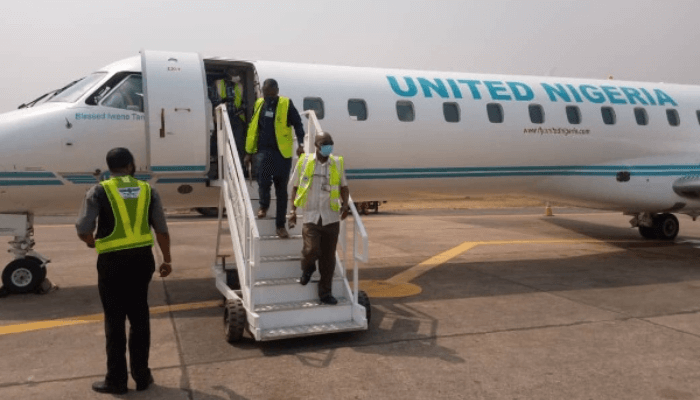

United Nigeria Airlines (UNA) has recorded more than seven bird-strike incidents in 2026, with repeated encounters forcing aircraft out of service, disrupting flights and adding significant costs to the airline’s operations.
The incidents have also renewed concerns over wildlife-hazard management at Nigerian airports, with the airline calling for stronger intervention by airport authorities.
On February 12, 2026, a United Nigeria Airbus A320 operating Flight UN0514/614 from Lagos encountered a bird strike while landing at Port Harcourt International Airport. Although no visible damage was initially detected, the aircraft underwent precautionary engineering inspections.
On February 14, 2026, another A320 operating Flight UN0523 from Asaba to Lagos was struck during take-off. Less than 24 hours later, on February 15, 2026, Flight UN0519 from Abuja to Lagos suffered a bird strike involving one of its engines during take-off.
United Nigeria said the February 15 incident was its fourth bird strike since January and resulted in two Airbus A320 aircraft being withdrawn from service within 24 hours. The airline warned that the grounding could disrupt flights across its network.
The carrier described the latest occurrence as “another bird strike too many” and said the affected aircraft would undergo comprehensive technical inspections before returning to service.
On February 18, 2026, United Nigeria chairman, Professor Obiora Okonkwo, led a delegation to a strategic meeting with Federal Airports Authority of Nigeria (FAAN) Managing Director, Olubunmi Kuku, in Lagos.
Okonkwo described the rising bird strikes as a major operational and financial challenge for airlines. FAAN said it had identified some causes of bird strikes and was implementing environmental measures, including improved grass and habitat management around airports.
On March 29, 2026, an Airbus A320 operating Flight UN0509 from Asaba to Lagos suffered a bird strike involving one of its engines. United Nigeria withdrew the aircraft for comprehensive inspection, warning that some flights would be disrupted.
The incident occurred on the same day another UNA aircraft was damaged by jet blast during ground operations at Murtala Muhammed International Airport in Lagos.
On April 14, 2026, Flight UN0579 from Kano to Abuja encountered a bird strike while landing at Nnamdi Azikiwe International Airport. The affected CRJ-900 was immediately withdrawn for inspection and maintenance. The airline described it as its fifth bird strike since January at the time.
However, the number later rose. Speaking at an International Air Transport Association conference in May, Okonkwo said United Nigeria had recorded seven bird strikes between January and April, with two aircraft then listed as aircraft on ground. He said bird strikes accounted for 40–50% of the airline’s downtime.
On June 7, 2026, Flight UN0578, an Airbus A320-200 operating from Lagos to Kano, suffered a bird strike during its final approach to Mallam Aminu Kano International Airport.
BusinessDay reported that United Nigeria immediately grounded the aircraft and, shortly after midnight on June 8, 2026, sent two engineers to Kano on an empty ferry flight to carry out technical recovery work.
The emergency operation involved ferry flights, crew costs, overnight engineering work, parts, ground handling and airport charges, generating no passenger revenue. United Nigeria’s Chief Commercial Officer, Dayo Olawuyi, said the airline was absorbing millions of naira in costs from bird-strike incidents.
BusinessDay subsequently reported that the June incident took the airline’s 2026 total to more than seven bird strikes.
Wildlife management becomes a wider aviation concern
The repeated incidents have highlighted a broader problem for Nigerian aviation. Ornithologist Jalo Muhammad attributed bird activity around airports to environmental conditions, including wetlands, grasslands and the availability of food and rodents around poorly managed airport environments.
FAAN has said it is implementing habitat and grass-management measures and strengthening environmental controls around airports. The authority has also announced infrastructure upgrades, including airfield-lighting improvements at Category II airports.
For United Nigeria, however, the issue extends beyond flight disruptions. The airline says aircraft downtime, emergency engineering deployments, ferry operations and maintenance costs are creating a growing financial burden.
The carrier has continued to emphasise that affected aircraft are withdrawn from service whenever bird strikes occur and subjected to technical inspections before returning to operations.