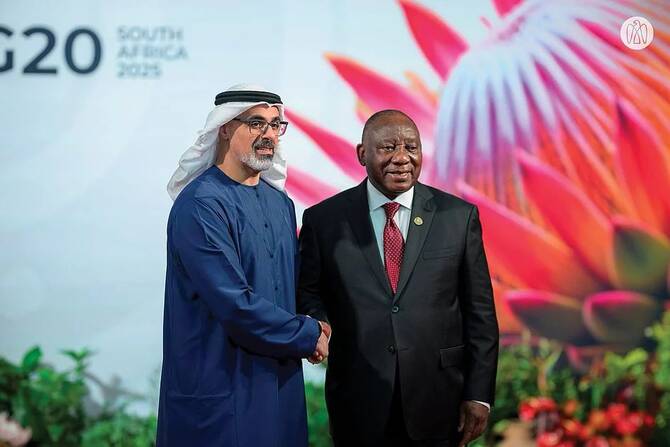

The United Arab Emirates has announced a landmark $1 billion investment to expand artificial intelligence infrastructure and AI-enabled services across Africa, underscoring its growing role as a strategic partner in the continent’s development. The initiative, unveiled by UAE Minister of State Saeed Bin Mubarak Al Hajeri during the G20 leaders’ summit in Johannesburg, reflects the UAE’s long-standing belief that digital innovation is essential for achieving sustainable growth.
Known as the “AI for Development Initiative”, the programme aims to deploy advanced AI tools in education, healthcare and climate adaptation. According to Al Hajeri, the UAE sees artificial intelligence as a cornerstone of humanity’s future and is committed to supporting African countries as they integrate new technologies into their national development agendas. He said the investment is part of the UAE’s broader strategy to accelerate innovation, boost productivity and ensure that the global rollout of AI is responsible and inclusive.
The initiative will support African governments seeking to modernise public services and enhance decision-making systems. In education, AI tools are expected to improve digital learning platforms, support curriculum delivery and bridge skills gaps, particularly in underserved communities. In healthcare, investments will focus on diagnostics, predictive analytics and telemedicine solutions that can expand access to quality care across remote and rural areas. For climate adaptation, the programme aims to introduce AI-driven early warning systems, environmental monitoring tools and resource management technologies that can help countries respond more effectively to climate risks.
Africa is expected to experience some of the fastest growth in global AI adoption due to its young population, rapid urbanisation and increasing digital connectivity. However, many countries face constraints such as limited data infrastructure, skills shortages and financing gaps. The UAE’s investment seeks to address these barriers by funding infrastructure, capacity building and collaborative research that can support long-term digital transformation.
The announcement reinforces the UAE’s position as one of Africa’s most significant economic partners. Bilateral trade between the UAE and African countries reached approximately 107 billion dollars in 2024, a growth of 28 percent from the previous year. Between 2020 and 2024, the UAE deployed more than 118 billion dollars in investments across the continent, covering sectors such as logistics, aviation, agriculture, energy and financial services. The new AI initiative broadens this engagement into frontier technologies that are shaping global competitiveness.
For many African governments, the partnership offers an opportunity to accelerate digitalisation without bearing the full financial and technical burden of the transition. By providing funding, expertise and access to cutting-edge technologies, the UAE aims to complement existing national and regional programmes geared toward digital governance, innovation ecosystems and industrial upgrading. The initiative also aligns with continental priorities under the African Union’s Digital Transformation Strategy, which encourages member states to adopt emerging technologies to drive inclusive growth.
The UAE’s focus on responsible and inclusive AI is crucial, given global debates around data governance, algorithmic bias and the risk of widening inequalities. Al Hajeri emphasised that the programme places ethical deployment at its core, aiming to help African countries build regulatory frameworks that support innovation while protecting citizens. This approach is expected to shape how governments integrate AI into sensitive sectors such as social protection, surveillance and financial services.
As geopolitical competition intensifies around technology leadership, the UAE’s initiative signals its intention to play a constructive role in shaping AI adoption across the Global South. For Africa, the 1 billion dollar investment represents a significant opportunity to scale technological solutions that can improve living standards, enhance resilience and unlock new economic opportunities. The success of the “AI for Development Initiative” will depend on effective partnerships with governments, private actors and local innovators. If implemented well, it has the potential to accelerate Africa’s digital transformation and support progress toward the continent’s long-term development goals.