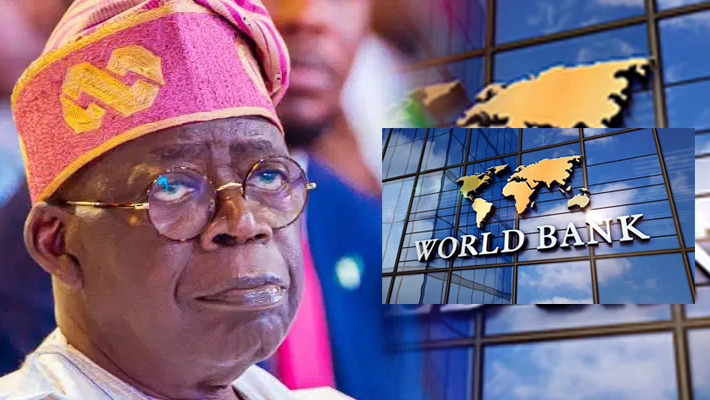

The Nigerian Presidency has launched a strong rebuttal against the World Bank, dismissing the multilateral institution’s recent claim that an estimated 139 million citizens are currently living in poverty. Labelling the stark figure as “unrealistic” and fundamentally detached from local economic realities, the government pushed back against the assessment, which was published as part of the World Bank’s latest Nigeria Development Update.
President Bola Tinubu’s administration contends that the figure, derived from the international extreme poverty line of $2.15 per person per day, is an analytical construct that fails to capture the true socioeconomic dynamics of the nation. Officials clarified that the $2.15 benchmark, when converted using current exchange rates and adjusted through the 2017 Purchasing Power Parity (PPP) methodology, equates to roughly N100,000 per month. They noted that this sum significantly exceeds the country’s new minimum wage of N70,000, arguing that the measure does not constitute an accurate, real-time headcount of genuinely poor citizens.
The Methodological Flaw and the Informal Economy
Economists remain divided on the validity of the government’s objection. While global benchmarks are necessary for international comparison, local analysts agree they struggle to account for Nigeria’s unique economic structure.
Dr. Muda Yusuf, Director-General of the Centre for the Promotion of Private Enterprise (CPPE), lent credence to the government’s critique of the metric. “The PPP metric often fails to capture the resilience of the Nigerian people, who rely heavily on non-cash transactions, subsistence agriculture, and communal support which are often not registered by such formal, consumption-based metrics,” Dr. Yusuf commented. He suggested that relying solely on the PPP threshold risks a significant overestimation of absolute poverty.
The Presidency stressed that the administration is focused on the trajectory of recovery and reform, rather than being bound by a static, globally modelled projection.
Reforms Versus Reality
However, the World Bank’s assessment underscored the immediate, harsh impact that recent macroeconomic reforms have had on purchasing power. The Bank commended the government’s “bold” actions—specifically the removal of the petrol subsidy and the unification of the exchange rate—as foundational for long-term growth.
Mathew Verghis, the World Bank Country Director for Nigeria, acknowledged the government’s efforts but cautioned that the macroeconomic gains had not yet provided relief to the masses. “Despite these stabilisation gains, many Nigerians are still struggling with eroded purchasing power,” Verghis stated. “The challenge is clear: how to translate reform gains into better living standards for all.”
The projected 139 million figure reflects the severe short-term hardship caused by soaring inflation, representing a steep increase from the 87 million recorded in poverty as recently as 2023.
This focus on the trend rather than the absolute number was echoed by development experts. Professor Olayinka Antai, a Lagos-based development economist, argued that the debate over statistics is a distraction from the crisis on the ground. “Whether the number is 139 million or 110 million, the direction is undeniable. The current reforms, while necessary, have created a massive cost-of-living shock that is pushing vulnerable people across the poverty line faster than our welfare programmes can pull them back,” she observed.
Historical Context and Political Reaction
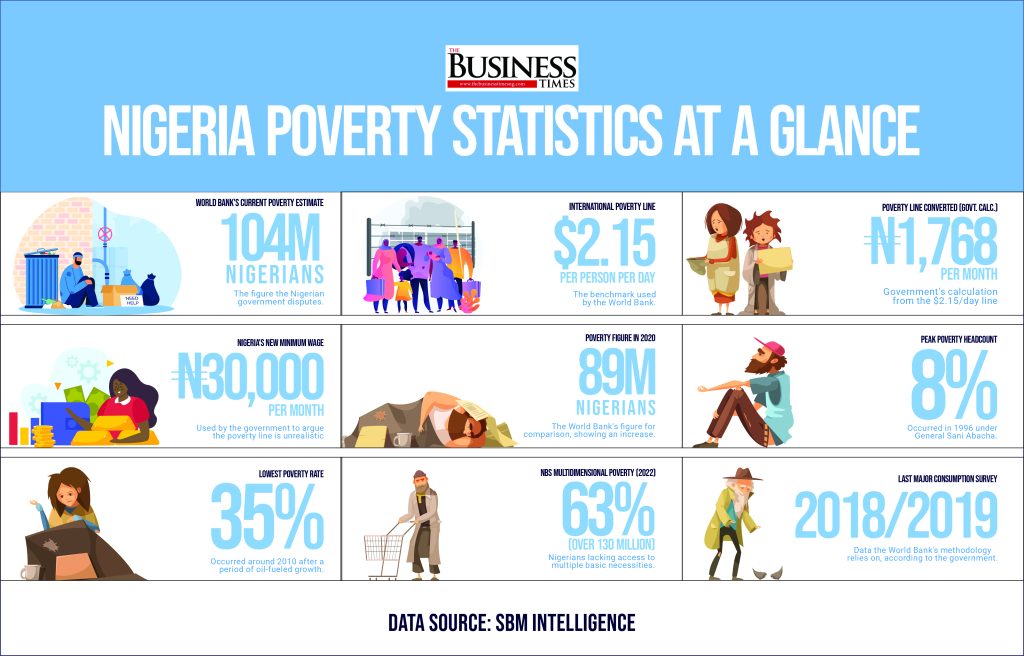
The current statistical dispute occurs against a backdrop of historic volatility in Nigeria’s poverty rates. Data from the National Bureau of Statistics (NBS) and the World Bank show that poverty has ebbed and flowed with political and economic stability. The poverty headcount notably peaked at 58.4% during the repressive military dictatorship of General Sani Abacha in 1996. Following the return to democracy and subsequent growth, the rate dropped significantly, with approximately 30.9% of Nigerians living below the international poverty line by 2018. However, the 2022 NBS Multidimensional Poverty Index revealed that over 133 million Nigerians suffered from poverty across multiple dimensions, such as lack of access to healthcare and electricity.
In response to the hardship, the government affirmed its focus on inclusive growth, highlighting the scale-up of Conditional Cash Transfers (CCTs) targeting vulnerable households, and the implementation of food security measures, such as subsidised grain distribution and agricultural mechanisation.
However, financial analysts have critiqued the government’s prioritization of debating the data over tackling root causes. Dr. Bismarck Rewane, CEO of Financial Derivatives Co., argued that the Presidency’s focus is misplaced. “The government’s energy should not be spent debating whether the poverty headcount is 139 million or 100 million,” Dr. Rewane asserted. “That detracts from the urgent requirement to stabilize the exchange rate and decisively tackle food inflation, which is the real accelerant of poverty today.”
Ultimately, the disagreement over the 139 million figure highlights the central challenge facing the Tinubu administration: transforming painful, foundational reforms into tangible, daily improvements for its vast population. Until those gains are felt through lower food prices and stronger purchasing power, the risk of losing public support for the reforms—as cautioned by the World Bank—will remain a critical threat.