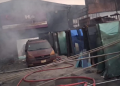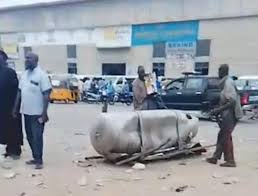

The Kaduna State Police Command has clarified that the explosion reported at Mando Motor Park was not a bomb blast but a minor incident involving a gas powered vehicle, urging the public to verify information before sharing to avoid unnecessary panic. The command’s Public Relations Officer, DSP Mansir Hassan, said in a statement that the incident occurred at about 3:00 a.m. on Sunday at the premises of Silver Luxury Travel, a bus company operating at Mando Garage, Kaduna.
Hassan stated that detectives were immediately deployed to the scene after a loud sound was reported. “Preliminary investigations revealed that the incident involved a Compressed Natural Gas powered luxury bus belonging to Silver Luxury Travel, which exploded due to overfilling of its gas tank,” he said. The affected vehicle had been evacuated to a safe location, while the area was secured by security personnel. No casualties or loss of property were recorded, and normal activities had since resumed in the area.
The Commissioner of Police in the state, CP Muhammad Rabiu, has ordered a full investigation to determine the circumstances surrounding the incident and prevent future occurrences. Operatives of the Police Explosive Ordnance Disposal Unit were also deployed to the scene as a precautionary measure, reflecting the seriousness with which security agencies treat any explosion related incident, even when initial assessments suggest no malicious intent.
From an economic and safety perspective, the incident highlights emerging risks associated with the growing adoption of Compressed Natural Gas as a fuel for commercial vehicles in Nigeria. The federal government has been actively promoting CNG as a cheaper and cleaner alternative to petrol and diesel, particularly following the removal of fuel subsidies. The Presidential Compressed Natural Gas Initiative has encouraged the conversion of commercial vehicles to CNG, offering conversion kits and establishing refuelling stations. However, the Kaduna incident suggests that safety protocols around CNG handling require attention.
Overfilling of gas tanks, identified as the cause of the explosion, is a preventable error. Unlike petrol tanks where overfilling may result in spillage but rarely explosion, CNG tanks operate under high pressure, and overfilling can cause catastrophic failure if safety valves malfunction or are absent. The incident underscores the need for proper training of refuelling attendants, installation of functioning overfill protection devices on vehicles, and regular inspection of CNG systems to ensure integrity. As more vehicles convert to CNG, the scale of potential safety incidents could grow unless preventive measures are scaled accordingly.
The police’s swift clarification that the incident was not a bomb blast is significant in the context of Kaduna State’s security history. The state has experienced terrorist attacks, kidnappings, and communal violence, and residents are understandably sensitive to any explosion. Misinformation or delayed clarification could have triggered panic, disrupted commercial activity, or led to reprisals against innocent communities. The police’s proactive communication, including the deployment of EOD personnel as a precaution, balances thorough investigation with public reassurance.
For the commercial transport sector, the incident may affect passenger confidence in CNG powered buses. Silver Luxury Travel, the company involved, will need to demonstrate that it has reviewed its safety procedures and that its fleet is safe for operation. Other transport companies using CNG may also face increased scrutiny from passengers and regulators. The National Orientation Agency and the Presidential CNG Initiative may need to intensify public education on CNG safety to prevent the incident from undermining the broader adoption of the fuel.
The police’s call for the public to verify information before sharing is particularly relevant in the age of social media, where unverified reports can spread rapidly and cause widespread alarm. In the absence of official communication, rumours of a bomb blast could have led to school closures, business shutdowns, and avoidance of the Mando area, with economic consequences for traders and commuters. The police’s timely statement helped contain the potential fallout.
The Commissioner’s order for a full investigation is appropriate. Beyond determining the immediate cause of the overfilling, the investigation should examine whether the vehicle’s CNG system was properly installed and maintained, whether refuelling attendants were adequately trained, and whether the refuelling station had functioning safety equipment. Findings and recommendations could inform industry wide safety standards, potentially preventing similar incidents as CNG adoption expands.
For residents of Kaduna, the incident serves as a reminder that not every loud sound signals an attack, but also that new technologies bring new risks. The police’s handling of the situation, including the precautionary EOD deployment and the prompt clarification, demonstrates a measured approach that avoids both overreaction and complacency. As the investigation proceeds, the public can expect further updates on safety recommendations.