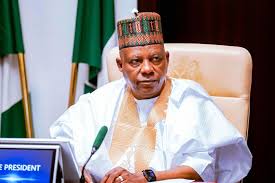

The Federal Government has stated that its ongoing tax reform agenda is specifically designed to remove the burden of multiple taxation and various levies currently affecting small businesses and low-income earners across Nigeria. Vice President Kashim Shettima, representing President Bola Tinubu, clarified that these fiscal adjustments aim to streamline the national tax framework and serve as a strategic tool for poverty reduction rather than an additional financial weight on vulnerable citizens.
Speaking at a high-level interfaith gathering at the State House in Abuja attended by members of the Federal Executive Council, the Governor of the Central Bank of Nigeria, and senior government advisors the Vice President addressed criticisms regarding the potential impact of the reforms. He noted that the planning phase of the tax policy was meticulously structured to improve the livelihoods of ordinary Nigerians and cautioned against narratives suggesting the reforms would further impoverish the public.
“The claims that the tax reform is meant to pulverize and pauperize the poor are far from the truth,” Shettima stated. He urged government officials and heads of agencies to act as advocates for the administration’s policies, emphasizing the necessity of communicating the factual objectives of the reforms to the Nigerian people. According to the Vice President, the government is actively releasing policy instruments intended to lift citizens out of poverty by creating a more equitable fiscal environment.
This commitment to tax simplification comes at a time when the Presidential Committee on Fiscal Policy and Tax Reforms, led by Taiwo Oyedele, has proposed reducing the total number of taxes in Nigeria to a single digit. Current data indicates that Nigerian businesses often face upwards of 60 different types of taxes and levies across three tiers of government. The proposed consolidation is expected to improve the ease of doing business and enhance compliance by making the process more transparent and less cumbersome for Small and Medium Enterprises (SMEs).
Beyond tax adjustments, the Vice President highlighted several broader economic indicators that he identified as gains from recent administration policies. These include the gradual increase in the nation’s foreign exchange reserves and the efforts to streamline the exchange rate market. Nigeria’s foreign exchange reserves have recently shown signs of stabilization following the unification of the forex windows and increased crude oil production, which averaged 1.48 million barrels per day in early 2024.
The Vice President also referenced the removal of the petrol subsidy, describing it as a courageous move to address a fiscal drain that had primarily benefited a small segment of the population for decades. He noted that while these reforms have introduced short-term pressures, they were essential measures that previous administrations had avoided. The administration maintains that the savings from the subsidy removal and the revenue from a more efficient tax system are being redirected into critical infrastructure and social intervention programs.
The government’s strategy emphasizes that by eliminating the “nuisance taxes” that disproportionately affect micro-businesses, the informal sector can be more effectively integrated into the formal economy. This shift is anticipated to broaden the tax base without increasing the tax rates for the poorest Nigerians.
In the coming months, the Federal Government expects to present the formal legislative framework for these tax reforms to the National Assembly. This legal transition is intended to institutionalize the new tax structures, ensuring that the promised relief for small businesses and low-income earners becomes a permanent feature of the Nigerian fiscal landscape. The administration remains focused on monitoring the implementation of these policies to ensure they align with the broader goal of national economic stabilization.