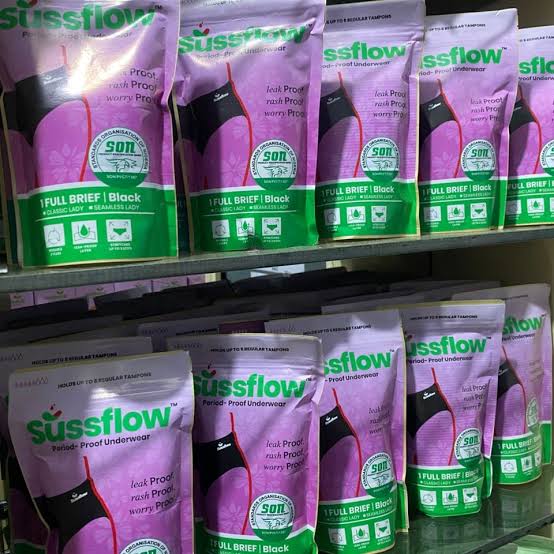

As the cost of menstrual products continues to pressure household budgets, Lagos-based Sussflow Reusable is betting on locally manufactured reusable products to give women a lower-cost option over time while building a business around menstrual health.
The company produces reusable sanitary pads, period underwear and menstrual cups, combining product sales with menstrual-health education and partnerships with schools, NGOs and organisations.
For founder Olabisi Emmanuel, the challenge is to make reusable menstrual care affordable without sacrificing quality.
“At Sussflow, we are intentional about balancing quality, affordability and local manufacturing,” Olabisi told Business Times.
She said the company assembles its reusable pads locally in Lagos and controls key stages of production, including material selection, cutting, stitching, finishing and quality checks.
Sussflow has standardised its designs and production processes and buys materials strategically to control costs. Olabisi said the company is also working to increase its in-house production capacity to improve consistency, reduce inefficiencies and serve a larger market.
The company is currently SON-certified and progressing through the NAFDAC registration process for its reusable sanitary pads, according to Olabisi.
The business is entering a market where affordability remains a major consideration. A study by researchers from Bayero University, Kano, and Family Health International, published in September 2026, found that reusable pads cost about ₦413 per menstrual cycle compared with ₦1,425 for disposable pads under its base-case assumptions. Over five years, the study estimated savings of ₦60,720 per user, while identifying upfront cost as a major barrier to adoption.
Sussflow is addressing that barrier through partnerships with NGOs, schools, community organisations and potential corporate social responsibility partners to make subsidised products available to women and girls.
“We don’t pretend that the upfront cost doesn’t exist,” Olabisi said.
The company also operates a Pad4Pad initiative under which, according to Olabisi, every four pads sold supports the donation of another reusable menstrual product.
But she said affordability alone would not change consumer behaviour.
“One of the biggest lessons we have learnt is that you cannot simply sell a reusable product and expect behaviour to change,” she said.
Sussflow therefore combines product distribution with menstrual-health education, taking conversations about menstruation, product use, washing, drying, storage and reproductive health into schools, communities and organisations.
For Olabisi, education is also about changing how consumers understand reusable products rather than simply presenting them as cheaper alternatives.
Although the company remains predominantly business-to-consumer, Olabisi said it is strengthening its business-to-business pipeline involving schools, NGOs, distributors and corporate CSR programmes.
She said this is important because reusable products have longer lifespans, making continuous customer acquisition through retail alone less efficient for scaling the business.
Over the next three to five years, Olabisi wants Sussflow to increase its Nigerian manufacturing capacity, create more jobs across its supply chain and expand its institutional reach.
West Africa is also part of the company’s longer-term expansion plan, although Olabisi said Sussflow intends to build the right partnerships and regulatory understanding before entering other markets.
“Our goal isn’t simply to replicate a Western menstrual-care model in Africa,” she said. “We want to develop solutions that make sense culturally, economically and practically for our market.”