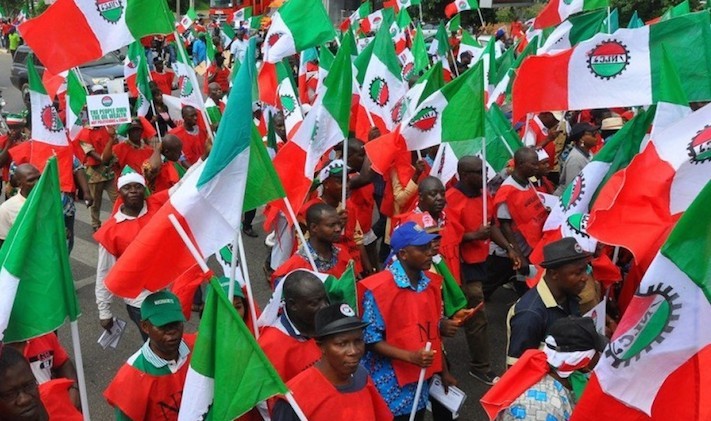

Nigerian workers are grappling with the worst cost-of-living crisis in a generation, as stagnant wages, double-digit inflation, and the cascading effects of fuel subsidy removal have eroded purchasing power and pushed millions into survival mode. For civil servants, private sector employees, and informal traders alike, the gap between monthly earnings and the rising cost of food, transport, rent, and school fees has widened to unbearable levels, forcing families to adopt drastic coping strategies that signal a deepening economic and social crisis.
The dimensions of the crisis are measurable in everyday terms. According to the latest “Jollof Index” compiled by SBM Intelligence, a minimum wage earner on ₦70,000 per month can now afford to cook only two pots of jollof rice—a staple across Nigerian households—due to the soaring cost of rice, tomatoes, pepper, vegetable oil, and meat or fish. Two years ago, before the full impact of subsidy removal and naira devaluation had taken hold, the same wage could stretch to six pots. The index captures in visceral terms what economic statistics express in percentages: the cost of living has outstripped wages by a margin that leaves no room for savings, investment, or even basic nutritional adequacy.
Joe Ajaero, President of the Nigeria Labour Congress, has framed the crisis as a fundamental challenge to the social contract between workers and the state. In his 2026 mandates, he stated, “A worker’s income must guarantee life, not mere survival. We enter 2026 with a fortified resolve to hold every tier of government accountable for policies that decimate our living standards for the benefit of a parasitic few.” His words reflect organised labour’s growing impatience with a government that has pursued fiscal consolidation while appearing indifferent to the erosion of household incomes.
The lived reality behind Ajaero’s rhetoric is captured in the testimony of Mr Chris Haggai, a civil servant and resident of Nyanya on the outskirts of Abuja. Expressing the frustration of the middle class, he noted: “What we used to buy for ₦10,000 can no longer last a week. It is becoming unbearable. We now cut down on quantity and sometimes skip certain meals, but it is still not enough because every day something new that costs more comes up.” His experience is echoed in countless homes across the country, where families have abandoned three meals a day, substituted cheaper alternatives, and eliminated non-essential purchases entirely.
The proximate driver of the crisis is the convergence of several shocks. The removal of petrol subsidy in mid-2023, while fiscally necessary, triggered an immediate spike in transport and logistics costs. The unification of exchange rate windows led to a sharp devaluation of the naira, making imported goods—from machinery to medicines to food—more expensive. Then came the Middle East conflict, which pushed global oil prices above $120 per barrel and fed directly into domestic fuel costs. Inflation, which peaked at over 30 per cent in 2024, has moderated to 15.38 per cent but remains elevated enough to ensure that wage increases, where they occur, are erased in real terms.
Aduragbemi Omiyale, an economic analyst reporting on private sector contraction in early 2026, noted that while demand remains “resilient,” higher fuel costs triggered by global volatility have led to a “steep intensification of inflationary pressures” that stagnant salaries cannot match. Her assessment points to a structural problem: even when businesses want to retain workers and maintain output, the cost of energy and credit constrains their ability to raise wages. The result is a labour market where nominal wages have increased only marginally while the real cost of living has soared.
The agricultural value chain, where most Nigerians earn their livelihoods, has not been spared. Mrs Aisha Nagogo, a mother of four from Gwagwalada, described the shift to “atomized buying” that has become the new normal for households trying to stretch limited incomes. “We now buy in cups instead of mudu. Even tomatoes and pepper are now too expensive, and to feed a large family now is not so easy anymore; it is a daily struggle.” The shift from bulk purchasing to incremental buying is both a symptom of poverty and a driver of higher per-unit costs, as smaller quantities often attract higher prices.
Malam Abubakar Nasidi, a tomato seller in Gwagwalada, offered an explanation for why food prices remain high even when harvests are decent. “It is not deliberate; we are not happy increasing these prices, but we have no choice. Transportation is the main problem because the cost of fuel has increased. Patronage has reduced because customers complain every day.” His testimony reveals the transmission mechanism from global energy markets to local food prices: higher fuel costs increase the cost of moving produce from farming areas to urban markets, and those costs are passed on to consumers, reducing demand and squeezing the margins of traders caught between falling sales and rising expenses.
The Nigerian worker is also falling behind continental peers. A new report from the African Development Bank on wage competitiveness shows that average real wages in Nigeria have declined by about 35 per cent since 2015, while countries like Ghana, Kenya, Rwanda, and South Africa have seen wage growth in sectors such as finance, technology, and manufacturing. A junior software developer in Lagos may earn approximately ₦300,000 monthly (about $215), while a peer in Nairobi takes home the equivalent of $450 to $600. The gap widens for senior professionals, with Nigerian salaries lagging by 40 to 60 per cent.
The weakness of the naira, which has depreciated by about 70 per cent against the dollar since 2020, compounds the problem, meaning that even when wages increase nominally, their value in hard currency declines. This has accelerated brain drain, as skilled professionals seek better opportunities abroad. Doctors, nurses, engineers, and IT professionals continue to leave for the UK, Canada, and Gulf countries, weakening the domestic supply of talent and further constraining productivity growth.
Dr Paul Alaje, an economist, highlighted the supply-side constraints that prevent firms from increasing wages. In recent manufacturing productivity reports from March 2026, he noted that the high cost of energy and interest rates are “crowding out” the ability of firms to increase wages, leaving workers in a permanent state of trailing their peers in other emerging markets. Manufacturers operate at a disadvantage compared to competitors in countries with lower energy costs and more stable currencies, limiting their ability to raise prices or improve margins.
The crisis has also exposed the inadequacy of the national minimum wage, which was raised to ₦70,000 in 2024 after months of negotiations between labour unions and the federal government. At the time, the increase was presented as a significant victory for workers. In real terms, however, it has already been overtaken by cumulative inflation. Labour unions, including the NLC and the Trade Union Congress, have called for further increases and targeted palliatives, but the government’s fiscal constraints, with debt service consuming a substantial share of revenue, limit its room for manoeuvre.
The potential for social unrest is visible in the frequency of protests and strikes across the country. The Nigeria Labour Congress has threatened industrial action if the government fails to address the worsening conditions, while civil society organisations have called for a comprehensive review of economic policies. The government has pointed to improvements in macro indicators, including moderating inflation and stabilising exchange rates, but these gains have not translated into tangible relief for households.
Without a comprehensive strategy that boosts productivity, attracts investment, creates higher-value jobs, and protects the most vulnerable through targeted social protection, Nigerian workers will continue to fall behind. The crisis is not merely statistical; it is measured in skipped meals, postponed medical care, withdrawn children from school, and the quiet desperation of families who no longer speak of their plans for the future. For a nation with Africa’s largest economy and its most ambitious development aspirations, the erosion of household welfare is not just a humanitarian concern but a threat to long-term stability and growth.