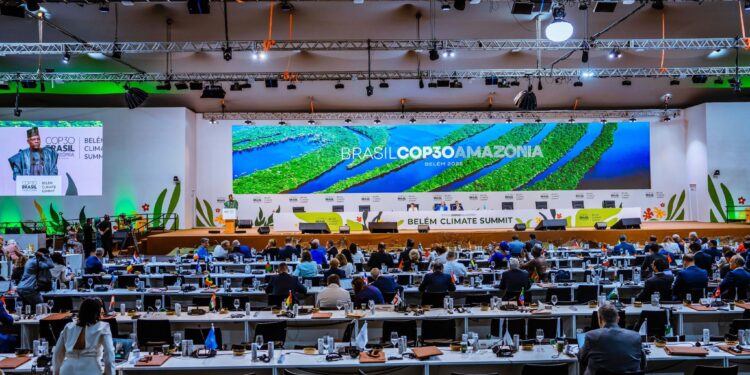

Nigeria has unveiled an ambitious financial strategy to tackle climate change and boost its transition to a green economy, announcing a target to mobilise up to $3 billion annually in dedicated climate finance. Vice President Senator Kashim Shettima revealed the bold plan during the United Nations Climate Change Conference (COP30) in Belem, Brazil, positioning the West African nation as a potential leader in nature-positive investment across the Global South.
Representing President Bola Ahmed Tinubu, Vice President Shettima addressed a high-level session, emphasising that Nigeria’s overarching climate strategy is designed to restore balance between nature, development, and economic resilience. He explained that this significant annual mobilisation of funds will be driven primarily through the newly established National Carbon Market Framework and the country’s dedicated Climate Change Fund. “Through our National Carbon Market Framework and Climate Change Fund, we aim to mobilise up to three billion US dollars annually in climate finance,” Mr Shettima declared. He further specified that these resources are earmarked for essential projects such as community-led reforestation, vital blue carbon initiatives, and sustainable agriculture, all of which are crucial economic sectors.
The economic angle of this strategy is profound, marking a deliberate shift to leverage the nation’s vast natural assets—its forests, mangroves, and landscapes—as tradable financial instruments. The government’s recently finalised Carbon Market Activation Policy is designed to unlock billions in high-integrity carbon credits by the end of the decade, thereby establishing Nigeria as a central hub for climate-smart finance on the African continent. This mechanism promises to attract much-needed private capital, de-risk green infrastructure projects, and finance scalable clean energy solutions, which are indispensable for stimulating economic diversification and creating well-paid green jobs for the country’s burgeoning youth population.
In his address to the international community, the Vice President called for scaled-up grant-based finance and the urgent implementation of innovative financial instruments such as debt-for-nature swaps and Blue Carbon Markets under Article 6 of the Paris Agreement. Mr Shettima was uncompromising in his demand for fairness in global climate action. “We call on our global partners to recognise the economic value of nature and to channel significant finance towards protecting and restoring it,” he asserted. He highlighted the intrinsic injustice faced by Global South nations, which have contributed the least to the climate crisis but bear the highest resultant costs. “Countries that have benefited more from centuries of extraction must now lead in restoration,” he said, pressing for predictable, equitable, and accessible funding from developed economies.
Domestically, the Nigerian government is backing this financial ambition with firm legislative and policy commitments. The country’s 2021 Climate Change Act enshrines nature-based solutions as a legal obligation of the state. Initiatives already underway include the Great Green Wall Initiative, which aims to reforest degraded lands and has already resulted in the planting of millions of trees and the creation of thousands of local green jobs. Furthermore, the new Marine and Blue Economy Policy promotes climate-smart fisheries and robust coastal protection, safeguarding the nation’s precious marine biodiversity and related economic activity.
Rejecting the narrative of Africa as a passive victim of climate change, Mr Shettima passionately argued that the continent is, in fact, a crucial part of the solution. “Africa’s rainforests, mangroves, peatlands, and oceans are global assets,” he stated. He insisted that the continent is home to some of the world’s largest untapped carbon sinks and possesses a youthful demographic capable of driving immense innovation and progress. The Vice President concluded by calling on global partners to join Nigeria and the African Union in advancing the African Nature Finance Framework, a mechanism specifically designed to unlock private capital for widespread ecosystem restoration across the continent. Nigeria’s message at COP30 is clear: this global compact must recognise Africa’s ecosystems as critical global assets deserving of substantial worldwide investment and protection.