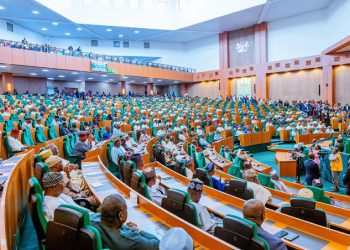

Lagos State Governor, Babajide Sanwo-Olu, has urged Nigerian banks to use the N4.65 trillion raised through the recent recapitalisation exercise to support businesses, expand industries and create employment opportunities.
He said the success of the exercise should go beyond strengthening banks’ financial positions and translate into tangible economic benefits for Nigerians.
Sanwo-Olu made the call on Saturday, October 31, 2026, at the 2026 Fellowship Investiture Ceremony of the Chartered Institute of Bankers of Nigeria (CIBN), held at Harbour Point Events Centre, Victoria Island, Lagos. The ceremony recognised 755 recipients, comprising 18 Honorary Fellows, 460 Elected Fellows and 277 Honorary Senior Members. CIBN President and Chairman of Council, Dele Alabi, announced the figures during his opening remarks.
Sanwo-Olu acknowledged that the recapitalisation exercise had improved the financial strength of Nigeria’s banking sector. However, he stressed that the additional capital should be channelled towards investments that would increase production, support business expansion and generate jobs.
“Recapitalisation has strengthened the capacity of our banks to withstand economic pressures and undertake larger transactions. But raising capital is only the beginning,” Sanwo-Olu said. “The true measure of success will be how effectively that capital supports productive enterprises, industrial expansion and economic opportunities for Nigerians,” he added.
He noted that manufacturers require affordable, long term loans to purchase equipment, increase production and compete in international markets. He also highlighted the financing needs of agricultural processors, particularly in storage, processing and distribution. According to the governor, small and growing businesses equally need credit facilities that reflect their operating conditions and support their expansion.
Alabi shared similar concerns, urging banks to direct their increased capital towards sectors capable of driving economic growth.
“Nigeria now has a historic opportunity to deploy this enhanced capital towards manufacturing, agriculture, infrastructure, energy, technology, and other productive sectors. The true measure of recapitalisation will not be the size of balance sheets, but the scale of economic transformation it enables,” Alabi said.
He disclosed that CIBN would hold its MSME Forum on December 1, 2026, to develop practical solutions for improving access to finance and supporting business growth. The institute is also advocating the establishment of small and medium enterprise hubs across the country to provide businesses with funding, training, digital tools and market access.
The CBN introduced the recapitalisation programme in March 2024, requiring banks to raise their minimum capital to N500 billion for international licences, N200 billion for national licences and N50 billion for regional licences. The 24 month exercise ended on March 31, 2026, with 33 banks raising a combined N4.65 trillion, according to the regulator.
Despite the exercise, access to affordable credit remains a challenge for many businesses. The National Credit Guarantee Company reported in July 2025 that about 80 per cent of Nigerian MSMEs remained outside formal credit channels. Sanwo-Olu’s call highlights the pressure on banks to turn their stronger capital positions into increased lending, business growth and job creation.