
When President Bola Tinubu took office in May 2023, electricity reform was framed as a central pillar of his economic agenda. He pledged that Nigeria would reach 15,000 megawatts of distributable electricity within four years, a promise that resonated strongly in a country where unreliable power has long constrained productivity, industrial growth, and living standards. Nearly thirty months into the administration, however, the contrast between policy ambition and everyday reality has become increasingly difficult to ignore.
Official data shows only modest growth in electricity generation, while public experiences reveal a power sector still defined by inconsistency, high costs, and unequal access. The economic consequences of this gap are evident not only in national indicators but also in the daily lives of Nigerians navigating outages, tariffs, and alternative power sources.
Living With Unreliable Electricity
For many Nigerians, electricity supply continues to disrupt rather than support daily life. Precious David from Aba describes the situation plainly. Frequent power outages, he says, “disrupt my daily routine and reduce productivity. Simple tasks take longer to complete, businesses lose customers, and studying or working at night becomes difficult without alternative power.” His account reflects the reality for millions of households and small businesses where time lost to outages translates directly into reduced income and efficiency.
From an economic standpoint, unreliable electricity imposes hidden costs. Productivity losses at the household and firm level accumulate into slower economic growth. When power supply is unpredictable, businesses cannot plan efficiently, and workers cannot maximize output. These constraints weaken Nigeria’s competitiveness, particularly in manufacturing and digital services.
Household Costs and Economic Strain
Beyond lost productivity, unreliable power has reshaped household spending. Precious explains that “unreliable electricity has significantly increased household expenses,” as money is now spent on fuel, generator maintenance, inverters, and solar alternatives. These costs represent defensive spending, resources used merely to maintain basic functionality rather than improve welfare.
This pattern has broader economic implications. Household income that could support education, healthcare, or savings is diverted into energy coping mechanisms. Over time, this reduces capital accumulation and deepens vulnerability, particularly among low and middle income earners.
Public Perception of Government Efforts
Public confidence in government efforts to improve electricity supply remains fragile. Precious believes that “while there are promises and reforms, the actual improvement in electricity supply is still not felt by most citizens.” This perception is widespread and reflects a credibility gap between policy announcements and tangible outcomes.
Adebisi from Lagos shares a similar concern, noting that electricity stability has not improved enough to justify higher tariffs. “The stability of electricity isn’t enough, but the charges are on the high side,” he says. Economically, this highlights a key tension in the power sector. Cost reflective tariffs are necessary for sustainability, but when price increases outpace service improvement, public resistance grows and trust erodes.
Coping Mechanisms and Inequality
To manage unreliable electricity, Nigerians adopt different coping strategies depending on income and location. Precious relies on generators and alternative energy, describing this reliance as “almost unavoidable and tiring.” These alternatives come with ongoing fuel and maintenance costs that place a heavy burden on household finances.
Adebisi’s approach is different. During outages, he relocates to paid workspaces if he can afford it. This strategy underscores how electricity instability reinforces inequality. Those with resources can buy alternatives or rent workspaces, while others simply lose productive hours. Electricity unreliability thus becomes a mechanism through which economic inequality is reproduced.
Uneven Access and Regional Differences
Despite widespread challenges, electricity supply is not uniformly poor across Nigeria. In Ibeno Local Government Area of Akwa Ibom State, Nkechi Anya reports a markedly different experience. “Electricity has been stable, and I pay a modest monthly bill.” She notes that since acquiring a generator in early 2025, she has barely used it. Her experience highlights the uneven distribution of power infrastructure and service quality across the country.
Paulo from Lagos also observes improvement in his area. He explains that since Tinubu came to power, electricity has been steadier, and generator usage has dropped significantly compared to previous years. However, he adds that outages still occur during grid collapses or transformer faults, sometimes lasting several days. For him, “light has improved, but it remains fragile.”
Grid Fragility and Structural Challenges
Grid instability remains one of the most serious constraints on Nigeria’s power sector. Frequent collapses disrupt economic activity nationwide and damage equipment. Paulo argues that the government should invest in redundancy so that “when one collapses, the other will pick up and not the whole nation going black.” His point reflects a widely acknowledged structural weakness. Nigeria’s grid lacks the resilience needed to support a modern economy.
Peace from Ibadan offers a sharper critique. She argues that “a country with an unstable national grid should not force its citizens into a Band A promise of 20 hours minimum power supply,” especially when outages are repeatedly blamed on vandalism or gas pipeline disruptions. From an economic perspective, ambitious service guarantees without reliable infrastructure increase the credibility gap and weaken policy effectiveness.
Generation Targets Versus Reality
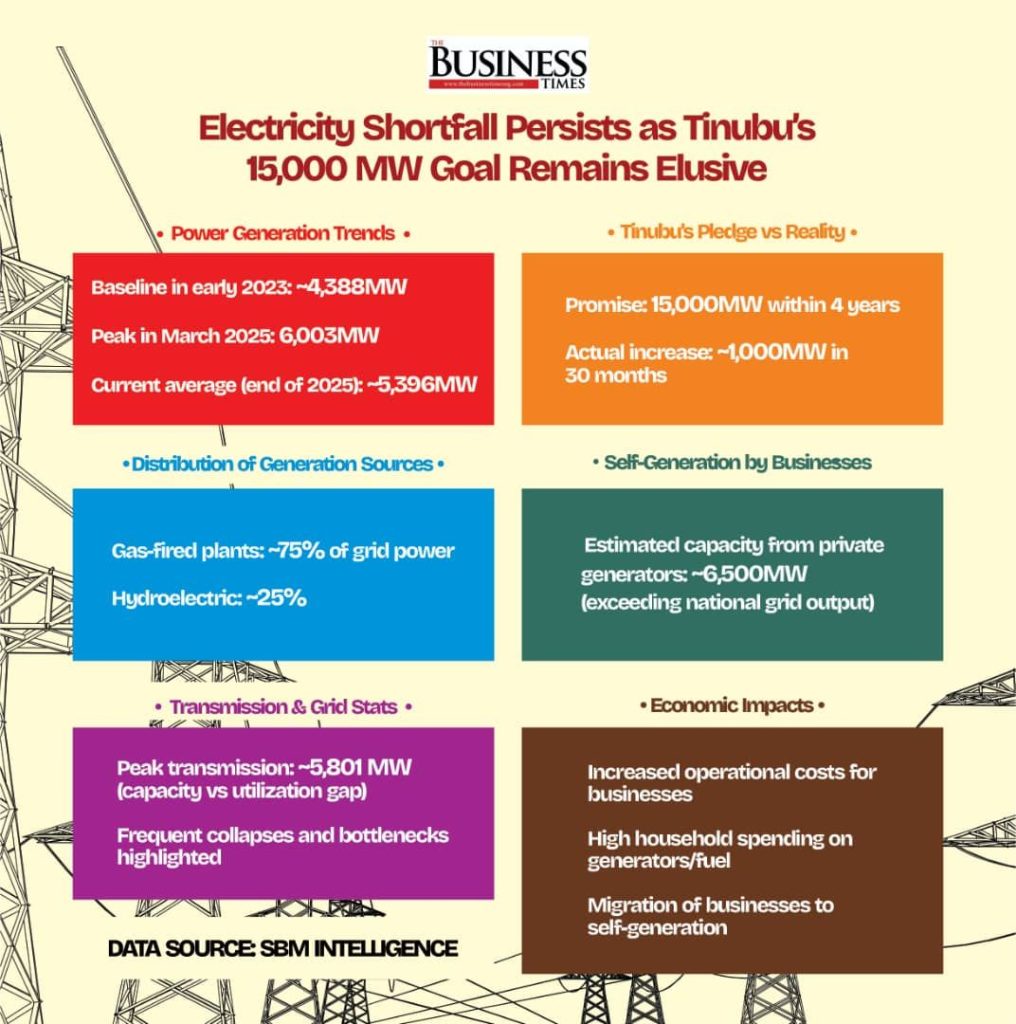
Official figures reveal the scale of the shortfall. Nigeria’s grid generation has increased from about 4,400 megawatts in mid 2023 to just over 5,300 megawatts by late 2025. This net addition of roughly 1,000 megawatts falls far short of the promised 15,000 megawatts. While record peaks above 6,000 megawatts have been recorded, they have not been sustained.
Energy experts estimate that Nigeria requires at least 30,000 megawatts to meet basic residential and industrial needs. Operating at a fraction of this level keeps production costs high and limits economic diversification. The electricity deficit therefore remains a binding constraint on growth.
Tariffs, Debt, and Sectoral Stress
Financial stress continues to plague the power sector. Tariff increases have reduced subsidies but shifted more costs onto consumers. Distribution companies struggle with revenue collection, while generating companies face unpaid debts. This imbalance discourages investment and perpetuates poor service delivery.
Loveday Izuwa from Ibadan frames the issue in stark terms. He recalls President Tinubu’s promise of uninterrupted electricity and contrasts it with rising tariffs and repeated grid collapses. He highlights rural communities that have remained without power for years, noting that millions still rely entirely on generators. “The facts speak louder than rhetoric and broken assurances,” he argues.
Economically, prolonged rural blackouts hinder agricultural processing, small scale manufacturing, and social development. Without electricity, rural communities remain disconnected from value chains and modern services.
Self Generation and Economic Leakage
One of the clearest indicators of power sector failure is the scale of self generation. Large firms, universities, and commercial centers now operate captive power plants that collectively generate more electricity than the national grid. While this ensures continuity for those entities, it weakens the grid financially by driving away high paying customers.
This shift also represents economic leakage. Spending on diesel and petrol generators diverts resources from productive investment and increases import dependence. It also raises environmental and health costs, further burdening the economy.
Reform Efforts and Long Term Outlook
The Tinubu administration has introduced reforms such as the Electricity Act of 2023, metering initiatives, and encouragement of state participation in power generation and distribution. These reforms hold potential, but their impact has been slow. Renewable energy, particularly solar mini grids, offers promise for rural areas, yet large scale integration remains limited.
Precious expresses cautious optimism. He believes the 15,000 megawatt target “may be achievable in the long term, but only if there is serious investment, commitment and proper maintenance of infrastructure.” This conditional hope reflects a broader national sentiment shaped by decades of unmet promises.
Nigeria’s electricity sector under Tinubu illustrates the tension between ambition and execution. While the promise of 15,000 megawatts acknowledged electricity as an economic foundation, progress has been incremental and uneven. Households and businesses continue to bear the cost through higher expenses, lost productivity, and reduced confidence.
Until structural weaknesses in generation, transmission, finance, and access are addressed, electricity will remain a constraint rather than a catalyst for growth. For many Nigerians, the question remains urgent and practical, expressed not in policy language but in lived experience: “where is the light?”