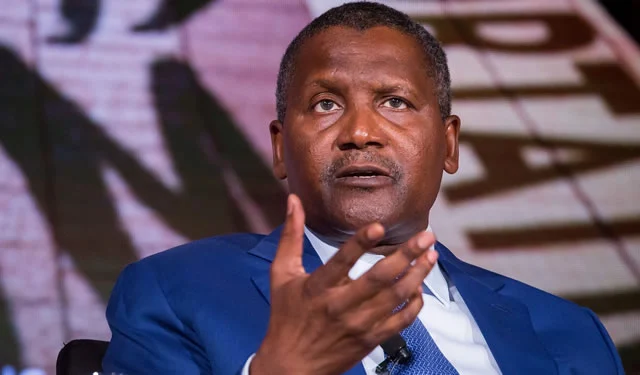

Aliko Dangote, president of the Dangote Group, has renewed his allegations that powerful criminal networks are undermining Nigeria’s oil and gas sector, claiming these groups are even stronger and more damaging than well-known international drug cartels. Speaking at a press briefing at the Dangote Petroleum Refinery in Lekki, Lagos, on Sunday, he outlined what he described as widespread theft, sabotage and regulatory failure that he says threaten the country’s energy infrastructure and economic progress.
Mr Dangote said the refinery, one of Africa’s largest and most modern, has suffered serious losses due to criminal activity. He disclosed that items worth an estimated $82 million have been stolen from the facility, a figure he says underlines the scale of the problem. According to him, one of the key tactics used by the saboteurs was to steal valuable equipment in ways designed to drive up costs and push the company into costly insurance claims.
“In this refinery, we have $82 million of stolen items,” he said, adding that the theft appears to have been engineered to force large insurance payouts that would continuously increase premiums. “There’s no free lunch. So, yes, there is sabotage,” he said, pointing out that the refinery now employs more security personnel than actual workers to protect its assets.
Mr Dangote cited specific instances of interference, including the removal of a spare part from a major boiler while it was in operation. He described this act as blatant sabotage and hinted at further damaging acts that are subject to legal action, saying they were too sensitive to disclose at the moment.
Beyond the refinery itself, he broadened his criticism to encompass the wider petroleum infrastructure in Nigeria. He said that pipelines and depots across the country originally constructed during the military era have been rendered unusable, accusing unspecified interests of destroying national assets rather than maintaining them.
Mr Dangote’s remarks were not limited to criminal networks. He also criticised regulatory authorities, raising allegations of corruption at the Nigerian Midstream and Downstream Petroleum Regulatory Authority (NMDPRA). He claimed that the CEO of the agency had paid large sums abroad for private schooling for his children, and called for a public investigation and explanation, a demand that has sparked calls for accountability across the sector.
Observers note that Mr Dangote’s claims echo longstanding frustrations within Nigeria’s energy industry, where the transition from reliance on imported refined fuel to domestic production has been fraught with logistical, financial and political challenges. Nigeria remains heavily dependent on fuel imports despite being Africa’s largest crude producer, and the success of local refining capacity is considered key to reducing foreign exchange losses and stabilising the country’s energy supply.
Supporters of the refinery argue that strengthening domestic refining is essential for economic independence, job creation and energy security. However, Mr Dangote insists that powerful vested interests have fought to maintain the status quo because they benefit from the existing system of fuel imports and the profits it generates. His assertions have intensified debates about transparency, regulation and the future direction of Nigeria’s oil industry.
The Dangote Petroleum Refinery, which has the capacity to process hundreds of thousands of barrels of crude per day, was built to address these challenges, yet its operations and long-term viability have been contested by various industry players. Mr Dangote said the company would continue to pursue legal and regulatory remedies to protect its investment and contribute to national development, but he warned that the scale of opposition remains formidable.
As these claims reverberate across the sector, they are likely to intensify scrutiny of both government regulators and private actors involved in Nigeria’s petroleum trade, with many calling for deeper investigations to improve accountability and safeguard the country’s energy future.