

Nigeria’s fuel policy is once again at a crossroad. At a time when the country is inching toward self-reliance in refining, fresh approvals for petrol imports are raising a familiar question: will Nigeria consolidate its gains or slip back into dependence? This renewed tilt toward importation has triggered concern among energy experts, who warn that short-term supply fixes could undermine long-term economic stability and industrial progress.
Nigeria’s renewed approval of petrol import permits has drawn firm warnings from energy policy experts, who argue that the move could undermine the country’s fragile economic stability and slow its transition toward domestic refining.
The concern, raised by the Energy Transparency and Market Justice Initiative (ETMJI), reflects a broader tension in Nigeria’s downstream petroleum sector: the need to guarantee immediate fuel supply while preserving long-term economic and industrial goals. According to the group, decisions taken now will determine whether Nigeria can finally reduce its dependence on imported refined products or remain trapped in a costly cycle.
In its advisory, ETMJI urged President Bola Ahmed Tinubu to weigh the wider consequences of expanding import permits. While acknowledging the regulator’s responsibility to prevent fuel shortages, the group warned that increased reliance on imports sends conflicting policy signals. As the group cautioned, “policy choices made at this stage will shape Nigeria’s long-term energy and economic stability.”
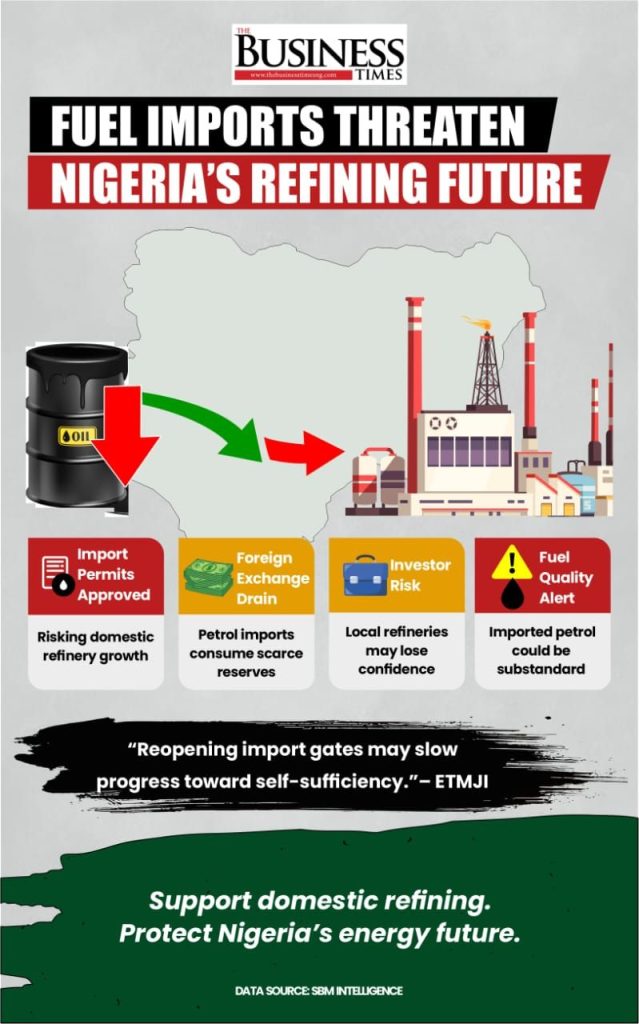
Dr. Salako Kareem, ETMJI president, noted that Nigeria has spent decades trying to resolve the contradiction of being a major crude oil producer that still depends heavily on imported fuel. Expanding import approvals at a time when domestic refining capacity is gradually improving, he argued, risks reversing progress. He warned that “reopening the door to large-scale importation could slow the momentum toward domestic refining.”
This concern is echoed by energy analyst Bamidele Funsho, who observed that rising imports could weaken the foundation of local refining. According to him, when imported fuel dominates the market, domestic refineries face reduced demand and less incentive to expand or invest. “It sends a mixed signal,” he noted, “while policy speaks of self-sufficiency, practice leans on imports.”
Beyond production concerns, the economic implications are equally significant. Petrol imports are paid for in foreign currency, primarily dollars, placing direct pressure on Nigeria’s foreign exchange reserves. Kareem stressed that the country has historically lost substantial volumes of foreign exchange importing products that could be refined locally.
Funsho reinforced this point, explaining that increased demand for dollars to finance imports can weaken the naira and intensify inflationary pressures. “As import volumes rise, demand for foreign exchange increases, and the naira comes under renewed strain,” he said, warning of a cycle that drives up costs across the economy.
The issue also extends to investor confidence. Funsho noted that frequent reliance on imports creates uncertainty for investors considering local refining projects. It suggests inconsistency in policy direction, raising concerns that government decisions could undermine profitability. “Investors may hesitate where policy signals are unclear or inconsistent,” he added.
ETMJI also highlighted risks associated with import-dominated supply chains, particularly the possibility of product dumping and the entry of substandard fuel into the market. Kareem pointed out that such conditions complicate regulation and impose hidden costs on consumers and industries.
Economist Layo Jochebed provided further insight into these risks, noting that poor-quality fuel can damage vehicle engines, industrial machinery, and critical equipment. “Substandard fuel carries hidden costs, from equipment damage to safety risks,” she explained, adding that it can also weaken confidence in the energy supply system.
Despite these concerns, both analysts acknowledge that imports cannot be eliminated entirely in the short term. Nigeria still faces supply gaps that require temporary external support. However, Jochebed emphasized that imports should function strictly as a buffer, not a long-term solution. “Imports should be a temporary measure, not a permanent strategy,” she said.
She argued that regulators must strike a careful balance between immediate supply security and future energy independence. This requires clear timelines for reducing imports, stable and predictable policies, and targeted incentives that encourage domestic refining.
For ETMJI, the central issue is policy alignment. Kareem stressed that short-term decisions must reinforce, rather than contradict, long-term national objectives. Strengthening local refining capacity, improving supply chain transparency, and protecting foreign exchange reserves should remain at the core of Nigeria’s energy strategy.
Jochebed added that achieving this alignment requires a coherent industrial framework. This includes enforcing strict fuel quality standards, setting transparent limits on imports, and providing sustained support for local producers. “Consistency in policy is critical to attracting and sustaining investment,” she noted.
Ultimately, the debate reflects a critical moment for Nigeria’s energy sector. The country has a rare opportunity to restructure its downstream industry, reduce dependence on imports, and build a more resilient economic base. However, this opportunity depends on disciplined and coordinated policymaking.
ETMJI concluded that close collaboration between regulators and the presidency is essential to avoid repeating past cycles of heavy importation that drained national resources and weakened economic resilience. Each policy choice, the group warned, now carries lasting implications.
If managed carefully, Nigeria can use this period to strengthen domestic refining, stabilize its currency, and encourage industrial growth. If not, renewed reliance on imports could delay self-sufficiency and prolong the structural weaknesses that have long defined the sector.