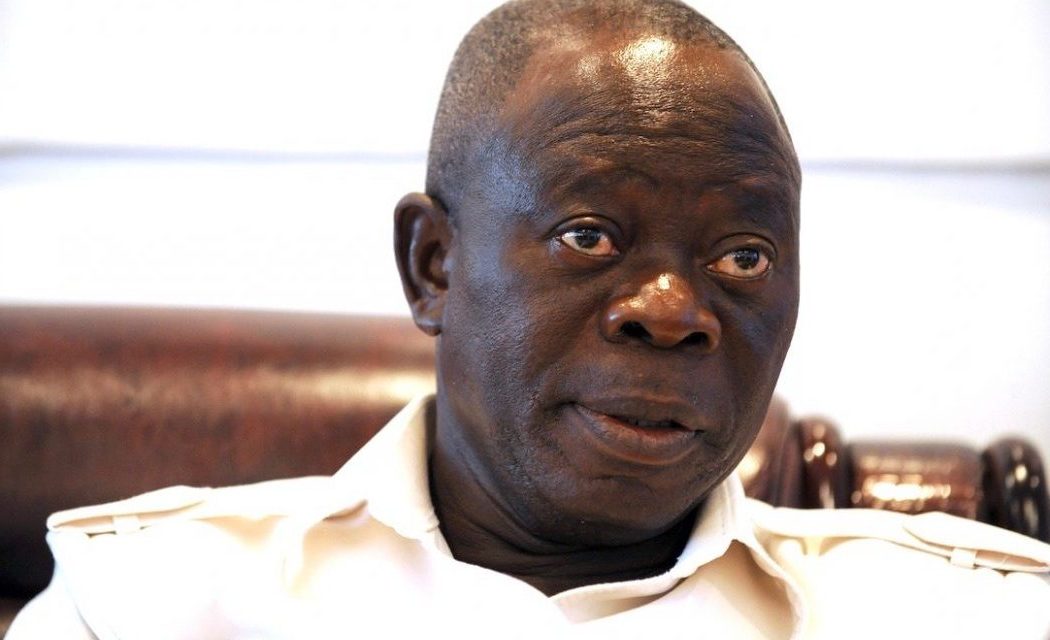

Senator Adams Oshiomhole’s comparison of the cost of buying a meal in Nigeria with the purchasing power of a dollar in the United States has reignited debate over the country’s economic hardship and the impact of President Bola Tinubu’s reforms.
Speaking on Channels Television’s Politics Today on Thursday, November 5, 2026, the former Edo State governor argued that ₦2,000 could still buy something at a local roadside restaurant popularly known as a mama put, whereas one dollar could hardly buy anything in the United States.
The remarks, which circulated through Channels Television presenter Seun Okinbaloye’s social media account, have raised an important economic question: does the fact that Nigerians can buy a meal for approximately the dollar equivalent of $1.48 mean they enjoy greater purchasing power?
The exchange-rate arithmetic provides some context. The Nigerian Foreign Exchange Market recorded a closing rate of ₦1,350.45 to the dollar on November 5. At that rate, ₦2,000 was worth approximately $1.48.
However, currency conversion alone does not measure purchasing power. Income relative to the cost of essential goods and services provides a more meaningful comparison.
Nigeria’s national minimum wage remains ₦70,000 monthly. In a letter dated October 12, 2026, Labour Minister Muhammad Maigari Dingyadi told the Nigeria Labour Congress that the next statutory review of the wage would be due on June 1, 2027. THISDAY reported the development on October 16.
At the November 5 exchange rate, the monthly minimum wage was equivalent to approximately $51.83.
In the United States, the federal minimum wage remains $7.25 per hour, according to the US Department of Labor, although several states have higher rates.
Using a standardised 40-hour working week over 52 weeks, an American earning the federal minimum wage would make approximately $1,257 monthly before taxes.
Applying the same working-hour assumption, a Nigerian earning ₦70,000 monthly would earn an equivalent of approximately ₦404 per hour. A ₦2,000 meal would therefore represent almost five hours of earnings.
For an American earning the federal minimum wage, $1.48 represents approximately 12 minutes of work.
Fuel prices provide another illustration of the difference between nominal prices and purchasing power. Legit.ng reported on November 5 that NNPCL outlets sold petrol at ₦1,325 per litre in Abuja and ₦1,355 in Lagos following a price adjustment on November 4.
Meanwhile, the American Automobile Association reported on November 5 that the national average price of regular petrol was $4.10 per gallon, equivalent to approximately $1.08 per litre.
At the prevailing exchange rate, Abuja’s NNPCL petrol price was approximately $0.98 per litre. A Nigerian earning the monthly minimum wage could purchase about 53 litres with an entire month’s salary, compared with approximately 1,160 litres for an American earning the federal minimum wage, using the American national average petrol price.
The comparison excludes taxes and other living expenses and uses specific Nigerian outlet prices against a US national average.
The pressure on Nigerian businesses is also reflected in borrowing costs. The Central Bank of Nigeria’s September 2026 Money Market Indicators showed an average maximum lending rate of 32.62%, while the prime lending rate stood at 19.04%.
This followed the CBN’s September decision to reduce its Monetary Policy Rate from 26.5% to 23%. Despite the reduction, commercial borrowing costs remain a challenge for businesses seeking funds for expansion and daily operations.
Infrastructure constraints add to the pressure. The Nigerian Electricity Regulatory Commission’s January 2026 operational performance report showed that Nigeria had 13,625 megawatts of installed generation capacity, but an average of only 4,901MW was available for dispatch. Average hourly generation stood at approximately 4,421MW.
Insecurity also carries significant economic consequences. Reuters reported on August 26, 2026, citing SBM Intelligence, that 7,825 people were kidnapped between July 2025 and June 2026, with confirmed ransom payments reaching ₦7.78 billion.
Separately, Semafor reported on August 31 that Ladd Serwat, a senior Africa analyst at ACLED, described the second quarter of 2026 as Nigeria’s most violent since the organisation began collecting records in 1997.
Oshiomhole’s comparison is valid as a narrow illustration of what a particular amount of money can buy in two countries. However, the availability of a relatively inexpensive meal does not establish that Nigerians enjoy greater purchasing power.
The more meaningful measure is how much people earn relative to the cost of feeding themselves, paying for transportation, accessing electricity and meeting other essential needs.
Ultimately, the difference between the naira and the dollar goes beyond their exchange rates. It also reflects the wages, infrastructure, access to affordable finance and economic opportunities available to the people who earn them.