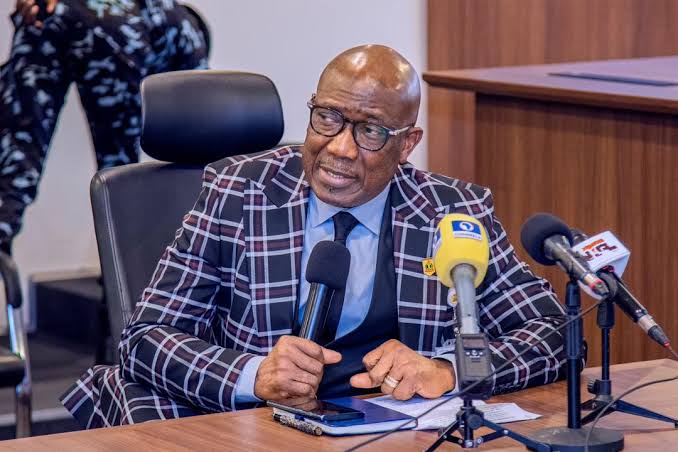

The Director-General of the National Centre for the Control of Small Arms and Light Weapons (NCCSALW), DIG Johnson Kokumo (retd.), has dismissed claims in a viral video alleging that National Security Adviser Nuhu Ribadu sponsored suspects arrested over the illegal importation of arms through the Tin Can Island Port in Lagos.
Kokumo described the claims as baseless, insisting that the facts surrounding the seizure of 399 automatic weapons did not support the allegations.
Speaking on Tuesday, September 1, 2026, during the joint security spokespersons’ briefing in Abuja, Kokumo said he was personally present at the Tin Can Island Port when the Nigeria Customs Service handed the seized weapons over to the NCCSALW.
“The story in the video is not correct and cannot be correct,” Kokumo said.
He said the 399 assorted automatic weapons had been intercepted by Customs and subsequently handed over to the centre, adding that he attended the handover personally alongside the Comptroller-General of Customs, Bashir Adewale Adeniyi.
Kokumo said the seized weapons were being kept in a secured armoury, while two suspects arrested in connection with the illegal importation remained in custody.
He added that investigations were continuing to identify those behind the shipment in Nigeria and, where possible, their international criminal partners.
Kokumo also condemned the viral video for allegedly calling for violence against Ribadu and other individuals, saying the claims circulating in it were not supported by the facts.
The 399 rifles were recovered after Customs intercepted a shipment of knocked-down firearm components at the Tin Can Island Port in August 2026. The components were subsequently assembled into 399 JOJEF automatic rifles, which were handed over to the NCCSALW on August 17, 2026, according to Kokumo.
The development was part of a wider series of arms seizures at the port, with Customs making another major interception later in August.
On Monday, August 31, 2026, the Nigeria Customs Service announced the seizure of another 204 pump-action rifles at the Tin Can Island Port.
According to Deputy Comptroller-General of Customs Timi Bomodi, the rifles were found in a 20-foot container that arrived from Turkey aboard the vessel MV Algeciras Express on August 16, 2026.
The container was flagged following credible intelligence and subjected to a 100 per cent physical examination on August 18. Customs officials found knocked-down firearm components concealed among declared household goods, including furniture, refrigerators, solar panels and detergent.
A joint team from the Customs Armament Unit and the NCCSALW subsequently assembled the components and identified 204 MAS 49 ALTER MAGNUM pump-action rifles, alongside additional firearm parts.
Bomodi, who represented Customs Comptroller-General Bashir Adewale Adeniyi at the briefing, said the latest seizure demonstrated the effectiveness of intelligence-led enforcement and closer cooperation between security agencies.
He said discrepancies were also found in the import documentation, particularly concerning the identity of the consignee, with investigations continuing into the shipment and those connected to it.
Kokumo also disclosed that the Federal Government destroyed 1,419 illicit weapons on July 30, 2026, during the NCCSALW’s Second Quarter Arms Destruction Exercise at the Muhammadu Buhari Cantonment in Giri, Abuja.
According to him, the exercise brought the cumulative number of illicit weapons destroyed by the centre since 2022 to more than 19,000.
He said the destruction was intended to prevent recovered weapons from being diverted back into circulation and used by criminal and non-state actors.
Kokumo further disclosed that the centre received 5,050 illicit, unserviceable, decommissioned and obsolete automatic weapons retrieved from the Nigeria Police Force in June 2026.
The NCCSALW is responsible for coordinating efforts to control and eliminate the circulation of illicit small arms and light weapons in Nigeria, working with security and law-enforcement agencies to prevent recovered firearms from returning to criminal networks.