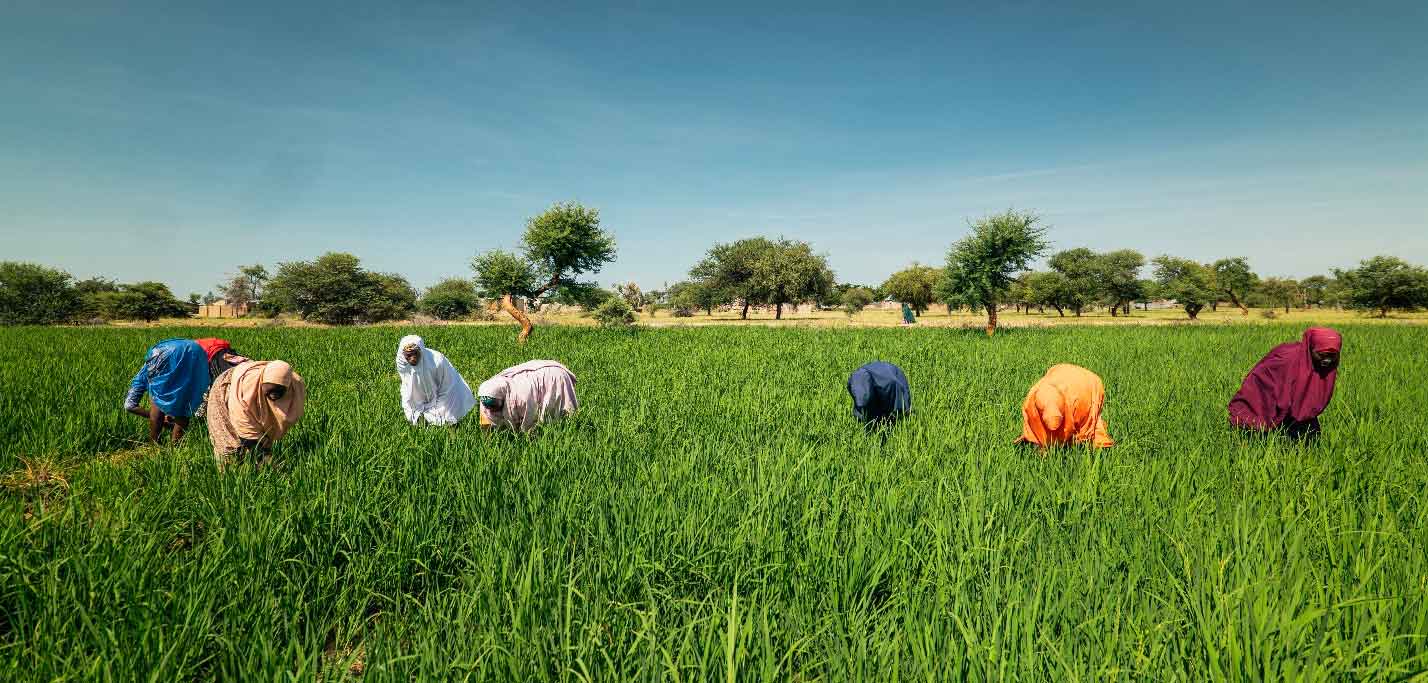

Nigeria’s worsening insecurity in major farming regions is doing more than deepening hunger in the North. It is disrupting the supply of staples, raising market costs and increasing the country’s exposure to food imports.
Nigeria’s food-security crisis is usually reported through the lens of hunger, displacement and humanitarian needs. But there is another economic consequence receiving far less attention: insecurity in the country’s major agricultural belts is increasingly becoming a national food-price and import-dependency problem.
PwC’s 2026 Economic Outlook estimates that 34.7 million Nigerians could face acute food insecurity in 2026, with conflict, high input costs and climate shocks among the major risks. FAO has independently projected the same 34.7 million figure for mid-2026.
The mechanism is straightforward. When farmers cannot safely reach their land, plant on schedule or harvest their crops, the resulting supply shortfall eventually reaches markets far beyond the affected communities.
Recent analysis by FEWS NET shows how this process is unfolding. In parts of Borno, Yobe and Adamawa, severe movement restrictions have cut communities off from farmland and markets. In the North West, violence in states including Zamfara, Katsina and Sokoto has restricted access to farmland, disrupted trade and forced some farmers to pay levies to armed groups to cultivate or harvest their fields.
The consequences are already visible in staple markets. FEWS NET says rice, maize, millet and sorghum prices remain elevated because of below-average market supply, seasonal depletion of stocks, higher household dependence on markets and rising transport costs. It expects 2026 main-season production to remain below the five-year average, particularly in conflict-affected surplus-producing areas.
The problem extends beyond grain.
Kano, one of Nigeria’s major agricultural centres, has also experienced a severe tomato pest outbreak this year, with growers reporting losses exceeding ₦1.5 billion. Such shocks illustrate how vulnerable food supply becomes when production, logistics and agricultural resilience are simultaneously under pressure.
The resulting pressure is particularly important for Nigeria because domestic production does not cover all consumption needs. The IMF estimates that imported food accounts for about 30% of food consumed in Nigeria, while the country remains overwhelmingly dependent on imports for commodities such as wheat.
That creates a second transmission channel.
When domestic production falls, traders and processors have to source more supplies from elsewhere, including abroad. Import substitution therefore becomes harder precisely when the government is trying to strengthen domestic agricultural production and reduce dependence on external supplies.
There is also a distribution problem. Food produced in one region must reach consumers in another. When insecurity closes markets, restricts roads or raises the risk and cost of moving goods, even available supplies can become effectively scarce.
This means Nigeria’s food-inflation problem cannot be explained by currency movements, fuel prices or seasonal shortages alone. Security has become part of the food-supply equation.
The evidence is particularly stark in the North West. FEWS NET estimates that staple production in Sokoto, Katsina and Zamfara in 2025 was 23% to 27% below the five-year average, reflecting the cumulative effects of insecurity, shrinking cultivated areas and weaker productivity.
The implication for policymakers is significant: agricultural investment without agricultural security may produce diminishing returns.
Nigeria can provide fertiliser, seeds, irrigation and financing, but if farmers cannot safely access their land or move their harvest to market, the production gains will remain limited.
The economic cost of insecurity is therefore not confined to the communities where attacks occur. It can travel through the food chain, from abandoned farmland to thinner market supplies, higher transport costs, rising staple prices and eventually greater dependence on imports.
For Nigeria, securing the food-producing regions is no longer only a humanitarian or security objective. It is an inflation-management, import-substitution and economic-growth priority.