
As Nigeria’s sovereign debt balloons to a staggering ₦152 trillion (approximately $190 billion), the nation finds itself walking a fiscal tightrope, caught between the urgent need to finance development and the crushing weight of borrowing costs that threaten to consume its future. A deep dive into the country’s financial strategy reveals a government increasingly reliant on high-interest international bonds and costly domestic debt, locking the economy into decades of expensive repayments and sparking a fierce debate among analysts, economists, and citizens about the true price of progress.
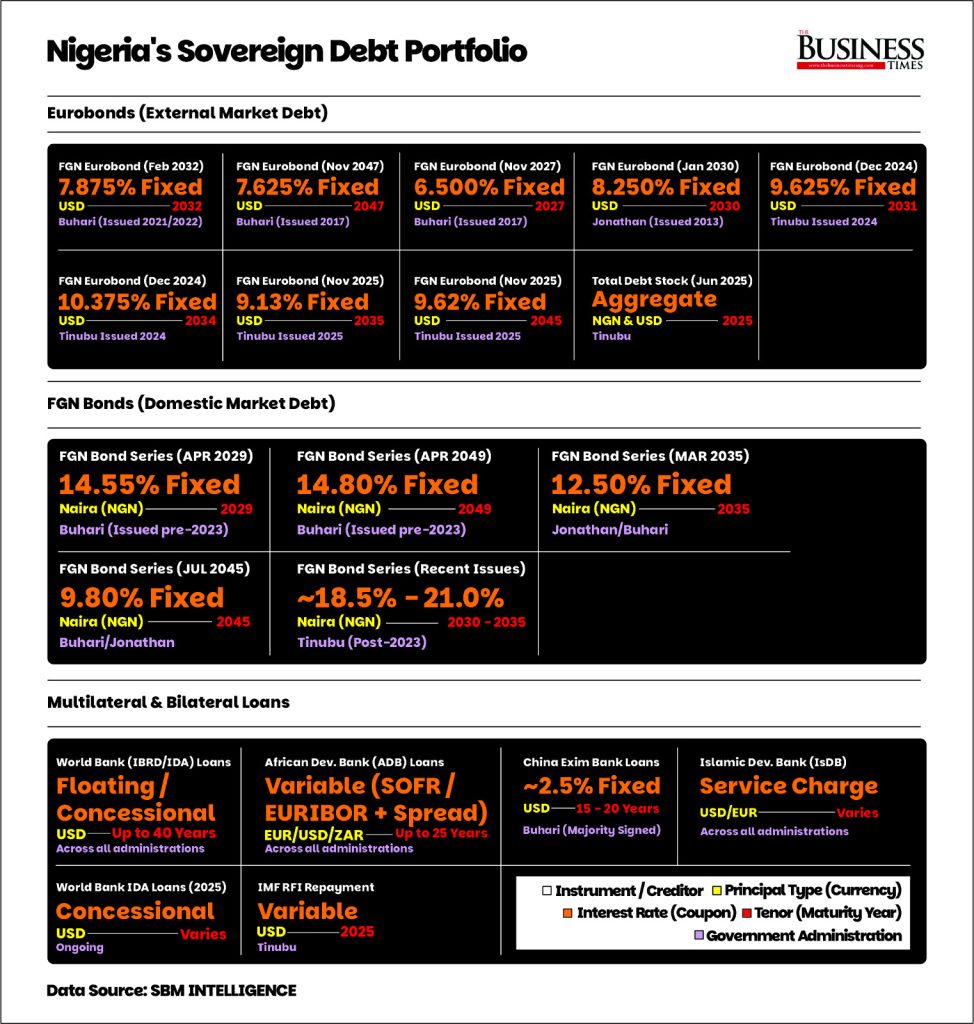
The administration of President Bola Tinubu has overseen a sharp escalation in the cost of capital. While previous governments secured Eurobonds with coupons between 6.5% and 8.25%, new issuances in 2024 and 2025 have witnessed rates soaring to 10.375%. A landmark 20-year bond, maturing in 2045, locks Nigeria into a punishing 9.62% interest rate. Domestically, the situation is even more acute, with Federal Government bonds now carrying coupons between 18.5% and 21.0%, a stark jump from the 9.80% to 14.80% range of prior years.
This soaring cost of borrowing is the central theme of Nigeria’s current economic narrative, a story of hard choices between slow, conditional aid and fast, expensive cash, with the livelihoods of millions hanging in the balance.
The Allure of Speed Over Affordability
The government’s celebratory announcement of a successful $2.35 billion Eurobond sale in late 2025, which attracted over $13 billion in orders, was framed by the Debt Management Office (DMO) as a resounding vote of confidence. Yet, financial experts dissect this “success” with a more cautious eye.
Simon Believe, a Lagos-based financial analyst, explains the paradoxical logic. “World Bank loans are cheap but too small and slow for Nigeria’s urgent problems,” he says. “Fixing roads, building power plants, or tackling climate change needs billions now, not in years. International markets give quick cash, but the high interest rates are the price we pay.”
For Believe, the strategy is about momentum. “It’s not just about money, it’s about keeping investors interested in Nigeria’s story,” he adds, pointing to the country’s oil wealth and large market as enduring lures for global lenders.
However, this perspective is countered by the stark warnings of other economists. Efosa Jegede, who advises small businesses in Abuja, highlights the monumental growth required to service such debt. “We’re paying nearly 10% interest on a 20-year Eurobond,” she states. “To handle that without slashing health or education budgets, Nigeria needs 8-10% GDP growth every year for a decade.”
This growth rate is a Herculean task for an economy that has struggled to consistently achieve half of that. Efosa stresses that this requires more than just borrowing; it demands a fundamental fiscal overhaul. “We need better tax collection, less corruption, and investments in jobs and infrastructure to boost revenue,” she says. Without these, she warns, debt payments could once again consume over 50% of government revenue, as they have in recent years, crippling public services.
A Tightrope Walk: Interest Rates, the Naira, and the Budget
The tension is not confined to external borrowing. The Central Bank of Nigeria (CBN) is engaged in a delicate balancing act of its own, aggressively hiking the Monetary Policy Rate (MPR) from 18.75% to 27.5% in 2024 to combat inflation and stabilize the Naira. While necessary for monetary stability, this move has a devastating side effect: it dramatically drives up the government’s own cost of borrowing in the local market.
Mr. Ikemesit Effiong, a partner at SBM Intelligence, describes this as a “tightrope walk.” He explains, “The CBN is raising rates to tame inflation and defend the Naira, but that also drives up borrowing costs for government. The solution lies in fiscal discipline, trimming the size of government, cutting waste, improving tax collection, and attracting foreign inflows, so we borrow less and rely more on real revenue growth.”
This high-interest rate environment has a cascading effect on the real economy, as noted by Christian Onaji, an economic observer in Port Harcourt. “High interest rates from government borrowing make loans unaffordable for small businesses and families,” he says. “I know traders who can’t expand because bank loans are over 20%. Families can’t buy homes or cars. This debt strategy is squeezing everyone.” Onaji points out that the CBN is trapped, unable to lower rates amid the government’s massive borrowing needs, thereby stifling job creation and economic growth for the broader population.
The Currency Risk and the Concessional Cushion
Compounding the problem of high interest rates is the ever-present threat of currency risk. Nigeria’s debt portfolio is a mix of US Dollar and Naira-denominated obligations. A further weakening of the Naira would exponentially increase the local currency cost of servicing the external debt.
According to Mr. Effiong, the government is attempting to mitigate this risk by “leaning on higher oil receipts, diaspora remittances, and FX reforms to boost dollar inflows. It’s also shifting more borrowing to local currency and exploring export diversification.” But he offers a sobering caveat: “Without stronger fiscal buffers, Nigeria remains vulnerable to sharp currency swings.”
Amid the focus on expensive market debt, a crucial part of the portfolio often goes overlooked: the concessional lifeline from multilateral institutions. The World Bank remains Nigeria’s top creditor with over $18 billion outstanding, supplemented by loans from the African Development Bank (AfDB). These loans carry highly favorable rates, often below 2%, providing a critical cushion.
Yet, even this safer borrowing attracts controversy. When the government secures new World Bank loans, such as a $500 million ‘Pay-for-Results’ model for digital infrastructure, it faces criticism from civil society and political groups. They argue, as echoed by Dr. Ikenna Obi, a public health worker, that “World Bank funds come with strings—policy changes, transparency, accountability. Those are hard for our government to commit to. Expensive loans give flexibility but burden us long-term.” For many, this choice to avoid conditional, cheaper loans in favor of costly, flexible ones feels like a gamble with the nation’s future to avoid difficult but necessary reforms.
The Human Cost: Debt Service Over Public Service
For everyday Nigerians, the abstract debate over debt composition and interest rates has tangible, personal consequences. The fear is that soaring debt service payments will inevitably crowd out essential funding for public services like education and healthcare.
Aisha Muhammed, a schoolteacher, voices the concerns of many educators and parents. “If the government keeps borrowing at these high rates, where’s the money for new classrooms or teacher training?” she asks. “My school’s roof leaks, and we can’t afford books. More debt feels like more struggle for us.”
In the health sector, Dr. Ikenna Obi shares her dread. “High-interest debt crowds out funding for hospitals,” he says. “We’re already short on equipment and staff. If debt eats the budget, patients will suffer most.” Their concerns are not hypothetical. With the Senate recently approving President Tinubu’s external borrowing plan of over $21 billion for the 2025-2026 fiscal cycle to fund infrastructure and the budget, the stage is set for a future where debt servicing and public spending are in direct competition.
The strong demand for Nigeria’s Eurobonds, often celebrated by officials, sends a mixed message, explains economist Efosa Jegede. “Investors buy our bonds for the high returns, not because they fully trust us. That 9.62% rate shows they’re worried about our rising debt, unstable naira, and oil dependence,” she says. “It’s a mixed message. We’re attractive, but not safe. To borrow cheaper, we need to diversify beyond oil and fix our fiscal policies.”
A Crossroads for a Generation
Nigeria stands at a pivotal moment. The next five years could see the effects of this debt strategy hit home hard. With debt payments potentially prioritizing over public spending, services may deteriorate further. Aisha Muhammed worries about her students: “If we don’t invest in schools now, what jobs will these kids have?” Small businesses, choked by high-interest loans, may cut jobs, tightening economic opportunities. Rising living costs, driven by the high-rate environment, could make essentials like food and transport pricier for everyone.
The path forward, experts agree, hinges on strategic investment and bold fiscal reforms. “We need to invest these loans in power, tech, or agriculture; things that create growth,” urges Simon Believe. “Otherwise, we’re just piling debt on our children.”
Efosa Jegede concurs, adding a critical final thought: “Without new revenue from non-oil sectors and better tax systems, we’re borrowing to survive, not thrive.” The collective hope of Nigerians like Aisha, Dr. Ikenna, and the analysts watching the numbers is that their leaders can transform this costly borrowing into tangible progress, ensuring that today’s financial gambles do not become an inescapable burden for generations to come. The nation’s fiscal health, and the well-being of its people, depends on it.