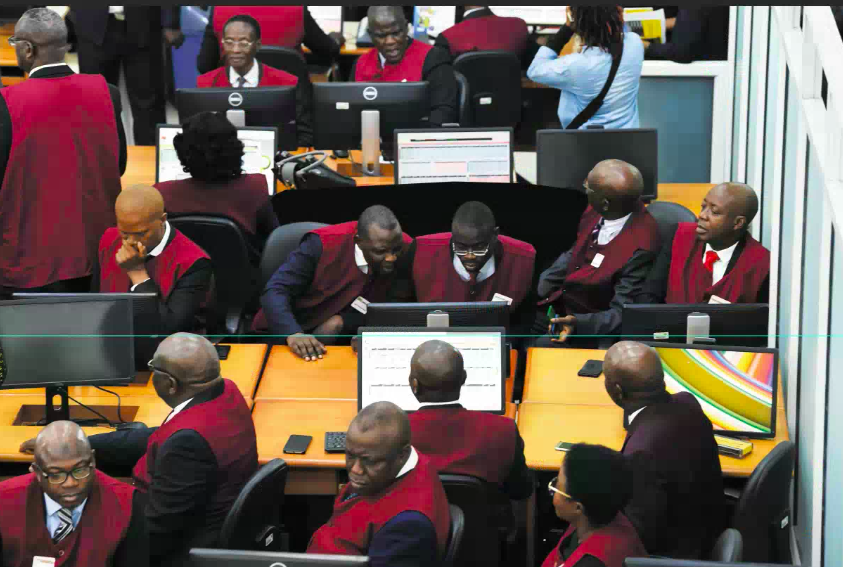

Total turnover on the Nigerian Exchange (NGX) recorded a sharp decline during the week, with 3.950 billion shares worth N201.312 billion traded in 359,642 deals, representing a 32.75 per cent drop in transaction value compared to the previous week’s 8.761 billion shares valued at N267.253 billion. The decline in trading activity reflects a consolidation phase following recent gains, with investors appearing to take a cautious stance amid broader macroeconomic developments including exchange rate volatility and the recent series of petrol price adjustments that have introduced fresh uncertainty into the market.
The Financial Services Industry maintained its dominant position, accounting for 2.881 billion shares worth N102.259 billion in 139,093 deals, representing 72.94 per cent of total volume and 50.80 per cent of total value traded during the week. The sector’s continued leadership reflects sustained investor interest in banking stocks, which have benefited from the recent recapitalisation exercise that strengthened balance sheets across the industry and enhanced the sector’s attractiveness to both domestic and foreign portfolio investors. Trading in three banks—Wema Bank Plc, Access Holdings Plc, and United Bank for Africa Plc—totalled 1.448 billion shares worth N43.191 billion, accounting for 36.65 per cent of total volume and 21.45 per cent of total value.
The Information and Communications Technology (ICT) sector emerged as the second most active, with 230.539 million shares valued at N45.172 billion exchanged in 52,669 transactions. The strong performance of the ICT sector reflects continued investor confidence in Nigeria’s digital economy, which has attracted significant investment in recent years and benefited from policy emphasis under the Renewed Hope Agenda. The Agriculture sector ranked third, recording 191.927 million shares worth N6.626 billion in 16,471 deals, suggesting sustained interest in agribusiness stocks amid government focus on food security and import substitution.
The NGX All-Share Index and market capitalisation declined marginally by 0.12 per cent to close at 200,913.06 and N128.969 trillion respectively, reflecting mixed sentiment across the market. While most indices closed lower, several sectors recorded gains. The NGX Main Board rose by 1.53 per cent, Insurance gained 2.22 per cent, AFR Div Yield advanced 1.36 per cent, Oil and Gas appreciated by 1.93 per cent, Lotus II added 1.61 per cent, Growth climbed 2.31 per cent, and Commodity recorded the strongest gain at 2.77 per cent. The NGX Sovereign Bond Index closed flat, indicating stability in the fixed income segment.
Market breadth was slightly negative, with 47 equities appreciating compared to 48 gainers recorded in the previous week, while 45 equities declined in price, up from 43 previously. Fifty-six equities remained unchanged, indicating a market characterised by selective buying rather than broad-based momentum. The week’s top losers included Livestock Feeds, which shed 95 kobo, Fidson Healthcare declining by N10.50, Cadbury Nigeria dropping N6.95, Austinlaz losing 44 kobo, and Learn Africa falling 85 kobo. Leading the gainers’ chart were Zichis Agro Allied Industries, which gained N5.21, Premier Paints advancing N14.10, John Holt rising N7.10, Legend Internet adding N1.50, and McNichols climbing N1.27.
From an investment perspective, the week’s trading pattern suggests a market in transition. The sharp decline in total value traded, coupled with mixed sector performance and a relatively balanced gainers-to-losers ratio, indicates that investors are selectively repositioning rather than exiting the market. The strong performance of the insurance, oil and gas, and commodity sectors suggests sector rotation as investors seek opportunities in areas poised to benefit from current macroeconomic conditions, including higher oil prices and government emphasis on agricultural productivity.