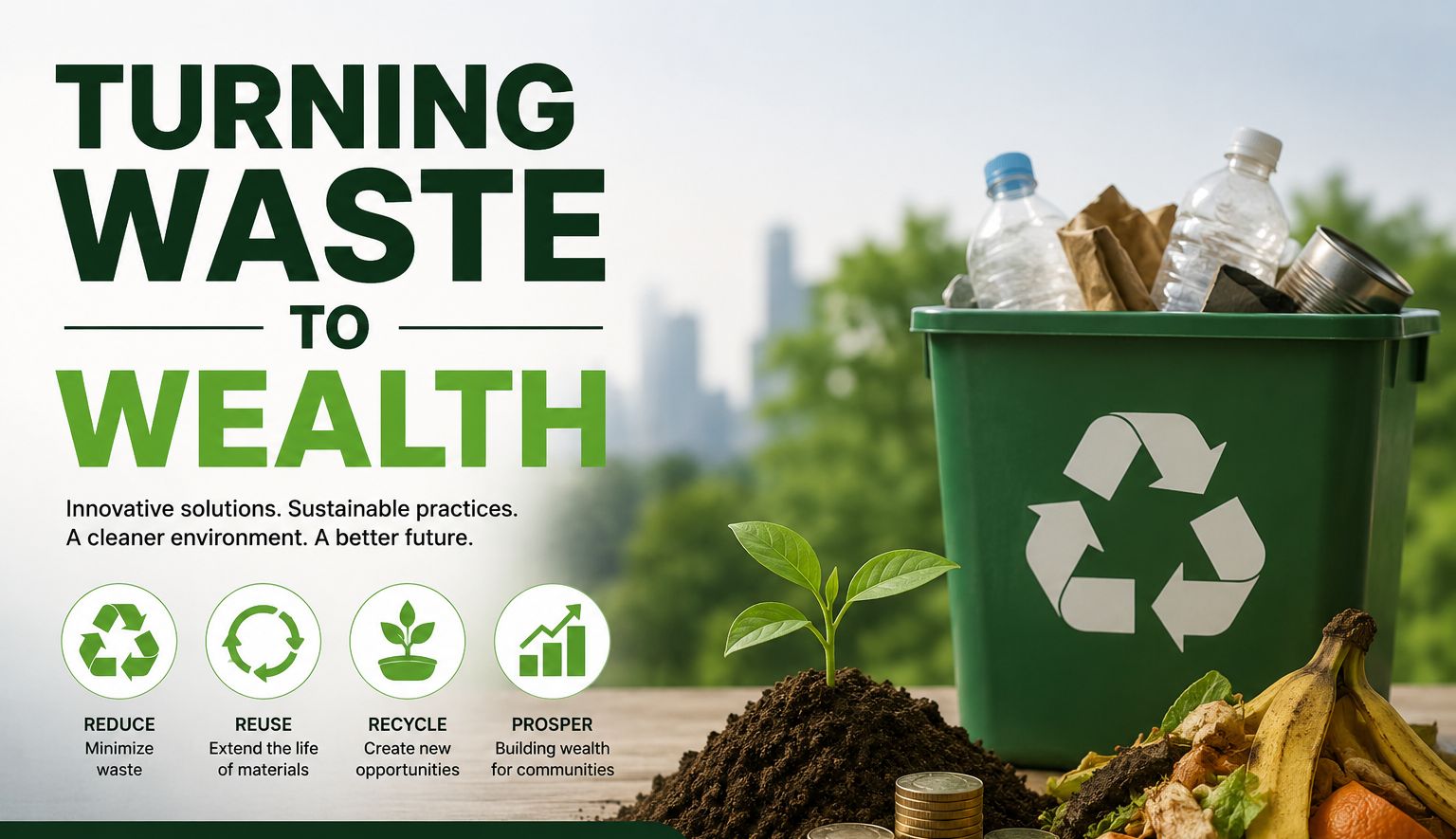

Nigeria’s growing waste management crisis is increasingly creating opportunities for entrepreneurs who see value where others see refuse. As mounting environmental challenges intersect with high youth unemployment, a new generation of innovators is demonstrating that discarded materials can be transformed into profitable enterprises while addressing critical economic and sustainability concerns.
Three entrepreneurs, Ruth Ede, Dotun Popoola, and Wisdom Onwunmelu, are emerging as leading examples of how the country’s circular economy is gaining momentum through agriculture, renewable energy, and the creative industries.
For Ruth Ede, entrepreneurship began after personal hardship. Following the demolition of her family’s home and businesses in Abuja, farming became their primary livelihood, ultimately inspiring the creation of Scratop Nigeria Limited.
The company converts agricultural and organic waste into environmentally friendly fertilizer for smallholder farmers seeking affordable alternatives to chemical inputs. Ede says the idea was sparked after hearing farmers complain about rising fertilizer costs, declining soil quality, and health concerns linked to prolonged chemical use.
A graduate of Michael Okpara University of Agriculture and a Mastercard Foundation Graduate Certificate Scholar at Arizona State University, Ede has received international recognition, including the YouthADAPT Solutions Challenge, the AYuTe Nigeria Award, and the EatSafe Global Challenge. She believes the awards validate African-led innovation capable of competing globally while strengthening food security and climate resilience.
Artist and sculptor Dotun Popoola has built an internationally recognized career by transforming discarded industrial materials into monumental sculptures.
Using scrap metal sourced from automobile workshops and junkyards, Popoola creates large-scale artworks that promote environmental conservation while highlighting the economic potential of recycling. His Scrap Art Museum in Ile-Ife has become both a creative hub and a training center for hundreds of emerging artists.
His latest exhibition, Reclaimed Beauty: A Dialogue Between Continents, showcases 25 installations crafted from reclaimed metal, reinforcing his long-standing mission of using art as a vehicle for environmental awareness and sustainable development.
Wisdom Onwunmelu, a master’s student at the Federal University of Agriculture, Abeokuta, is applying scientific research to convert rice husks, an abundant agricultural by-product into clean energy and organic fertilizer.
His project earned the top prize at the Nigeria Circular Economy Week 2026 Research Prize, securing a ₦1 million grant to advance the technology. The innovation aims to lower energy costs for food vendors while providing farmers with sustainable fertilizer, creating economic benefits across the agricultural value chain.
Although operating in different sectors, the three entrepreneurs share a common objective: transforming Nigeria’s waste streams into commercially viable products with measurable environmental impact.
Their businesses reflect the growing importance of the circular economy, a model that emphasizes keeping resources in use for as long as possible through recycling, reuse, and regeneration. As governments, investors, and development organizations increasingly prioritize green innovation, ventures like these demonstrate how sustainability and profitability can reinforce one another.
Their success also signals a broader shift in Nigeria’s entrepreneurial landscape, where young innovators are addressing environmental challenges while creating jobs, expanding local industries, and positioning the country as a growing hub for sustainable business solutions.