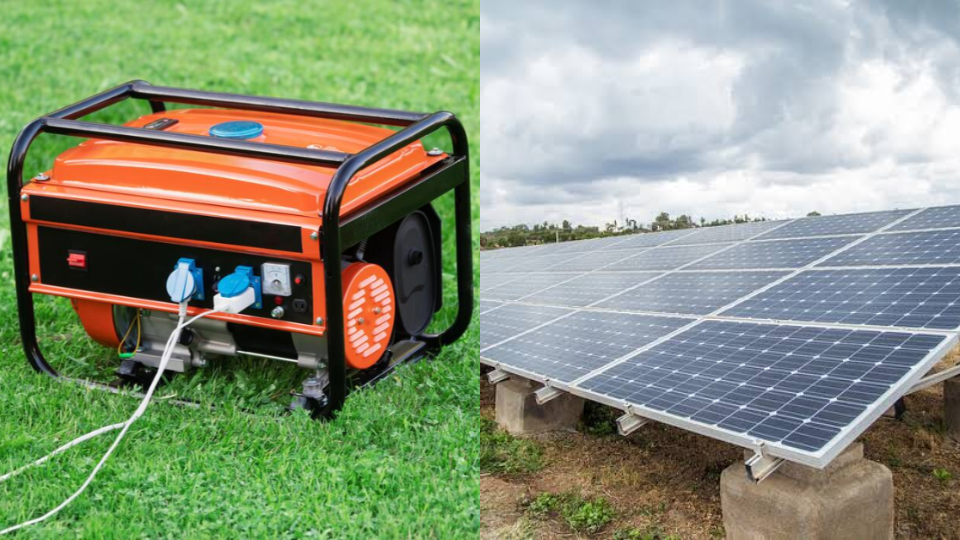

Nigeria’s generator economy is entering a new phase. For decades, unreliable electricity has made petrol and diesel generators a critical part of daily economic activity, powering homes, shops, offices, factories and telecommunications infrastructure.
That dependence is now facing increasing competition from solar power, battery storage and other distributed energy systems. But the shift is unlikely to eliminate generators in the near term.
A World Bank assessment estimated that more than 22 million petrol and diesel generators were operating in Nigeria, supplying about 26% of households and 30% of micro, small and medium-sized enterprises. Their combined capacity was estimated at roughly eight times the capacity connected to the national grid.
The economic burden is also significant. In October 2021, African Development Bank President Akinwumi Adesina said Nigerians spent about $14 billion a year on generators and fuel. He repeated the figure in a 2023 speech, describing unreliable electricity as a major constraint on Nigerian industry. The figure is therefore best understood as an estimate cited by the AfDB president, rather than a current 2026 measure of household and business spending.
Lagos provides a stark example of generator dependence. A 2024 Sustainable Energy for All (SEforALL) study, carried out with the Lagos State Government, identified almost 4.5 million fossil-fuel generator sets across the state.
The study estimated annual emissions from those generators at about 39 million tonnes of carbon-dioxide equivalent. SEforALL said the research was intended to support planning for replacing fossil-fuel self-generation with cleaner distributed-energy systems.
The finding also points to a potentially large market for solar, batteries and other alternatives. For businesses, reducing generator use can mean reducing exposure to fuel, maintenance and equipment costs.
Nigeria’s telecommunications industry illustrates another dimension of the problem. Mobile network sites require continuous power, and diesel generators have traditionally provided backup or, at some locations, a major source of electricity.
The GSMA reported in September 2024 that mobile operators and tower companies in Nigeria were purchasing and transporting more than 40 million litres of diesel each month to power network sites.
That level of fuel consumption gives telecom companies a strong commercial incentive to explore solar, batteries and hybrid power systems. The objective is not simply to cut emissions but also to reduce dependence on a fuel-intensive operating model.
Nigeria’s generator economy, however, is unlikely to disappear simply because cleaner alternatives are expanding.
Solar and battery installations require upfront capital, while batteries have finite operating lives. Businesses that cannot tolerate interruptions also need dependable backup capacity. Nigeria’s electricity market is therefore more likely to evolve towards a hybrid model in which grid electricity, solar, batteries and generators operate together.
The transition is already attracting new financial mechanisms. In March 2026, SEforALL and Gold Standard launched a methodology that allows carbon finance to support projects replacing fossil-fuel generators with renewable-energy systems while maintaining electricity reliability and incorporating safeguards for affected workers and communities.
For Nigeria, that could eventually change the economics of self-generation. Generator dealers, mechanics and fuel suppliers may face slower demand growth, while solar installers, battery providers, energy-service companies and financiers could capture a larger share of the power market.
But until grid electricity becomes sufficiently reliable and affordable for businesses and households, the generator will remain part of Nigeria’s energy infrastructure.
The next stage is therefore not the end of the generator economy. It is an economy that increasingly uses generators alongside cleaner sources, and where the economics work, uses them less.