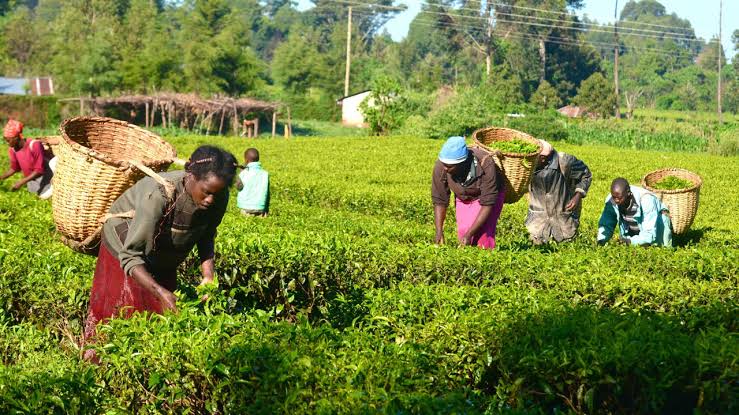

Nigeria’s agricultural sector grew by 4.39% in the second quarter of 2026, its strongest growth trajectory since 2021, but the expansion has yet to remove the pressure of high food costs on households and farmers.
Minister of State for Agriculture and Food Security, Aliyu Sabi Abdullahi, disclosed the figures on Friday, October 16, 2026, during the commemoration of World Food Day.
According to the National Bureau of Statistics’ Gross Domestic Product report for the second quarter, agriculture’s growth accelerated from 2.82% in the corresponding quarter of 2025 and 3.15% in the first quarter of 2026. Crop production, the sector’s largest component, grew by 3.66%.
Nigeria’s economy expanded by 4.43% year-on-year during the quarter, while agriculture accounted for 26.15% of real gross domestic product. The services sector remained the largest contributor, with a 56.62% share.
The figures point to stronger agricultural activity, although growth in output does not necessarily translate into lower food prices or better earnings for farmers.
The livestock subsector recorded 6.92% growth in the second quarter, compared with 2.20% in the first quarter and 1.64% in the second quarter of 2025, according to figures reported by Nairametrics on September 1, 2026.
Forestry also expanded, with Vanguard reporting on September 9 that the subsector grew by 4.88% year-on-year. Crop production remained the largest agricultural activity, contributing approximately ₦9.44 trillion in the quarter.
Abdullahi attributed the sector’s performance to government interventions and reforms aimed at improving food production, mechanisation, financing and agricultural value chains.
He said the National Agricultural Growth Scheme and Agro-Pocket programme had supported smallholder farmers to produce about 2.5 million metric tonnes of staple foods across four farming seasons.
The figure is consistent with a February 6 report by the News Agency of Nigeria, which said the programme recorded 2,536,184 metric tonnes of produce, valued at an estimated ₦2.31 trillion.
The minister also said Nigeria’s annual domestic wheat production had risen to approximately 420,000 metric tonnes from a previous baseline of 120,000 metric tonnes.
Other government initiatives include the Renewed Hope Agricultural Mechanisation Programme, which is deploying 2,000 tractors and implements to improve farming efficiency and reduce reliance on manual labour.
The government is also targeting lower post-harvest losses and improved access to agricultural financing, while pursuing measures to strengthen irrigation, storage and processing.
However, production costs, insecurity and weaknesses in food distribution remain important challenges for the sector.
In a September 1 report, the News Agency of Nigeria quoted farmers and agricultural input suppliers in Abuja’s Bwari Area Council as warning that expensive fertilisers, improved seeds and agrochemicals were forcing some farmers to reduce the size of their farms.
Transport costs also remain a concern. In a September 17 report, Newsverge quoted the Lagos State chairman of the All Farmers Association of Nigeria, Sakin Agbayewa, as saying rising fuel prices were increasing the cost of farm inputs, agricultural operations and food transportation.
Agriculture Minister Abubakar Kyari also acknowledged the disconnect between production and consumer prices in an interview reported by The PUNCH on September 19. He said farm-gate prices had fallen, but consumers were yet to benefit fully because of gaps in processing and distribution.
The distinction is important as Nigeria seeks to turn stronger agricultural output into affordable food and sustainable farm incomes.
While the latest GDP figures indicate improving performance, the lasting impact of the growth will depend on whether farmers can produce profitably, move their harvests to markets at reasonable cost and supply food at prices households can afford.