
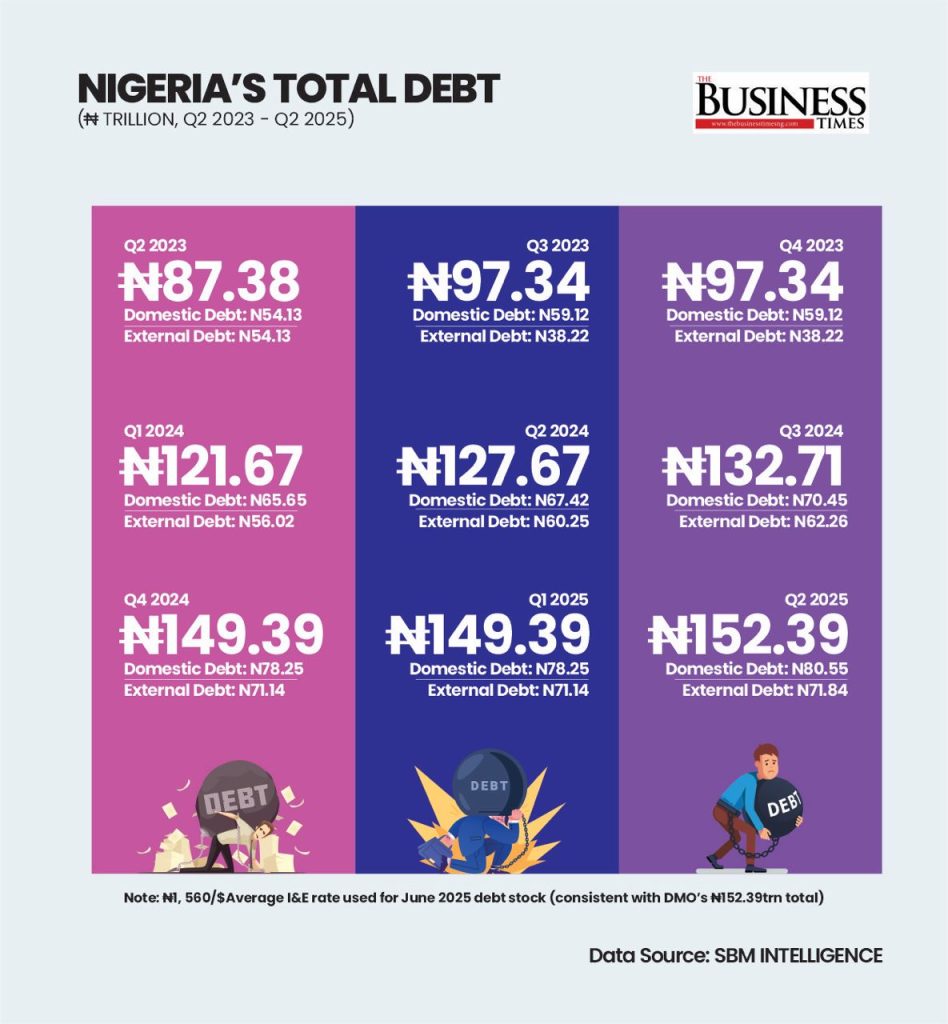
Nigeria’s public debt has reached a record-breaking ₦152.39 trillion as of June 30, 2025, after rising by ₦3 trillion in just three months, according to data from the Debt Management Office (DMO). The figures reveal an economy increasingly dependent on borrowing to keep its engines running. Domestic debt stood at ₦80.55 trillion, while external debt totalled ₦71.84 trillion.
Borrowing to Breathe
Nigeria’s rising debt reflects a government caught between low revenue and rising obligations. For years, successive administrations have used debt to plug budget deficits created by weak revenue generation and an ever-expanding public expenditure.
What makes the current situation more worrying is not just the quantum of debt, but its sustainability. This concern was starkly illustrated in a recent analysis by Femi Oladehin, Partner at Argentil Capital Partners, who cited Central Bank of Nigeria (CBN) data to highlight a critical monthly imbalance. “Nigeria’s debt service obligations stood at ₦696.27 billion while total retained revenue amounted to only ₦483.47 billion in January 2025,” Oladehin stated, “indicating that debt service alone consumed about 144 per cent of all government earnings in the month under review.”
This pattern is not a one-off event. A statement from the civic organization BudgIT, analyzing Nigeria’s debt crisis, corroborates this long-term trend, pointing to a fundamental failure in fiscal management. “Poor fiscal discipline, as evidenced by violations of the Fiscal Responsibility Act of 2007, has led to borrowing for non-productive purposes,” the BudgIT analysis noted. “Consequently, over 80% of government revenue is now allocated to servicing debts, leaving minimal funds for essential services like health and education.”
The headline figure of ₦152.39 trillion is further clarified by the impact of currency weakness. As one economist explained, focusing on the exchange rate’s role, “One important factor that amplified the debt number was the exchange rate. Because if you look at the totality of our debts in dollar terms, you will discover that the difference between where we were and where we are now is not that significant, but because of the naira depreciation, the dollar component of the debt has gone up by almost three times.”
A Fragile Fiscal Equation
At the core of Nigeria’s debt dilemma is its revenue problem. Despite being Africa’s largest economy, the country’s tax-to-GDP ratio remains among the lowest on the continent. Oil revenue, once a reliable anchor, has become unpredictable due to production shortfalls, theft, and volatile global prices.
This revenue fragility has forced the government to rely on borrowing not just for capital projects but also for recurrent expenditure. The situation has become so severe that economic think tanks are raising alarms about its fundamental nature. A report from Dataphyte Insight outlined the definitive sign of a broken cycle: “The sharp rise in 2023 and 2024, surpassing 100%, means Nigeria has been spending more on debt servicing than it earns in revenue. This implies that the country is borrowing to finance development and recurrent expenditures and meet its debt repayment obligations, a classic signal of unsustainable fiscal practices.”
The DMO maintains that Nigeria’s debt-to-GDP ratio remains “within sustainable limits” at around 47 percent and insists that “budgetary provisions remain adequate to meet obligations,” citing support from proceeds of a $2.2 billion Eurobond issued earlier this year. However, the International Monetary Fund (IMF) has advised a different course. In its 2025 Article IV Consultation staff report, the IMF recommended a neutral fiscal stance in 2025 to safeguard macroeconomic stabilization, suggesting that “adjustment would have to come from the expenditure side to preserve critical projects with the highest contribution to growth and job creation.”
Expert Warning and Investor Flight
Afe Babalola, founder of Afe Babalola University, Ado Ekiti (ABUAD), expressed deep concern over Nigeria’s growing debt burden, warning that the country’s economic reputation is deteriorating and discouraging foreign investment.
The legal icon lamented that the country’s worsening debt profile was undermining investor confidence, adding that the local financial sector is also feeling the strain. He cited bank complaints that the Central Bank of Nigeria (CBN) has been unable to honour government promissory notes.
“The theme of this Conference is most appropriate at this time of our development. The record shows that Nigeria, as of today, is a big debtor country. Nigeria’s total public debt is put at N152.4 trillion or $99.7 billion,” Mr Babalola said.
“Consequently, most business companies from other countries do not want to invest in this debtor country. As I am talking to you now, I know as a fact that our banks are complaining that the Central Bank is not honouring Promissory Notes issued by the government on the allegation that the federal government is in debt and cannot pay the Central Bank.
“The main function of a government is contained in Section 14 of the Constitution. To avoid doubt, it reads as follows: The Federal Republic of Nigeria shall be a State based on the principles of democracy and social justice.
“It is hereby, accordingly, declared that: Sovereignty belongs to the people of Nigeria from whom government through this Constitution derives all its powers and authority;
“The security and welfare of the people shall be the primary purpose of government. The participation by the people in their government shall be ensured in accordance with the provisions of this constitution.”
The Way Forward: Borrowing for Growth, Not Survival
There is no quick fix. Yet, the path to stability lies in aligning debt with productivity. Borrowing is not inherently bad, as most countries borrow, but what matters is the purpose and efficiency of the loans.
At the same time, the European Union has approved a ₦320.5 billion (€190 million) credit line through the European Investment Bank (EIB) to boost Nigeria’s agricultural productivity, a facility expected to support cocoa, dairy, and climate-smart farming through commercial banks. Such targeted borrowing could become a model if managed well, channelled into projects that expand output, create jobs, and raise exports.
According to Kunle Ojo, an economist, if the debt is mismanaged, it risks becoming another addition to Nigeria’s growing pile of underperforming loans, money borrowed in the name of development but lost to inefficiency and corruption. Ojo explained that the country must deepen its tax base, improve non-oil revenue, and strengthen public financial management systems. Equally important is transparency, ensuring citizens know where borrowed funds go and how they are used.
The government’s target to cut public debt servicing costs through longer tenors and lower coupon rates is a step in the right direction, but without the parallel reforms in spending discipline and revenue collection as suggested by the IMF, it may only buy time.
Nigeria’s debt profile tells a complex story of ambition constrained by structural weakness. Each new loan buys a little space, but also builds new pressure. Unless the country’s borrowing shifts decisively toward growth-linked investments and away from recurrent lifelines, that space will keep shrinking. For now, the numbers continue to rise, and with them, the stakes.