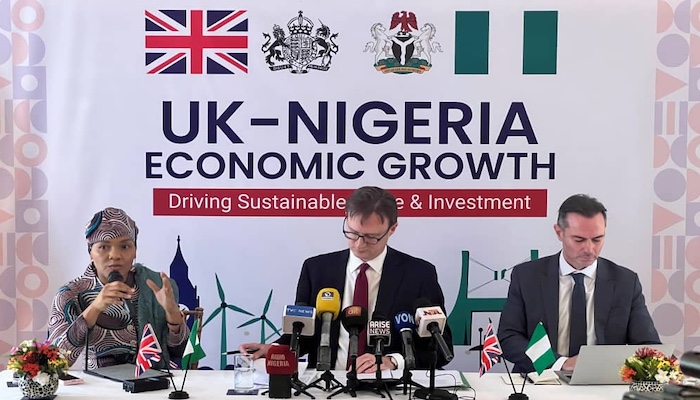

The Federal Ministry of Industry, Trade, and Investment (FMITI) has disclosed that the United Kingdom emerged as Nigeria’s leading source of foreign investment in 2025, contributing approximately 65 percent of new capital inflows into the country.
The ministry attributed the strong inflows to the implementation of the UK–Nigeria Enhanced Trade and Investment Partnership, alongside domestic economic reforms aimed at rebuilding investor confidence.
This was contained in a policy document titled 2025: A Defining Year for Nigeria’s Industry, Trade and Investment, which reviewed the first year of President Bola Tinubu’s Renewed Hope Agenda. According to the report, 2025 marked a significant shift in Nigeria’s investment outlook, despite challenging global economic conditions.
FMITI highlighted two major UK-backed transactions as indicators of renewed investor interest: a $7.5m investment in agricultural enterprise Babban Gona and a $40.5m capital injection into manufacturing company Johnvent Industries.
“UK investors now account for roughly 65 per cent of recent foreign investment inflows,” the ministry said, describing the trend as evidence of growing international confidence in Nigeria’s reform agenda.
The document explained that the government has moved away from traditional, passive investment promotion strategies. Instead, the ministry now focuses on structured systems that improve access to information, enhance project visibility, and strengthen the financial viability of investment opportunities.
Through this approach, FMITI said it has developed a de-risked investment pipeline valued at over $5bn across priority sectors of the economy. The framework is designed to support investors throughout the investment lifecycle, from initial engagement to final commitment, reducing delays often associated with capital mobilisation.
Officials also linked the surge in UK participation to sustained bilateral engagements, including high-level investment missions to the United Kingdom and other strategic markets. These engagements, the ministry noted, have helped reshape global perceptions of Nigeria and reposition the country as a more competitive destination for foreign capital.
The ministry maintained that the renewed inflows underscore Nigeria’s intention to remain open to business and deepen partnerships that support industrial growth, trade expansion, and long-term economic transformation.