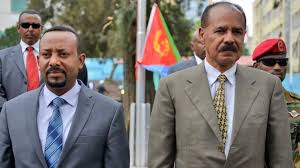

Ethiopia has accused neighbouring Eritrea of supporting armed groups in its northern regions, raising fears of renewed hostilities between the two Horn of Africa states whose relations have grown increasingly fragile in recent months.
In a letter addressed to United Nations Secretary-General António Guterres, Ethiopian Foreign Minister Gedion Timothewos alleged that Eritrea was “funding, mobilising and directing armed groups” in the Amhara region, where Ethiopian federal forces are battling local insurgents. He further claimed that Asmara was working in coordination with the Tigray People’s Liberation Front (TPLF), the former rebel group and opposition movement based in northern Ethiopia.
Eritrea has not yet issued a formal response to the allegations. However, the claims mark a significant escalation in diplomatic tensions, coming barely two years after the end of the devastating Tigray conflict, in which Eritrean troops fought alongside Ethiopian forces against the TPLF.
Relations between Addis Ababa and Asmara have deteriorated sharply in recent months, rekindling memories of their bloody 1998–2000 border war that left tens of thousands dead. Eritrea gained independence from Ethiopia in 1993 after a decades-long liberation struggle, taking control of the Red Sea coastline and leaving its landlocked neighbour without direct sea access.
In 2018, Ethiopian Prime Minister Abiy Ahmed and Eritrean President Isaias Afwerki signed a historic peace agreement, restoring diplomatic ties after nearly two decades of hostility. The rapprochement earned Abiy the Nobel Peace Prize the following year and was widely hailed as a turning point for regional stability. But the relationship has since soured amid Ethiopia’s renewed push to secure maritime access, which Asmara views as a potential threat to its sovereignty.
The latest accusations by Ethiopia’s top diplomat suggest a deepening mistrust between the two governments. Timothewos told the UN that Eritrea’s alleged actions were undermining Ethiopia’s internal security and violating international norms of non-interference. He urged the UN to take “appropriate measures” to prevent further escalation and protect Ethiopia’s sovereignty.
Tensions in Ethiopia’s Amhara region have intensified since mid-2023, when local militias known as Fano began clashing with federal forces over the government’s efforts to integrate regional fighters into the national army. The conflict has led to hundreds of deaths, mass displacement, and growing instability in one of Ethiopia’s most populous regions.
The TPLF, which governed Ethiopia for nearly three decades before Abiy came to power in 2018, has largely retreated from national politics following its defeat in the two-year civil war that ended with a peace deal in November 2022. However, Addis Ababa’s claim that Eritrea is now collaborating with the group would represent a remarkable reversal in alliances, given that Asmara and the TPLF were bitter enemies during the Tigray conflict.
Analysts say the accusation may also reflect Ethiopia’s anxiety over shifting regional dynamics. Abiy’s administration has increasingly emphasised the strategic importance of regaining direct access to the Red Sea — a goal that has unsettled Eritrea, Djibouti, and Somalia. In late 2023, Abiy declared that landlocked Ethiopia’s lack of a seaport was an “existential issue,” sparking speculation that the government might seek territorial concessions or new maritime arrangements.
Eritrea, in response, has warned against any attempt to “reopen colonial-era borders” or undermine its sovereignty. The two sides have exchanged veiled criticisms through state media, and diplomatic communication has reportedly grown tense.
Despite the escalating rhetoric, Foreign Minister Timothewos insisted that Ethiopia remains committed to resolving its disputes through peaceful means. “Ethiopia still hopes to settle its differences with Eritrea through dialogue and negotiation,” he said in his letter, reaffirming Addis Ababa’s preference for diplomacy over confrontation.
Observers note, however, that the situation could easily spiral if both governments fail to de-escalate. The Horn of Africa remains one of the world’s most volatile regions, where overlapping ethnic, political, and economic grievances often fuel protracted conflicts.
The UN has yet to publicly respond to Ethiopia’s complaint, but regional diplomats are likely to watch developments closely amid fears that a breakdown in relations between Addis Ababa and Asmara could destabilise an already fragile neighbourhood.
For now, both countries appear to be navigating a precarious balance — wary of war but trapped in a growing web of suspicion and competing national interests. Whether diplomacy can hold will determine if the peace forged seven years ago can survive the renewed strain of ambition, mistrust, and memory.