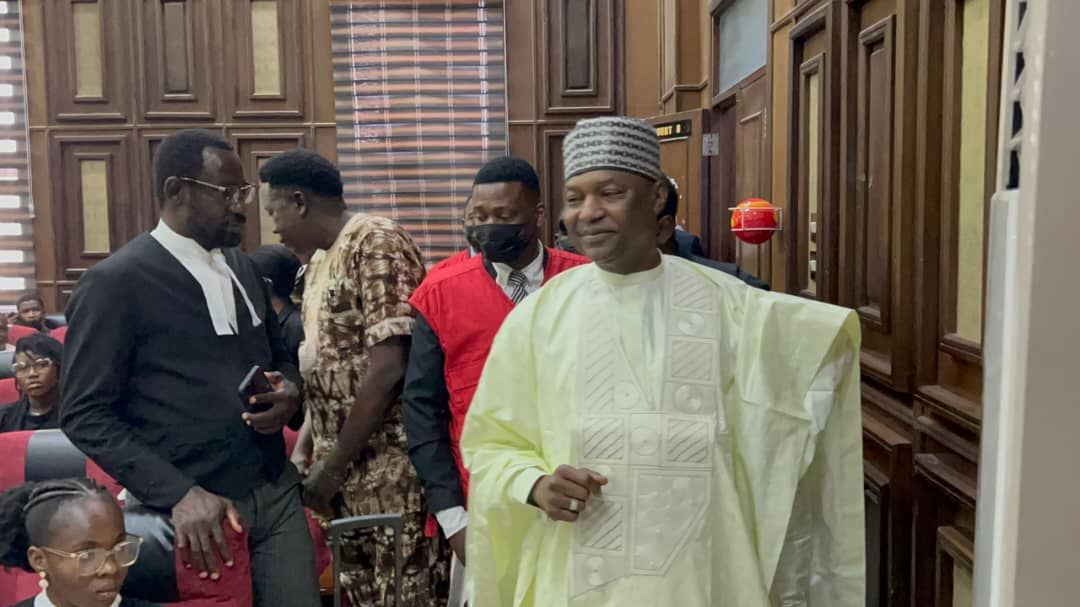

Abubakar Malami, the former Attorney-General of the Federation and Minister of Justice, alongside his wife, Bashir Asabe, and their son, Abubakar Malami, was arraigned on Tuesday before the Federal High Court in Maitama, Abuja. The Economic and Financial Crimes Commission (EFCC) has charged the trio with money laundering involving a staggering sum of N8.7 billion.
The defendants appeared before Justice Emeka Nwite to answer to a 16-count charge. The allegations center on conspiracy, procuring, disguising, concealing, and laundering the proceeds of unlawful activities, violations under the Money Laundering (Prevention and Prohibition) Act, 2022.
According to Dele Oyewale, the spokesperson for the EFCC, the total sum in question is N8,713,923,759.49. The anti-graft agency alleges that this amount was laundered through a complex web of corporate entities and bank accounts between 2022 and 2025.
Specific counts in the charge sheet detail how the funds were allegedly moved. One count accuses Malami and his son of using a company named Metropolitan Auto Tech Limited to conceal N1.014 billion in a Sterling Bank account between July 2022 and June 2025. The prosecution contends they “reasonably ought to have known” that these funds were proceeds of unlawful activities.
Another count alleges that in September 2024, Malami, his wife, and son conspired to disguise the origin of N1.049 billion paid through a Union Bank account belonging to Meethaq Hotels Limited in Jabi. Further allegations state that Malami and his son indirectly took control of another N1.36 billion paid into the same hotel’s savings account between November 2022 and October 2025.
During the proceedings, prosecuting counsel Ekele Iheanacho requested that the charges be read to the defendants, a move not opposed by the defense counsel, J.B. Daudu. Following the reading of the charges, the prosecution announced its readiness for trial.
A contention arose regarding bail. Iheanacho informed the court that the EFCC had received a written bail application from the defense just a day prior and requested time to respond properly. Conversely, Daudu attempted to secure bail through an oral application, arguing that the offenses were bailable and citing legal precedents to support his motion that a written application was not mandatory.
The prosecution vigorously opposed this oral application. Iheanacho argued that a case involving such grave economic crimes and complex financial networks required formal affidavit evidence, not just oral submissions. He emphasized that the “high office previously occupied by the first defendant does not entitle him to any preferential treatment” and that public interest must be paramount.
Justice Nwite sided with the prosecution on the procedural matter, ruling that the EFCC must be given adequate time to respond to the formal bail application. Consequently, the judge ordered that Malami, his wife, and his son be remanded at the Kuje Correctional Centre. The case has been adjourned to January 2, 2026, for a hearing on the bail application.
This arraignment marks a significant development in Nigeria’s anti-corruption efforts, placing a former high-ranking government official and his immediate family in the dock to answer for serious financial allegations. The adjournment to early 2026 sets the stage for what promises to be a closely watched legal battle.