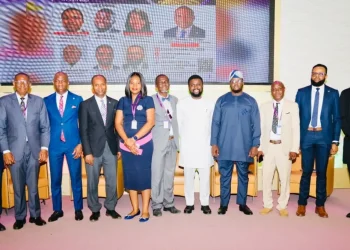

In a bold call to action, Tunji Olowolafe, Chancellor of Ekiti State University and Chairman of the Tunji Olowolafe Foundation, urged the government, private sector and academic institutions to join forces to accelerate Nigeria’s digital transformation. Speaking at the opening of the Digital Nigeria International Conference 2025 in Abuja, he said the nation can build a $1 trillion digital economy by 2030, if collaboration becomes the norm.
He emphasised that digital transformation is not a goal in itself, but the pathway to prosperity. Olowolafe pointed to the ICT sector’s growing significance, noting it already contributed over 11 % to Nigeria’s GDP in Q2 2025. Drawing inspiration from India’s digital infrastructure model, he highlighted the opportunity for Nigeria to replicate similar results through integrated ID systems, e-government platforms and broadband expansion.
The Chancellor reminded attendees that Africa’s innovation heritage is deep: “Our tribal marks were early biometric identifiers, and the talking drum was a form of analog communication that transmitted complex messages across distances.” He challenged Nigerian innovators to craft tech “by African minds, for African needs.”
At the event, Olowolafe acknowledged the efforts of the Nigeria Data Protection Commission, the Nigerian Communications Commission and the National Information Technology Development Agency (NITDA) for creating the regulatory scaffolding needed for this transformation. He also announced a blockchain-based tokenised credentials pilot, aimed at fighting certificate fraud in education, as evidence of concrete steps already underway.
Looking across industries, he cited examples: Nigeria’s digital health market (about $1.5 billion in size) is expanding via AI-powered kiosks and telemedicine. In agriculture, platforms like ThriveAgric are helping increase yields and incomes through data-driven solutions. On fintech, the emergence of unicorns such as Flutterwave, OPay and Moniepoint demonstrates Nigeria’s growing leadership in Africa’s financial-technology space.
Ultimately, Olowolafe issued what he described as a call to collaborative code, urging accelerate broadband access, invest aggressively in digital talent and infrastructure, and empower youth and academia to innovate. “When Nigerians invest in Nigeria; in data sovereignty, in daring partnerships, digital excellence will not be a conference; it will be our commonwealth,” he concluded.