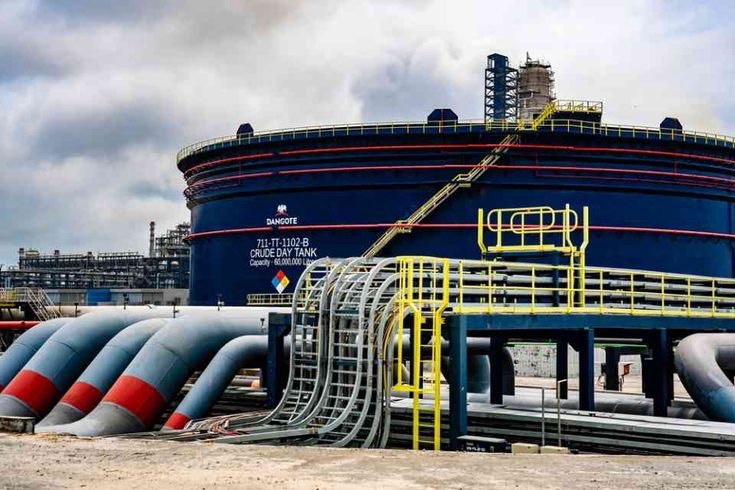

Nigeria’s downstream petroleum sector is facing renewed tension as Dangote Petroleum Refinery has returned to court to challenge the issuance of petrol import licences to several marketers and the Nigerian National Petroleum Company Limited.
The refinery believes the continued approval of fuel imports goes against the law and could negatively affect local refining operations. According to the company, the Petroleum Industry Act allows fuel importation only when local production cannot meet national demand.
The disagreement comes at a sensitive period when Nigerians are already struggling with rising fuel prices caused by instability in the global oil market. Industry stakeholders fear the dispute could further affect the country’s fuel supply system and create uncertainty in the sector.
Recently, the Nigerian Midstream and Downstream Petroleum Regulatory Authority approved licences for the importation of 720,000 metric tonnes of Premium Motor Spirit (PMS), also known as petrol. The licences were issued to companies including NIPCO, AA Rano, Matrix, Shafa, Pinnacle, and Bono Energy.
Under the approval, AA Rano and Matrix were each permitted to import 150,000 metric tonnes, while NIPCO, Shafa, and Pinnacle received approval for 120,000 metric tonnes each. Bono Energy was granted approval for 60,000 metric tonnes.
Dangote Refinery, in its fresh legal action, asked the court to cancel the import permits, arguing that they violated an earlier directive to maintain the status quo. The company also accused the Federal Government of disregarding a previous understanding reached during an earlier legal dispute.
The refinery had previously withdrawn a similar lawsuit after intervention from the Federal Government, but the latest approvals appear to have reignited the conflict.
Despite the import approvals, recent industry data released by the regulatory authority showed that the Dangote Refinery now supplies more than 90 percent of Nigeria’s daily petrol consumption. The report also revealed that fuel imports by marketers dropped significantly in April 2026.
According to the figures, Nigeria consumed about 51.1 million litres of petrol daily in April, an increase from 47.3 million litres recorded in March. However, fuel imports dropped from 5.9 million litres per day in March to 3.7 million litres per day in April.
Local refining output, largely driven by Dangote Refinery, reportedly supplied about 40.7 million litres daily during the same period, showing the growing strength of domestic refining capacity.
Reacting to the legal battle, the Petroleum Products Retail Outlets Owners Association of Nigeria (PETROAN) said competition must remain part of the downstream petroleum sector. Its National President, Dr. Billy Gillis-Harry, explained that while Dangote Refinery has the right to seek legal action, Nigeria must avoid creating a monopoly in the fuel market.
He praised the refinery for boosting local production and reducing dependence on imported fuel, but warned that allowing one operator to dominate the market could lead to unfair pricing and supply problems.
PETROAN stressed that healthy competition helps lower prices, improve fuel availability, encourage investment, and protect consumers from exploitation.
The Depot and Petroleum Products Marketers Association of Nigeria (DAPPMAN) also defended the import licences, insisting that they were legally issued under the Petroleum Industry Act to guarantee energy security and uninterrupted fuel supply.
According to the marketers, cancelling the licences could disrupt investments worth billions of naira already committed to storage facilities, depots, and logistics operations across the country.
However, the Jetties and Petroleum Tank Farm Owners of Nigeria (JETFON) backed Dangote Refinery’s position, arguing that Nigeria’s growing refining capacity can now satisfy local demand without relying on foreign imports.
The group urged the Federal Government to stop issuing import licences, saying continued fuel importation weakens local industries, puts pressure on the naira, and discourages investment in domestic refining.
Industry experts have advised all parties involved to resolve the matter peacefully and within the provisions of the law to avoid further instability in the petroleum sector.