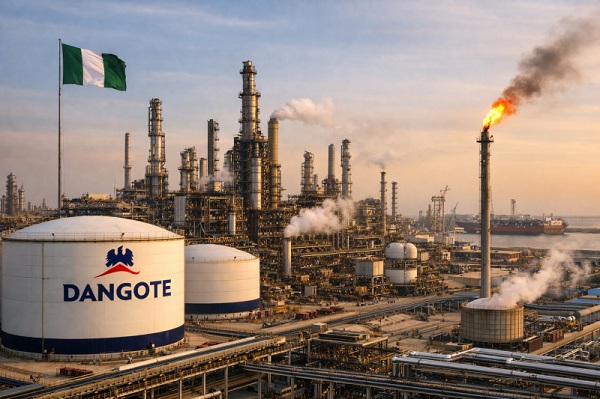

The Dangote Group is set to significantly expand its footprint in Africa’s downstream petroleum industry by targeting a combined refining capacity of 2.1 million barrels per day (mb/d), a move that would further strengthen its position as one of the continent’s largest refining operators.
The expansion strategy combines the group’s existing refining operations in Nigeria with a proposed 700,000 barrels-per-day refinery in Kenya. Once completed, the combined capacity would comprise 1.4 million barrels per day in Nigeria and an additional 700,000 barrels per day in Kenya, creating an integrated refining network serving both West and East African markets.
The planned investment reflects the company’s broader strategy of reducing Africa’s dependence on imported refined petroleum products while improving regional energy security. By establishing refining capacity closer to key consumption centres, Dangote aims to shorten supply chains, reduce transportation costs, and improve the availability of fuels across the continent.
Nigeria remains the cornerstone of the group’s refining ambitions, with its large-scale refining infrastructure designed to process crude oil into products including petrol, diesel, aviation fuel, and other petroleum derivatives. The proposed Kenyan refinery would complement these operations by serving rapidly growing demand in East Africa, where several countries continue to rely heavily on imported refined products.
Industry analysts say expanding refining capacity across Africa could help cushion the region from global fuel supply disruptions and volatile international refining margins. Increased domestic processing capacity may also support foreign exchange savings for importing nations while encouraging industrial development linked to petrochemicals and related manufacturing activities.
For Kenya, the proposed refinery could strengthen its role as a regional energy hub, supplying neighbouring countries and supporting economic integration within the East African region. Improved refining infrastructure may also enhance fuel supply reliability and reduce logistical bottlenecks that have periodically affected regional energy markets.
The planned expansion underscores a broader trend among African energy companies seeking to add value to the continent’s abundant crude oil resources through local refining rather than exporting crude and importing finished fuels. Such investments are increasingly viewed as critical to improving energy resilience, supporting industrialisation, and creating skilled employment across the value chain.
If executed as planned, Dangote’s combined refining capacity of 2.1 million barrels per day would represent one of the largest integrated refining platforms in Africa, reinforcing the company’s long-term strategy of becoming a leading supplier of refined petroleum products across multiple regional markets while supporting the continent’s drive toward greater energy self-sufficiency.