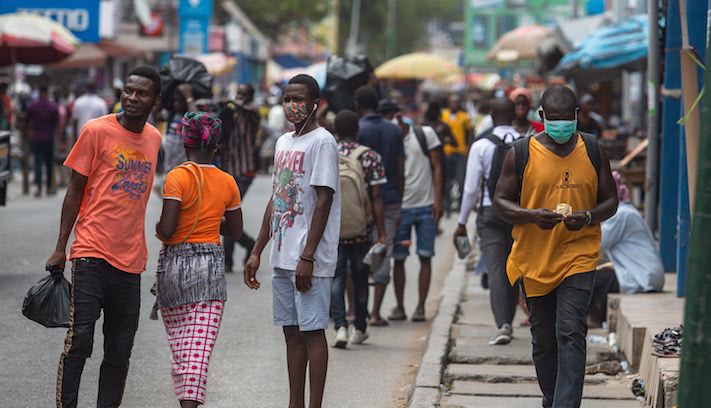

Nigeria’s latest inflation figures are exposing a problem that goes beyond rising food prices: for many households, there is simply too little room between income and essential spending to absorb another financial shock.
The National Bureau of Statistics (NBS), in its Consumer Price Index report released on 17 August 2026, said headline inflation eased to 15.43% year-on-year in July 2026, from 15.91% in June. But food inflation moved in the opposite direction, rising sharply to 20.31% year-on-year, compared with 17.52% in June. On a month-on-month basis, food inflation jumped to 5.56% from 3.75%.
For households, that distinction matters. A slower overall inflation rate does not necessarily mean food has become cheaper. It means prices are rising at a slower rate than before. In July, the cost of food was still increasing rapidly, putting pressure on the part of household budgets that cannot easily be cut.
That pressure is occurring alongside a significant rise in household borrowing.
Data attributed to the Institute of International Finance (IIF) showed that Nigerian household debt reached $38.7 billion by April 2025, equivalent to about 20.4% of GDP. The figure was described as the highest level in two decades and exceeded the combined debt of Nigeria’s financial and non-financial corporations.
The numbers suggest that borrowing is increasingly becoming part of how households manage financial shortfalls. But borrowing can only provide temporary relief if income does not eventually catch up with expenses.
The PiggyVest Savings Report 2025, based on responses from more than 26,000 Nigerians across the six geopolitical zones and published in 2026, illustrates the scale of that pressure. The survey found that 28% of respondents reported having no income, while another 30% earned below ₦100,000 a month. It also found that 68% relied on a single income source.
The savings picture was equally troubling. According to the report, 53% of respondents said they did not save, while only 40% saved monthly and another 7% saved occasionally. Six in 10 said they had no emergency savings, while only 6% described themselves as secure and content with their financial situation.
Yet the same survey provides an important qualification to the debate about borrowing. Among respondents who reported being in debt, business needs were the most common reason for seeking lenders, accounting for 35%, followed by major expenses at 27% and financial emergencies at 24%.
That means not every loan represents reckless consumption. Some borrowing is an attempt to generate income or deal with unavoidable expenses. The problem arises when borrowing becomes the regular mechanism for paying ordinary household bills.
Financial recovery therefore has to begin with cash flow.
Households should first establish what comes in each month and separate essential expenses from spending that can be delayed or reduced. Where debt exists, high-cost loans should receive priority, while taking a new loan simply to service an old one should generally be avoided unless the new arrangement genuinely reduces the cost or improves repayment terms.
The second priority is an emergency buffer. It does not have to start at several months of expenses. Even a small reserve can help prevent an unexpected medical bill, rent demand, school expense or business setback from immediately becoming another loan.
The third is income resilience. With 68% of PiggyVest’s respondents relying on one income source, developing a second, realistic source of earnings could provide protection when the primary income is disrupted.
This does not mean every Nigerian household needs another job or side hustle. It means households need to understand how vulnerable their finances are when one income source is responsible for almost everything.
Nigeria’s July 2026 inflation data makes the challenge clear. Headline inflation is easing, but food inflation is rising sharply. Household debt is already substantial, while savings and emergency buffers remain weak.
Financial recovery, therefore, is not about becoming wealthy overnight. It is about creating enough breathing room to ensure that the next unexpected expense does not automatically become the next loan.