


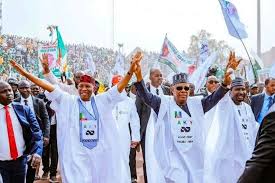

The All Progressives Congress (APC) has secured a significant legislative victory in Kano State, sweeping two vacant seats in the House of Assembly following by-elections held on Saturday, February 21, 2026. The Independent National Electoral Commission (INEC) declared Aliyu Nabil Daneji and Aminu Sa’ad Sa’ad winners for the Kano Municipal and Ungogo constituencies, respectively. This double victory marks a strategic consolidation of power for the APC in a state characterized by intense partisan rivalry.
The political consequence of this sweep is the fortification of the APC’s presence in the 10th Kano State House of Assembly. In Kano Municipal, Returning Officer Prof. Ibrahim Tajo Siraj announced that Daneji polled 7,484 votes, comfortably outpacing eight other contenders. Meanwhile, in Ungogo, Prof. Ali Tijjani Abdullahi declared Aminu Sa’ad Sa’ad the winner with 8,975 votes. For the APC, these results provide a critical morale boost and legislative leverage as the party navigates a shifting political landscape following recent high-profile defections within the state’s leadership.
Analytically, the elections were defined by two contrasting themes: security success and voter apathy. While Prof. Siraj and Prof. Abdullahi both commended security agencies for a “smooth and orderly” process, the exercise was shadowed by a noticeably low voter turnout. Electoral officials attributed this apathy to “political fatigue” a sentiment likely exacerbated by the absence of major opposition parties on the ballot in some areas. Despite the technical success of the Bimodal Voter Accreditation System (BVAS), the low participation suggests a growing disconnect between the grassroots electorate and the legislative process.
The impact on “Legislative Dynamics” is a vital dimension of these results. With Daneji and Sa’ad Sa’ad joining the Assembly, the APC has strengthened its hand in a chamber where the New Nigeria People’s Party (NNPP) has historically held significant influence. Daneji, in his post-election remarks, pledged to justify the confidence of his constituents, while party supporters celebrated the outcome as a “show of strength” ahead of the broader 2027 electoral cycle. The peaceful conduct of the polls, even with low turnout, provides a positive data point for INEC as it tests its 2026 operational frameworks.
Furthermore, the victory in Ungogo is particularly noteworthy as Aminu Sa’ad Sa’ad successfully navigated a multi-candidate field to reclaim a seat that has been at the center of local political maneuvering. The cooperation of observers and party agents during the collation process helped mitigate potential disputes, allowing for a swift declaration of results. This transparency is seen as a necessary step in restoring voter confidence in the FCT and state-level by-elections held concurrently across the country.
The long-term outlook for Kano’s assembly hinges on how these new members integrate into the current legislative agenda. As the state deals with significant shifts in party loyalty among its top executives, the APC’s increased numbers in the House could play a decisive role in future policy debates and oversight functions. For now, the successful conclusion of the Kano by-elections underscores the APC’s resilience in its northern stronghold, even as it grapples with the challenge of re-engaging an increasingly indifferent electorate.


