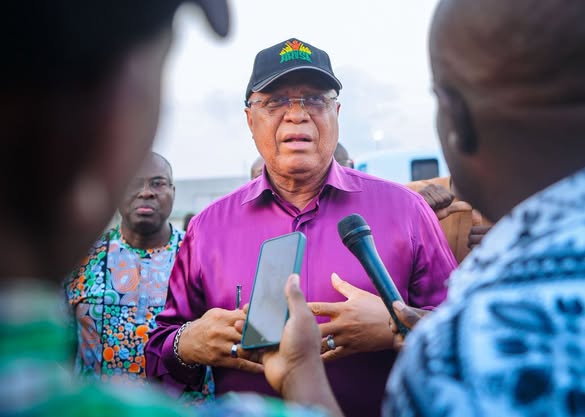

Governor Umo Eno of Akwa Ibom has reaffirmed his administration’s commitment to deepening reforms and attracting investment in the power and maritime sectors, positioning these industries as central pillars of the state’s economic development strategy. Speaking on Saturday at the Victor Attah International Airport upon his return from the United Kingdom, where he accompanied President Bola Tinubu on a State visit, the governor disclosed that the trip provided opportunities to engage with investors, particularly in the power sector, and assured residents of positive outcomes from the discussions.
The governor’s focus on power and maritime infrastructure reflects a strategic approach to economic diversification that leverages Akwa Ibom’s natural advantages. With a coastline along the Gulf of Guinea and significant hydrocarbon resources, the state has long been positioned as a potential hub for industrial and logistics activity. The Ibom Deep Seaport project, a long-envisioned initiative designed to create a modern, deep-water port capable of handling large-scale cargo and competing with regional maritime gateways, remains a flagship priority for the administration. Eno noted that the state had completed payment for feasibility studies, signalling progress in the project’s development timeline.
In the power sector, the governor acknowledged the challenges facing the national grid but expressed confidence in the state’s reform efforts. “We have made giant strides in reforming the power sector, but it takes a while; it is not a walk in the park,” he said, urging patience as the administration works through technical and regulatory processes. The emphasis on power aligns with broader federal objectives under the “Renewed Hope” agenda, which has prioritised energy access as a critical enabler of industrial growth and household welfare.
The governor’s remarks also underscored the importance of process discipline in large-scale infrastructure development. “Things don’t happen overnight, but we have good engagements, and people are showing interest,” Eno said, addressing the public’s enthusiasm for the seaport project while emphasising the need to follow due process. His comments reflect a recognition that infrastructure of this magnitude requires sustained coordination among federal and state agencies, private investors, and multilateral development partners.
From an investment climate perspective, Akwa Ibom’s pursuit of maritime and power sector development sends a signal to domestic and international investors about the state’s commitment to creating enabling conditions for capital deployment. The Ibom Deep Seaport, if realised, would not only serve the state’s industrial ambitions but also relieve pressure on existing ports in Lagos and provide a strategic gateway for the South-South and South-East regions. Similarly, investments in power generation and distribution could reduce reliance on the national grid, offering reliable electricity to industries and households—a critical factor in business location decisions.
The governor’s participation in the presidential delegation to the UK also highlights the role of subnational governments in attracting foreign direct investment. While federal-level engagements set the framework for bilateral economic relations, state-level follow-through is essential for translating high-level commitments into concrete projects. Eno’s direct engagement with investors during the trip suggests an approach that combines federal alignment with state-specific execution capacity.
For Akwa Ibom residents, the administration’s emphasis on infrastructure reform addresses longstanding aspirations for economic transformation. The state has significant oil and gas resources, but has also faced challenges in translating resource wealth into diversified economic growth. Investments in maritime and power infrastructure represent efforts to build the foundational assets that can support manufacturing, logistics, and services sectors beyond extractive industries.
As the administration moves forward with feasibility studies, investor engagements, and regulatory coordination, the pace of implementation will be closely watched. The governor’s call for patience reflects the reality that complex infrastructure projects require time, capital, and sustained political will. However, for a state that has consistently articulated an ambitious economic vision, the coming years will test the capacity to translate planning into operational reality.