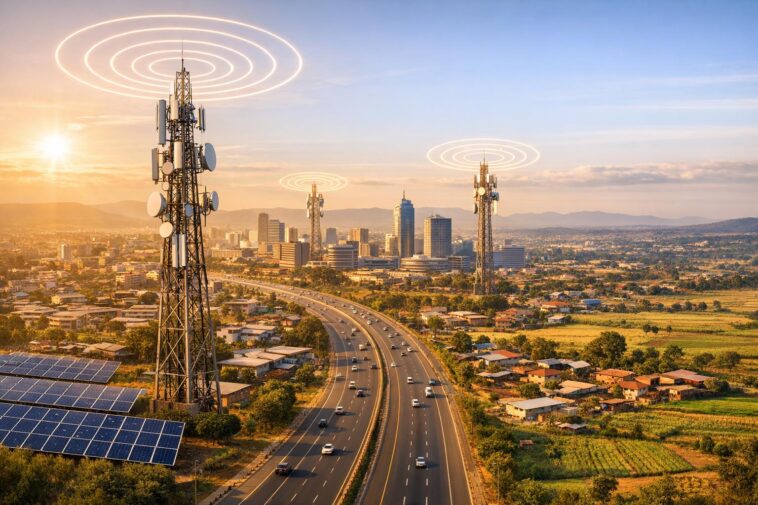

Africa’s digital landscape is undergoing a profound transformation as the rollout of fifth-generation (5G) wireless technology accelerates across the continent. According to the latest data from GSMA Intelligence, a significant milestone was reached by the end of 2025, with 53 operators across 29 African markets having launched commercial 5G services. This expansion signals a pivotal shift in connectivity, positioning the continent to bridge the digital divide and foster a robust digital economy.
Rapid Expansion and Market Leaders
The momentum is far from slowing down. While nearly 30 countries have already activated 5G networks, an additional 14 markets have committed to launching their own networks in 2026 and beyond. This surge in deployment is largely driven by skyrocketing data demand and the implementation of more supportive policy frameworks by regional governments.
North Africa currently leads the charge, spearheaded by Egypt’s aggressive spectrum strategy. In 2024, Egypt generated over $700 million through 3.5 GHz spectrum auctions, enabling major players like Telecom Egypt, Vodafone, Orange, and Etisalat Misr to drive urban commercial deployments. Meanwhile, in Sub-Saharan Africa, a “4G-first” approach remains common, with nations like Kenya and Tanzania leveraging technology-neutral policies to repurpose existing spectrum for 5G use.
The Nigerian Landscape and Strategic Innovation
Nigeria remains a critical focal point for the continent’s 5G ambitions. Despite the economic hurdles and the high cost of infrastructure, major operators like MTN Nigeria and Airtel have prioritized expansion. MTN Nigeria, an early mover in the space, has deployed over 2,100 5G sites as part of a broader $3.5 billion investment plan.
A key development in the Nigerian market is the shift toward unlimited data offerings to satisfy consumer demand. Egerton Idehen, Chief Broadband Officer at MTN Nigeria, noted that these new unlimited 5G broadband plans are designed to provide the high-speed infrastructure necessary to support Nigeria’s digital evolution, allowing customers to “stay limitless” without the constraints of data caps.
Fixed Wireless Access: The New Frontier
One of the most promising avenues for 5G in Africa is Fixed Wireless Access (FWA). Of the 53 operators currently live, 25 have deployed 5G FWA services. This technology is proving essential for providing high-speed broadband to suburban and rural areas where laying fiber optic cables is prohibitively expensive or geographically challenging. By bypassing traditional infrastructure gaps, FWA is bringing reliable internet to underserved communities and small businesses.
Challenges on the Horizon
Despite the progress, significant barriers remain. By the end of 2025, Africa accounted for approximately 54 million 5G connections—just 3.8% of total mobile subscriptions. Penetration continues to lag behind global averages due to two primary factors: spectrum availability and device affordability.
Only about 30% of African nations had officially allocated 5G spectrum by mid-2025, compared to over 90% in Europe. Furthermore, the cost of 5G-enabled smartphones remains a hurdle. While prices are dropping, many devices still range from $75 to over $1,000, remaining out of reach for a large portion of the population. However, the anticipated arrival of sub-$100 5G smartphones later this decade is expected to trigger a massive wave of adoption.
Economic Impact and Future Outlook
The stakes are high for Africa’s economic future. GSMA forecasts that 5G will contribute an estimated $10 billion to the continent’s economy by 2030. Beyond faster streaming, 5G is expected to revolutionize sectors such as fintech through secure network slicing, telemedicine in healthcare, and precision agriculture via the Internet of Things (IoT). As more markets gear up for 2026, 5G is set to become the backbone of a digital economy projected to contribute $712 billion to Africa’s GDP by mid-century.