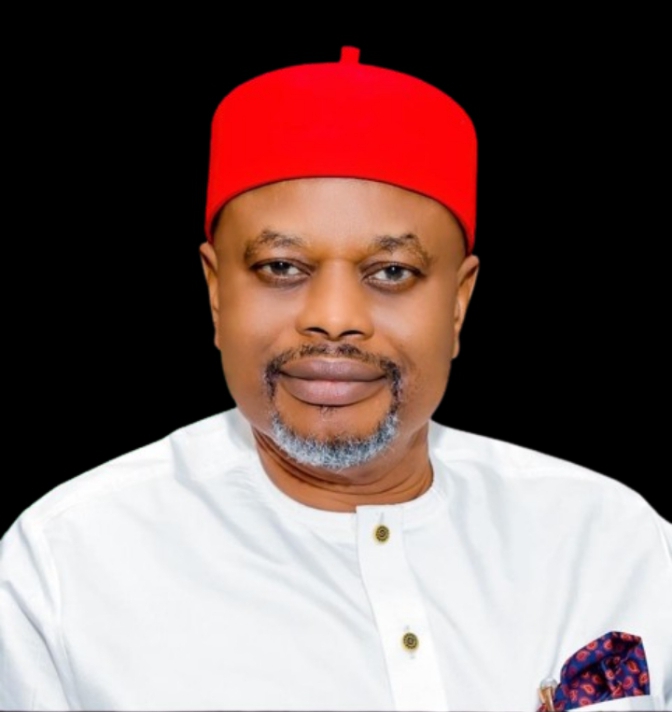

Uche Nnaji, the current Minister of Science and Technology, has formally acknowledged in court documents that the University of Nigeria, Nsukka (UNN) “never issued” him a degree certificate, validating earlier claims that his academic credentials may have been forged.
From the start of his nomination in July 2023, sharp questions surrounded Nnaji’s educational background. His academic and NYSC documents were immediately challenged as possibly forged. But until now, the Minister had not publicly responded. His recent admission comes via his lawsuit in the Federal High Court in Abuja, where he sued the Minister of Education, the National Universities Commission, UNN, and several university officials, including Vice‑Chancellor Simon Ortuanya and Registrar Oguenjiofor Ujam.
In the suit, Nnaji asked the court to restrain the university from “tampering with” or releasing details of his academic record, and to compel UNN and the regulatory authorities to produce his full transcript. He also sought an injunction to prevent the university from acting on his records until the court decided the matter. While the court granted some of his requests, it declined to bar UNN from releasing information. The case is now adjourned to October 6 for further proceedings.
The minister’s most damning revelation appears in his affidavit, specifically paragraphs 12 and 13 of a 34‑paragraph statement. There, Nnaji states that although he was admitted in 1981 to study Microbiology/Biochemistry and completed the program in 1985, UNN never issued him a certificate. He blamed this on what he called the “non‑cooperative attitude” of university officials.
UNN previously issued a letter in December 2023 confirming that Nnaji was a student who “graduated” in 1985 with a Second Class (Lower Division) degree. However, that letter did not constitute the physical certificate itself—a distinction the Minister’s court filing reinforces.
By admitting that the university never issued him a certificate, Nnaji has, in effect, confirmed allegations of forgery originally raised by critics and investigative media. His admission could expose him to legal consequences under Nigerian law, which bars the submission of fraudulent documents in public office appointments.
Across Nigeria, the admission has reignited public outrage and renewed debates over vetting and accountability for public officials. Civil society groups have demanded an immediate investigation and possible suspension, while opposition figures accuse the administration of negligence in allowing a minister with questionable credentials to hold high office, especially in a ministry tied to science, research, and academic integrity.
As the court proceedings move forward, all eyes are on whether UNN will be compelled to release full records, and whether those official documents will corroborate or contradict Nnaji’s statements. The outcome may have broader implications for trust in governmental appointments and the integrity of public service.