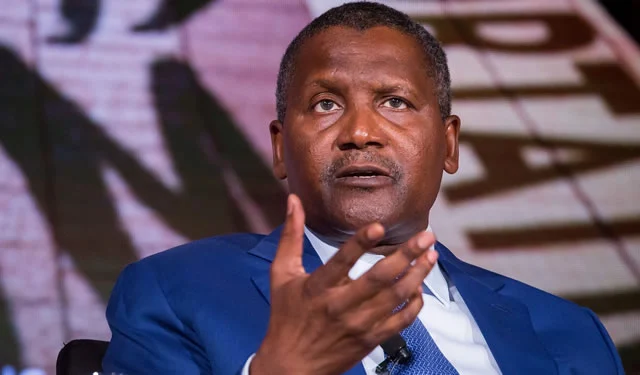

Aliko Dangote, President of Dangote Industries Limited, has issued a powerful call to action for African entrepreneurs and the private sector, outlining a transformative strategy designed to accelerate the continent’s industrial development and economic independence. Speaking to a delegation of global CEOs, Africa’s richest man emphasized that the era of relying solely on foreign intervention or government initiatives must give way to a bold, indigenous-led industrial revolution.
At the heart of Dangote’s strategy is a shift in mindset. He asserted that the primary barrier to Africa’s growth is not a lack of resources, but a historical hesitation to “think big.” Citing the successful completion of the Dangote Petroleum Refinery—the world’s largest single-train refinery—as a case study, he noted that the project was born out of a refusal to be intimidated by scale. “If you think small, you don’t grow; if you think big, you grow,” Dangote remarked, urging leaders to pursue projects that solve foundational problems rather than settling for marginal gains.
The refinery serves as more than just an industrial asset; it is a symbol of African capability. Dangote explained that overcoming the immense logistical and economic challenges of such a project has emboldened his group to target even more ambitious goals. He believes that if one African entity can achieve world-class industrial milestones, the blueprint can be replicated across sectors like agriculture, mining, and technology to create a self-sustaining ecosystem.
A cornerstone of Dangote’s new roadmap is the retention of African capital within the continent. He criticized the trend of wealthy Africans moving their assets to offshore accounts, arguing that such actions signal a lack of confidence that deters foreign direct investment. “We, as Africans, must stop taking our money abroad,” he insisted. “If we don’t show confidence in our own economies and leadership, foreign investors certainly won’t.”
By reinvesting profits locally, African businesses can address the continent’s most pressing challenge: job creation for a rapidly expanding youth population. Dangote highlighted that the disparity between population growth and employment opportunities is a ticking time bomb that only massive industrialization can defuse.
Dangote identified three critical pillars for Africa’s future: a strong banking sector, a robust manufacturing base, and a thriving agricultural sector. He advocated for a move away from the export of raw materials, which leaves Africa vulnerable to global price shocks and robs the continent of value-added profits. Instead, he proposed a focus on “backward integration”—the process of controlling the entire supply chain from raw materials to finished products.
This strategy is already being implemented within his conglomerate. For instance, Dangote Sugar Refinery is undergoing a $700 million expansion to boost local production, a move supported by Group Executive Director Fatima Aliko-Dangote. She noted that this expansion is vital for strengthening Nigeria’s industrial base and supporting small businesses that rely on local manufacturing.
Ultimately, Dangote’s strategy envisions Africa as a single, integrated market. By embracing the African Continental Free Trade Area (AfCFTA) and viewing the continent as a borderless entity, businesses can achieve the scale necessary to compete globally. He encouraged the visiting CEOs to remain ambitious despite policy inconsistencies or infrastructural hurdles, reminding them that the responsibility to build Africa rests squarely on the shoulders of its people. “It is better to try and fail than never to try at all,” he concluded, reinforcing the message that action is the only path to progress.