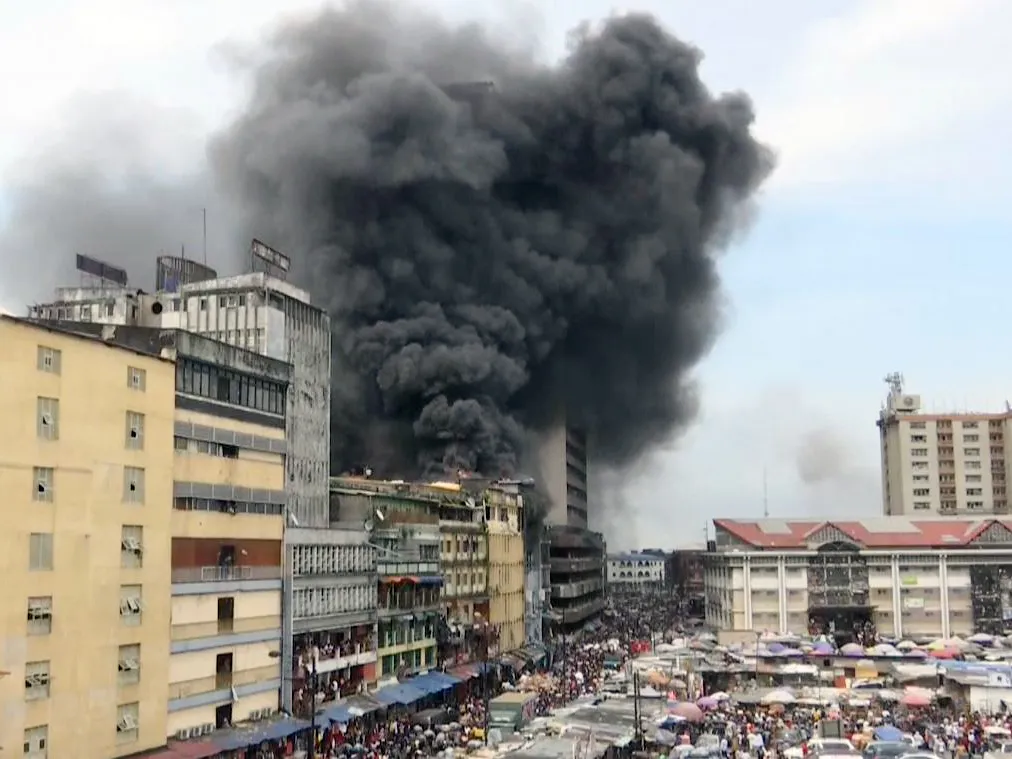

In the dense, vibrant heart of Lagos, a 103-year-old woman perishes in a blaze on Bola Street, Oyingbo. Her death, a profound personal tragedy, is not an anomaly but a data point in a grim statistical trend. On Christmas Eve 2025, triplets known as the “Mr. Classic” brothers—their lives and business inseparable—are consumed in the inferno of the 25-storey GNI Building. Their story, whispered by a fellow trader named Jennifer, echoes the collective dread of a city perpetually on the brink. These incidents, separated by geography and scale, are threads in the same burning fabric: Lagos is grappling with a fire epidemic that is eroding its economic foundations and scarring its social soul.
The numbers tell a story of alarming escalation. Data from the Lagos State Fire and Rescue Service reveals a system under siege. In 2025 alone, 1,685 fire incidents claimed 133 lives and incinerated an estimated ₦19.72 billion in property. This is not a sporadic crisis but a chronic condition. The trajectory from 2018’s catastrophic Otedola Bridge tanker fire, which killed 12 and melted 54 vehicles, to the back-to-back high-rise disasters of 2024 and 2025, shows a pattern of increasing frequency, complexity, and cost. Each annual report from the Fire Service, while a testament to the responders’ grueling work, reads as a deeper indictment of systemic failure. As Margaret Adeseye, the Controller-General, notes with strained resolve, “Our people remain our greatest asset; preparedness is the backbone… but false distress calls continue to strain our resources.” Her statement hints at a reality where the system is not only fighting fires but also battling misuse and overwhelming demand.
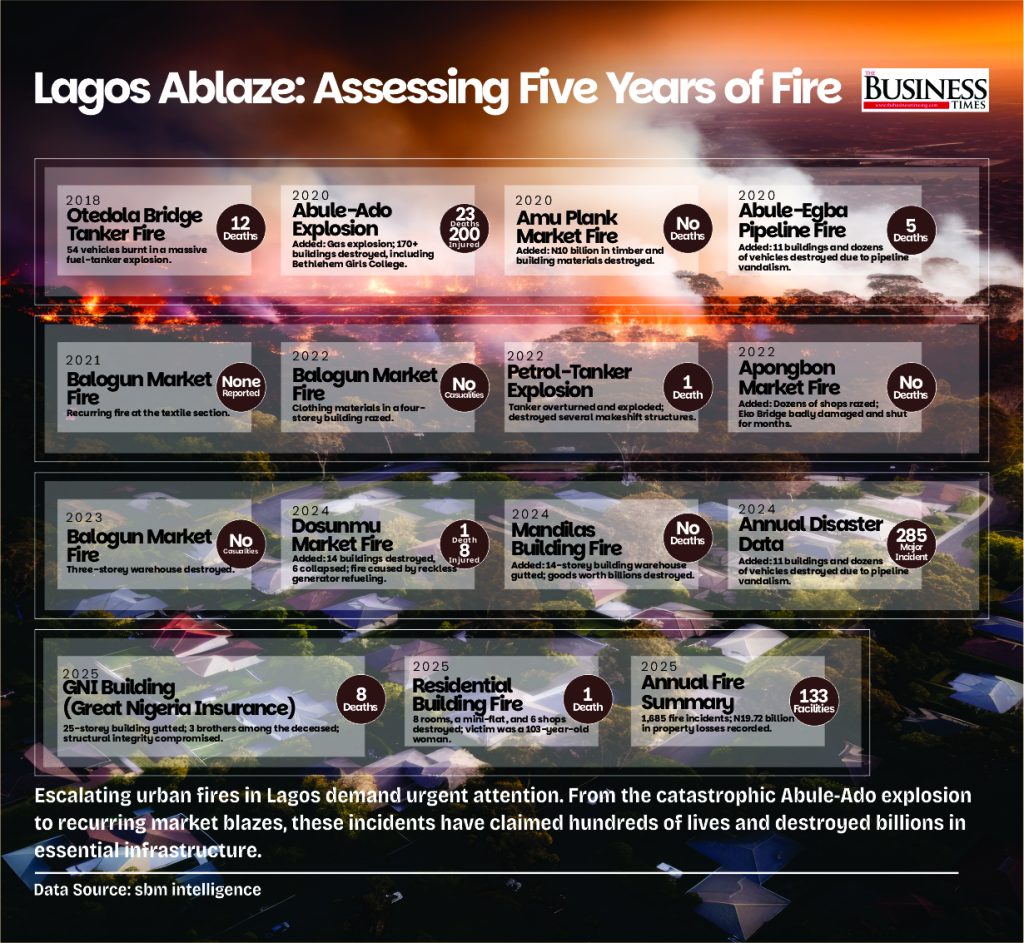
The economic impact operates on a devastating dual track, ravaging both the micro-economy of survival and the macro-economy of national commerce. For the vast informal sector—the lifeblood of Lagos—a fire means total erasure. Ebuka Azu, a trader who survived the Mandilas Building fire, captures this desolation: “I am short of words… I have lost millions. Only the educated traders insured theirs; the rest of us lost everything.” This loss is not merely of inventory but of generational capital, pushing families from subsistence into destitution. The fires at Amu Plank Market (2020, ₦10 billion in timber lost) and countless other informal hubs are not news items but economic mass extinctions.
Simultaneously, these fires strike at the commanding heights of Lagos’ economy. The GNI and Mandilas buildings are not just structures; they are nodes in the commercial network of West Africa. Gutting them disrupts supply chains, paralyzes banking and luxury goods sectors, and shatters investor confidence. Alhaja Adeniji Rashidat, the Iyaloja of Mandilas Market, expressed a helplessness felt by many: “The situation is beyond our expectations, it’s beyond what we can handle.” Furthermore, infrastructure fires have cascading costs. The 2022 Apongbon Market fire under the Eko Bridge did not just destroy shops; it crippled a critical transport artery for months, imposing a hidden tax of congestion and delayed goods on the entire metropolis. The economic narrative of Lagos as a “city of excellence” and “Africa’s premier investment destination” is persistently undermined by the specter of preventable ruin.
Beneath the economic statistics lies a deeper social pathology—a normalization of risk borne out of neglect and inequality. The comments from survivors and witnesses paint a vivid picture of a city living on a razor’s edge. Mary Okonkwo, a regular buyer at Mandilas, describes an environment of palpable danger: “You see wires hanging loosely… I always feared this would happen. You would see 10 people pulling from one small cable.” This is the reality in many markets and residential areas: aging electrical grids overloaded by the demands of a growing population, exacerbated by ubiquitous generator use. The 2024 Dosunmu Market fire, triggered by reckless generator refueling, which killed one and collapsed six buildings, is a textbook example of this endemic hazard.
The human cost is measured in more than fatalities. It is measured in the trauma of survivors like Femi Lawal, who lived through the Otedola Bridge blast: “The first explosion took me somewhere else, I couldn’t move anymore… I was vibrating on the ground.” It is measured in the loss of community heritage, as seen in the Abule-Ado explosion of 2020 that killed 23 and flattened a girls’ school along with 170 homes. It is measured in the vulnerability of the elderly, like the centenarian in Oyingbo, trapped in the “mixed-use” fire traps that define much of Lagos’ housing. The social contract is frayed when citizens, from market leaders to civil servants, feel the systems designed to protect them are failing. Boladele Dapo-Thomas, Chairman of the Lagos State Civil Service Commission, implicitly acknowledges this crisis in institutional ethos, stressing that “Discipline and empathy are essential for effective service delivery… particularly in the fire and rescue service.”
Compounding the physical vulnerability is the often-cited issue of response. Ibitayo Adenike of NEMA points to a critical delay factor: “It was alleged that the people around did not notice the fire until it was too late before fire service was contacted.” This speaks to a potential gap in public awareness and early warning, but also to the formidable challenges of access in Lagos’ notoriously clogged and informal landscapes. Even the most disciplined and empathetic service can be thwarted by streets inaccessible to fire trucks, a lack of functional hydrants, and the sheer vertical challenge of skyscraper fires for which the infrastructure was never designed.
The path forward demands a paradigm shift. Lagos must transition from a firefighting posture to a fire-preventing society. This requires moving beyond commendable annual data compilation to actionable, enforced regulation. Stricter and consistently enforced building codes, especially for high-rises and mixed-use developments, are non-negotiable. Public safety campaigns must move beyond posters to community-driven drills and education on electrical safety and early reporting. Investment in the Fire Service must be strategic—not just in trucks, but in modern equipment for high-rise rescue, digital dispatch systems, and the welfare of the personnel who bear this relentless burden.
Ultimately, the story of Lagos’ fires is the story of Lagos itself: a city of immense energy and entrepreneurial spirit, grappling with the contradictions of rapid, unplanned growth. The ashes of Otedola, Abule-Ado, Mandilas, and GNI are a stark audit. They reveal the cost of overlooked wiring, of marginalized planning, and of a resilience that has been romanticized when it should be rendered obsolete by safety. To honor the memory of the 103-year-old woman, the triplet brothers, the FIRS staff, and the hundreds of other victims, Lagos must choose to build not just taller, but smarter. The true measure of a megacity’s excellence is not how spectacularly it rises from the ashes, but how diligently it ensures its people never have to face them. The economic future and social fabric of Africa’s largest city depend on this critical ignition of political will and systemic change.