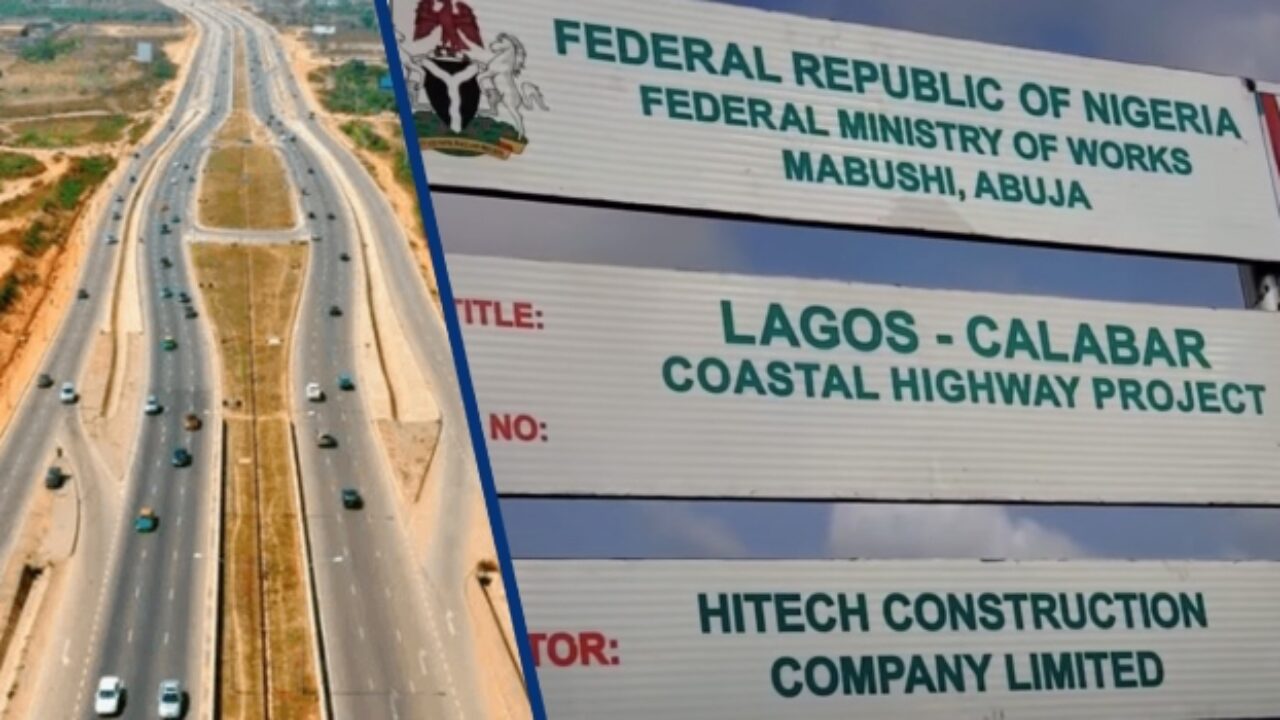

The Federal Government has clarified concerns surrounding the apparent absence of railway tracks along sections of the Lagos–Calabar Coastal Highway, explaining that the rail component remains part of the project’s design but could not be accommodated in some densely developed areas.
The clarification follows public debate sparked by videos circulating online that showed completed and ongoing sections of the highway without a visible rail corridor, particularly around Victoria Island and the Lekki axis in Lagos.
The 700-kilometre Lagos–Calabar Coastal Highway, which began construction in 2024, is one of the government’s flagship infrastructure projects aimed at improving connectivity, trade, and tourism along Nigeria’s southern coastline. The Minister of Works, David Umahi, had earlier stated that the highway would integrate a railway line within its median to support multimodal transport.
However, reacting to the concerns, the Federal Controller of Works in Lagos State, Olufemi Dare, explained that land constraints informed the design variation along the Lagos section.
According to Dare, the railway line is fully captured in the project design. Still, it cannot be implemented along the first nine kilometres of the highway due to the heavily built-up nature of the corridor.
He said the stretch from Chainage Zero at Eko Atlantic through Victoria Island to the Jakande area in Lekki lacks sufficient land to accommodate both the highway and a rail line. As a result, only the road infrastructure could be constructed in that area.
Dare explained that beyond the Jakande axis, the project design provides adequate space for the railway. From Chainage Nine onwards, a central median of about 20 metres has been reserved specifically for the rail line, which will run through the remainder of the highway. He added that a railway station is also planned around the Jakande area.
He stressed that the Lagos alignment’s first nine kilometres are the only section without provision for rail infrastructure, noting that sufficient land becomes available further along the corridor.
While declining to comment on design details at the Calabar end of the project, Dare said his explanation was limited to the Lagos section under his supervision.
The Lagos–Calabar Coastal Highway is expected to link several coastal states, including Lagos, Ogun, Ondo, Delta, Edo, and Cross River. The project continues to attract attention over its economic potential, cost implications, environmental impact, and engineering design.