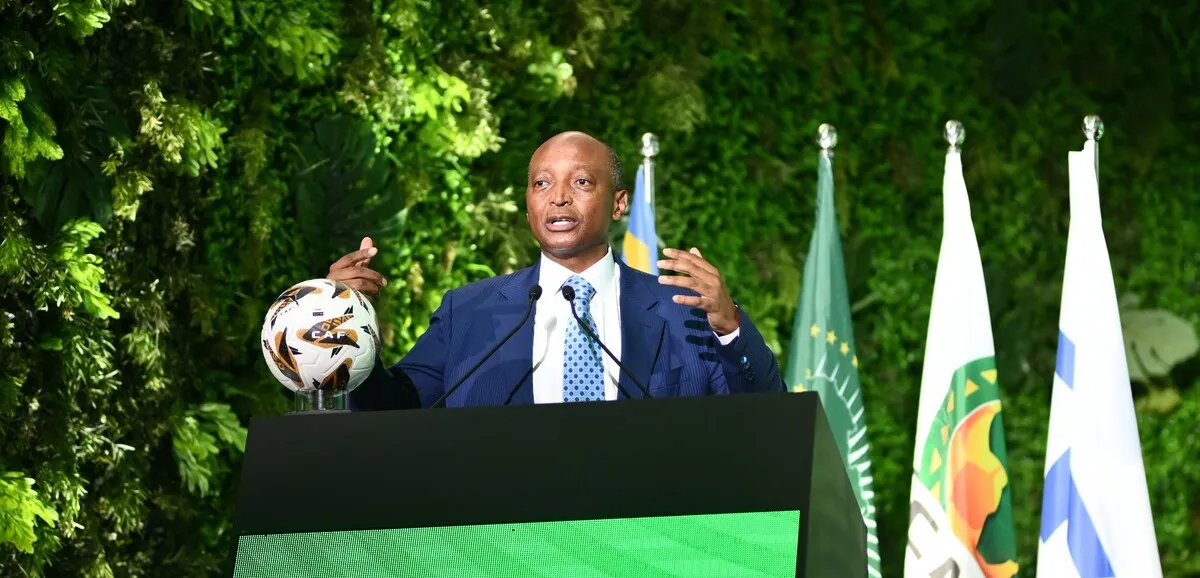

The heartbeat of African football is slowing. In a landmark announcement, Confederation of African Football (CAF) President Patrice Motsepe confirmed the Africa Cup of Nations (AFCON) will shift to a four-year cycle after the 2027 edition, ending its decades-long biennial rhythm. Framed as a modernization to “harmonize” with the global calendar, this seismic decision is seen by many as a capitulation to external pressure, triggering a wave of concern over the continent’s sporting sovereignty, economic stability, and developmental future.
A Sovereignty Surrendered?
The announcement bore the unmistakable imprint of external influence. For years, European clubs have lamented the mid-season departure of stars like Mohamed Salah and Victor Osimhen. The optics of the press conference, as noted by journalist Ed Dove, solidified the narrative: Motsepe delivered the news seated beside FIFA Secretary General Mathias Grafström. Motsepe admitted he was initially opposed but swayed by financial arguments.
This dynamic has sparked fierce criticism over CAF’s autonomy. “This is not a CAF decision; let’s be honest, it is a FIFA decision,” asserted veteran sports administrator Ayodeji (Deji) Adegbenro. “These days, CAF basically runs like a department of FIFA. [Gianni] Infantino says jump, and CAF says ‘how high?’”
His sentiment is echoed across the analyst community. Journalist Osasu Obayiuwana lamented, “On 20th December 2025, Infantino got his way… I weep for Africa.” Columnist Solace Chukwu offered a withering assessment of CAF’s internal process, describing its Executive Committee as a “toothless rubber stamp” for “Infantino’s vassals,” and arguing the decision was reached with “minimal consultation.”
The Precarious Financial Equation
The shift rolls the dice with CAF’s financial bedrock. AFCON historically generates around 80% of the confederation’s revenue. Halving its frequency creates a potential “revenue black hole.”
CAF’s proposed solution is the “African Nations League,” launching in 2029. Motsepe promises it will provide “financial resources every year,” but when pressed for specifics, could only call it a “good trade-off.” Analysts are deeply skeptical. ESPN’s Kirk warned the format, even in its successful UEFA incarnation, has mixed appeal and may struggle for lucrative media rights in Africa’s fragmented market.
Chukwu draws a dire parallel to FIFA’s failed African Super League, predicting “less financial independence” for member associations. He speculates CAF’s finances may need to be “augmented by FIFA (perhaps through their consorting with the Saudis) in order to sweeten the deal.” If the Nations League fails, a liquidity crisis could cripple the subventions that sustain smaller federations.
Infrastructure: Lost Stimulus or Relieved Burden?
A critical debate surrounds infrastructure. For decades, the biennial AFCON deadline acted as an unrivaled “stimulus package,” forcing governments to fund stadiums, roads, and airports. Adegbenro points to Nigeria’s decay—only one approved stadium in 25 years without hosting duties—as a cautionary tale. He fears that without the biennial pressure, political will for investment will evaporate, widening the gap between nations like Morocco and Egypt and the rest.
Chukwu, however, offers a nuanced counterpoint, suggesting the burden may have become unsustainable. “There has already been a sort of groaning under the weight of the financial obligation,” he notes, arguing CAF’s rigid demands have made AFCON “less and less relevant” as a development catalyst. This divergence highlights the central risk: if the tournament becomes both too infrequent to spark projects and too expensive to host, infrastructure development could stall entirely.
Sporting Costs: Prestige Versus Momentum
The sporting argument is split. Proponents like journalist Joe Crann believe spacing out the event “increases the prestige,” potentially elevating it to Euro or World Cup stature.
Opponents fear this kills AFCON’s unique essence. ESPN’s Sam argues the biennial frequency was its heartbeat, creating constant momentum that allowed legends like Samuel Eto’o to flourish and letting fans “see emerging talent” regularly. A four-year gap, he worries, reduces it to “just another event.”
The shift disproportionately threatens Africa’s “minnows.” Nations like Comoros and The Gambia thrived on frequent qualification cycles. “What happens to countries like São Tomé and Príncipe?” Adegbenro asks. “Once they don’t qualify, they have nothing to do. Nobody wants to play them in friendlies.” The simultaneous cancellation of the home-based players’ tournament, CHAN, further narrows developmental pathways.
The proposed Nations League, intended to fill the fixture void, faces its own scrutiny. Its likely regional format—while cutting costs—risks severe imbalance. “The West African block… is too strong. It’s not going to be evenly balanced,” Adegbenro warns, potentially creating uncompetitive “killing fields” for smaller nations. Sam, however, sees a silver lining, suggesting intense regional rivalries like Ghana vs. Nigeria could drive viewership.
A Bittersweet Horizon
As Africa celebrates the 2025 finals in Morocco, the mood is tinged with anxiety. The stadiums shine now, but the post-2029 landscape is fraught with uncertainty. CAF has bet that European-style harmonization will bring world-class commercial returns. Critics see a dangerous detour, sacrificing the vibrant, frequent rhythm that fueled growth for an unproven model.
Reflecting on past reforms like the 24-team expansion, which many initially doubted, Adegbenro strikes a cautiously hopeful, if bittersweet, note: “Maybe this could turn out good if managed properly.” For millions dreaming of AFCON glory, that fragile hope is all that remains. The long wait begins, and with it, the ultimate test of whether African football has secured its future or surrendered its soul.