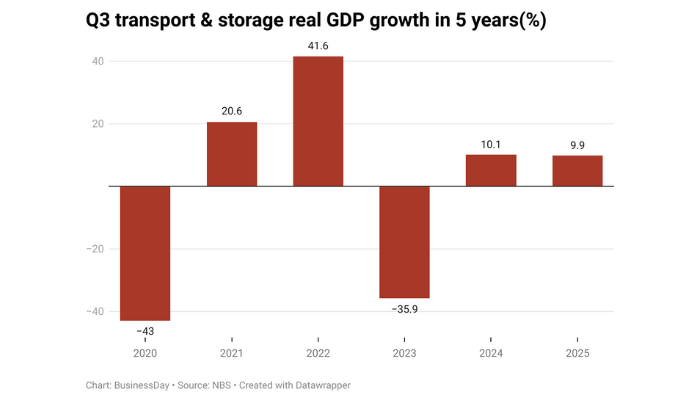

Nigeria’s vital transport sector saw its real growth rate decelerate sharply in the third quarter of 2025, slowing to 9.87 per cent as persistent infrastructural bottlenecks continue to undermine industry performance. Data released by the National Bureau of Statistics (NBS) showed the sector’s expansion dipped by 0.23 percentage points year-on-year, falling from 10.10 per cent recorded in the corresponding quarter of 2024.
The dip reveals a deeper malaise when compared to the preceding quarter. The NBS report noted that the 9.87 per cent rate represented a substantial decrease of 12.22 percentage points relative to the second quarter of 2025, highlighting a sudden loss of momentum. This cooling off in growth is directly attributed to long-standing deficiencies across the logistics ecosystem, which spans road, rail, pipelines, water, and air transportation, alongside post and courier services.
The sector is plagued by an extensive list of challenges, including decaying road networks, severely congested ports, outdated rail infrastructure, debilitating traffic in urban hubs, and chronic security risks. These issues collectively lead to significant operational delays, substantial damage to goods, and ultimately stifle both domestic and international trade, creating a major economic headwind.
From an economic perspective, the slowdown is more than just a statistical drop; it translates directly into higher costs for businesses and consumers alike. Efficient logistics form the backbone of a competitive economy, yet in Nigeria, the high cost of transportation often inflated by poor infrastructure is estimated to account for up to 50 per cent of the final value of goods in some cases. This high cost of doing business reduces the country’s global competitiveness and acts as a significant driver of inflation.
According to Mr.Chukwuemeka ihechi, an economic analyst based in Lagos, the figures are a warning sign. “This sharp deceleration in real terms is a direct consequence of the infrastructure crisis. When logistics costs are this high, every delay on a bad road is essentially taxing the consumer, pushing up food prices and manufacturing input costs. The decline shows that these bottlenecks are actively eroding Nigeria’s true growth potential and undermining macroeconomic stability,” he explained.
Despite the real term slowdown, the sector did manage to increase its overall contribution to the nation’s output. Its contribution to real Gross Domestic Product (GDP) in Q3 2025 stood at 0.69 per cent, a marginal improvement from 0.65 per cent in both the preceding year and the previous quarter. In nominal terms, the sector grew by 24.35 per cent year-on-year, though this was significantly lower than the 37.53 per cent recorded in Q3 2024.
For those on the ground, the struggle is tangible. Mr Abdul kazeem, a long-haul truck owner operating between mile 12 market Lagos and the North, lamented the harsh realities of the industry. “We are still groaning. The cost of running my truck keeps soaring because the roads destroy the tyres and the insecurity makes every trip a risk. The government talks about growth, but out here, we see losses and delays, whether it’s at the congested Apapa port or on the major highways. We desperately need functional railways and better-maintained roads to bring down the cost of food and trade for everyone.”
Positively, four of the six sub-activities that make up the industry reported positive growth rates for the quarter. However, the overall performance suggests that these pockets of growth are not enough to offset the systemic issues in the dominant road transport segment.
Experts widely agree that unlocking Nigeria’s full economic potential demands decisive action. This involves increasing infrastructure funding, particularly through Public-Private Partnerships (PPPs), enacting sweeping policy reform, and developing modern, integrated logistics solutions that properly utilise rail and water transportation to alleviate pressure on the overstretched road network. Without coordinated investment, the transport sector will remain a drag on the country’s wider economic ambition.