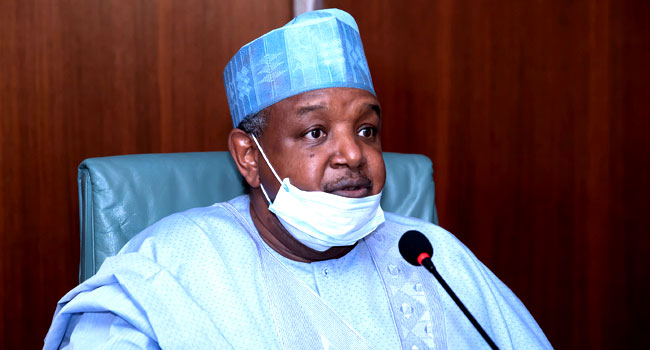

Nigeria’s Minister of Budget and National Planning, Atiku Bagudu, stated that the country must secure at least $100 billion in annual investments to achieve its goal of becoming a middle-income country by 2050.
Bagudu shared this insight at a policy dialogue in Abuja, where he described the “Nigeria Agenda 2050” as a “realistic pathway to prosperity.”
The minister emphasized that President Bola Tinubu’s government has already taken significant steps to reverse years of fiscal weakness and economic distortions.
He explained that the Agenda 2050 is structured into six medium-term plans, beginning with the 2021-2025 period and continuing in five-year phases.
Bagudu highlighted that recent fiscal reforms have improved Nigeria’s revenue-to-GDP ratio, raising it from 9% in June 2023 to 16%.
However, he noted that the country still lags far behind its peers. To illustrate the disparity, he compared Nigeria’s annual federal budget of $36 billion to Brazil’s, a country with a similar federal structure, which has a budget of approximately $700 billion.
He also pointed out that Japan, with about half of Nigeria’s population, spends more than $20 trillion annually.
The minister’s remarks underscore the significant investment required from both the private and public sectors to unlock Nigeria’s economic potential and ensure the country is on track to meet its ambitious growth targets.