

SBM Intelligence has placed Nigeria among the highest-risk economies in Africa in its newly released 2025 Africa Country Instability Risk Index (ACIRI), describing the country’s economic environment as increasingly fragile amid rising inflationary pressures, deepening insecurity and persistent policy uncertainty.
In the report, Nigeria scored 52 points, earning a “critical” rating and registering one of the most notable risk increases on the continent. SBM Intelligence explains that the rise stems largely from the economic shocks that have hit households and businesses since the federal government removed petrol subsidies and unified the exchange rates. The organisation says these reforms, while intended to stabilise public finances, have pushed up living costs, weakened consumer demand and forced many small enterprises to shut down.
According to the report, insecurity remains a major contributor to Nigeria’s instability score, with persistent incidents of kidnapping, banditry and sabotage in oil-producing regions continuing to weigh on economic productivity. SBM Intelligence notes that although the government has intensified engagements with investors and introduced fiscal tightening to improve macroeconomic conditions, policy implementation gaps and the widening disconnect between official economic gains and household realities have kept Nigeria in a vulnerable position.
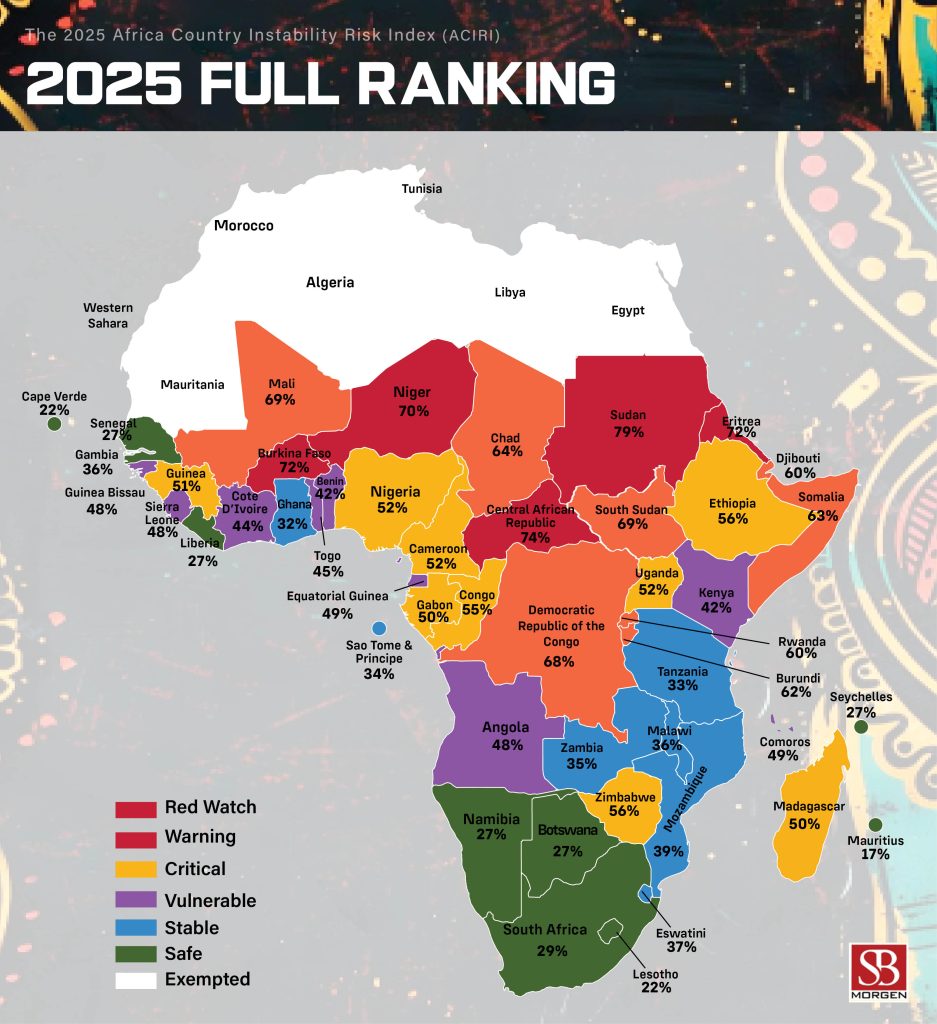
The report situates Nigeria’s struggle within a wider continental pattern that shows rising instability across West Africa. SBM Intelligence highlights that the region contains some of the highest-risk states, including Mali, Niger, Burkina Faso and Guinea, where military takeovers, violent extremism and shrinking civic spaces have disrupted economic and political structures. The instability in these neighbouring countries, it says, feeds into Nigeria’s risk environment because of long-standing trade links, porous borders and shared security challenges.
Outside West Africa, SBM Intelligence identifies more stable pockets across Africa, particularly in the island economies of Seychelles, Mauritius and Cape Verde, which continue to outperform due to stronger institutions and diversified income sources. The report also notes that Namibia and Botswana maintain relatively stable ratings, despite pressures from fluctuations in global commodity prices.
For investors analysing the continent, SBM Intelligence describes Nigeria as a high-risk but potentially high-return market. It explains that opportunities remain in sectors such as telecommunications, energy transition and consumer goods, but warns that these prospects must be weighed against persistent insecurity, currency volatility and uneven reform outcomes.
The report concludes that Nigeria’s path to improved stability will depend on the government’s ability to reduce economic hardship, strengthen institutions and ensure that ongoing reforms deliver measurable benefits to citizens. It stresses that unless these conditions are met, Nigeria is likely to remain in the high-risk category through 2025.