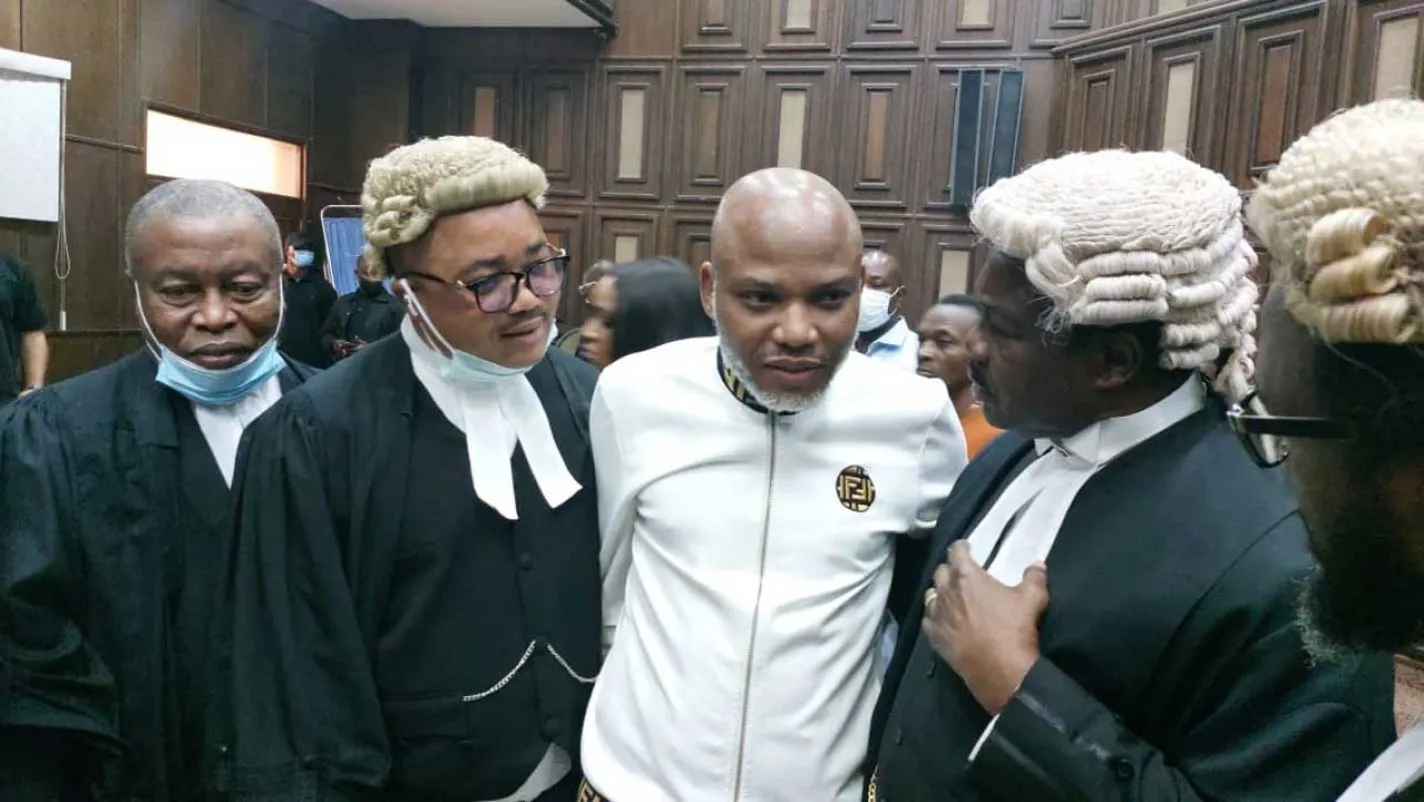

The Federal High Court in Abuja on Thursday sentenced Nnamdi Kanu, leader of the Indigenous People of Biafra (IPOB), to life imprisonment for terrorism-related offences, marking a significant development in Nigeria’s long-running fight against separatist agitation in the southeast.
Trial Judge James Omotosho convicted Kanu on all seven charges, which included inciting violence, attacking security personnel, membership in a proscribed organisation, and illegally importing a radio transmitter. Although the court noted that the offences warranted the death penalty, Judge Omotosho commuted the sentence to life imprisonment, citing scriptural guidance from the book of Matthew. Kanu was handed 20 years for his membership in IPOB and an additional five years for illegally bringing in the radio equipment, with all sentences to run concurrently.
The court also imposed a ban on Kanu’s use of digital devices and ordered that he be kept in protective custody. The smuggled radio equipment was forfeited to the federal government. Throughout the trial, which began in 2015, the court noted Kanu’s unremorseful and confrontational behaviour, citing his refusal to show contrition and his repeated challenges to judicial authority.
Kanu’s case resonates with that of Simon Ekpa, a self-styled Biafra activist who was sentenced in Finland to six years in prison for offences linked to terrorism and incitement. Legal analysts suggest that these high-profile convictions signal a more assertive approach by the Nigerian judiciary and security agencies toward separatist movements, sending a clear message that violent agitation will not be tolerated.
The verdict has immediate political and security implications. In the southeast, IPOB remains a polarising force, and Kanu’s imprisonment may heighten tensions in some quarters, potentially prompting unrest among supporters. At the same time, the ruling strengthens the federal government’s position in its ongoing efforts to maintain national unity and combat organised insurgency. Analysts note that the government may face renewed pressure to ensure security in volatile communities, particularly in areas prone to attacks by separatist elements or other non-state actors.
Economically, the conviction carries indirect but significant consequences. Persistent insecurity and separatist activity in the southeast have historically disrupted trade, commerce, and foreign investment, particularly in states that are central to Nigeria’s oil, gas, and manufacturing sectors. By enforcing the rule of law and curbing violent separatist actions, the government hopes to stabilise the business environment and reassure investors, though risks of localised disturbances remain.
Observers also highlight potential digital and media implications. Kanu’s ban from using digital devices and the confiscation of the radio transmitter underscore the government’s ongoing concern over the use of communication tools to mobilise support for proscribed groups. Restricting the technological capabilities of high-profile agitators may limit the spread of propaganda and reduce the likelihood of coordinated disruptive actions.
Human rights and legal commentators have called for careful monitoring to ensure that Kanu’s rights are protected within the legal framework, even as the state maintains its duty to safeguard citizens and public order. They note that the application of concurrent sentences, as in this case, reflects both judicial pragmatism and a calibrated approach to sentencing, balancing deterrence with legal proportionality.
Kanu’s life sentence is likely to be a defining moment in Nigeria’s struggle against separatist insurgencies. While supporters of IPOB may view the conviction as a setback for the Biafra cause, the federal government is likely to emphasise it as a demonstration of the state’s resolve to uphold the rule of law. The coming months will be crucial in determining whether this landmark ruling contributes to a reduction in violence or further fuels political and social tensions in the southeast.
The case underscores the complex intersection of law, security, and politics in Nigeria, illustrating how high-profile prosecutions can have ramifications far beyond the courtroom. For investors, policymakers, and local communities, the verdict is a reminder that Nigeria’s path to stability involves navigating both legal enforcement and broader socio-political reconciliation.