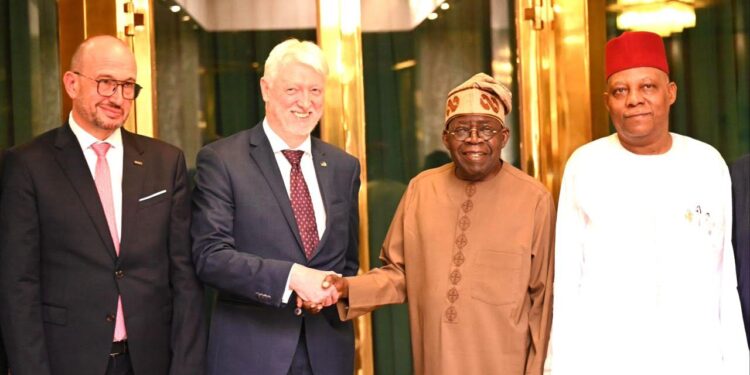

President Bola Tinubu has instructed that key power infrastructure projects under the Presidential Power Initiative be expanded into three distinct phases, aiming to enhance electricity reliability and affordability for Nigerians.
The directive came during a meeting at the State House, Abuja, with Siemens Energy officials, including Dietmar Siersdorfer, Managing Director for the Middle East and Africa. Tinubu praised Siemens for its ongoing work under the initiative, which was launched in 2019 to tackle transmission and distribution challenges across the country.
The President confirmed that major transformer substations will be upgraded from two to three phases, a move expected to strengthen power supply and reduce frequent blackouts that disrupt households and businesses.
Minister of Power Adebayo Adelabu highlighted that the sector has seen significant progress, including the signing of the Electricity Act 2023, the creation of a National Integrated Electricity Policy, and the attraction of over $2.2 billion in new investments. Fifteen state electricity markets have been activated under the policy, enhancing local electricity management and competition.
The minister noted that Phase One, Batch One, involves upgrading substations in Abeokuta, Offa, Ayede-Ibadan, Sokoto, and Onitsha, with two expected to be operational by December 2026. Phase One, Batch Two, will further expand the grid with 16 additional substations, potentially adding 4,104MW to the national capacity.
Siersdorfer emphasised that the Presidential Power Initiative is not just a project but a platform for long-term development, training local engineers, creating jobs, and increasing local content. A more stable and reliable power supply is expected to reduce production costs for manufacturers, lower electricity bills for households, and improve economic activity across Nigeria.
German officials assured ongoing support for the initiative, reinforcing the country’s partnership with Nigeria in energy infrastructure.
Under the PPI, 10 mobile substations and 10 mega transformers have already been ordered, with some units manufactured and ready for deployment. The programme aims to position Nigeria as a regional power hub and improve electricity access for millions of citizens, boosting productivity and living standards.