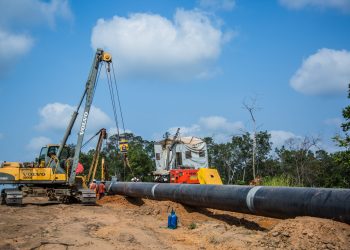

The Federal Government has flagged off the construction of the Kogi International Cargo Airport in Zariagi, Adavi Local Government Area, with the project expected to generate between 2,000 and 3,000 direct and indirect jobs.
President Bola Tinubu, represented by the Minister of Aviation and Aerospace Development, Festus Keyamo, performed the groundbreaking ceremony on Tuesday, November 10, 2026, alongside Kogi State Governor Ahmed Usman Ododo.
According to a report published by the Federal Ministry of Information and National Orientation on November 10, the project is expected to strengthen Kogi’s position as a transportation and logistics hub, attract investment and expand economic opportunities.
Speaking at the ceremony, Keyamo defended the decision to build the airport, arguing that governments must provide essential infrastructure to attract businesses rather than wait for investors to arrive before developing necessary facilities.
The minister said the airport would place Zariagi on the global aviation map and provide a foundation for future economic development.
“It is the airport that attracts these developments. The airport is the precursor,” Keyamo said, stressing that aviation infrastructure could encourage the establishment of businesses and supporting facilities.
Keyamo also attributed the project’s commencement to President Tinubu’s economic reforms, which he said had increased revenue allocations to state governments, and Ododo’s infrastructure development agenda.
The first phase of construction will include a 3,600-metre runway designed in line with International Civil Aviation Organisation standards and capable of accommodating wide-body aircraft, including Boeing 747s.
Kogi State Commissioner for Works, Momoh Salami Ozigi, said the initial phase would also cover taxiways, an aircraft parking apron, drainage systems, perimeter fencing and access roads.
The project is being handled by China Civil Engineering Construction Corporation (CCECC). Its Managing Director, Henry Shuo, assured the state government that the company would deploy its technical expertise to deliver the facility to the required standards.
Governor Ododo described the airport as a strategic investment in Kogi’s economic transformation, saying it would strengthen the state’s position in commerce, transportation, logistics and investment.
According to the governor, the facility would improve access to national and international markets for farmers and agro-processors while creating opportunities across agriculture, mining, manufacturing, tourism and hospitality.
Kogi has significant agricultural and mineral resources, including cassava, cashew, rice, iron ore, limestone and coal. The state government expects improved cargo transportation to support the movement of these products and attract businesses involved in processing, storage and logistics.
The governor also called on investors and business leaders to explore the opportunities associated with the project.
The airport forms part of the state’s broader infrastructure development strategy aimed at diversifying its economy beyond its traditional dependence on the civil service.
However, the projected employment figures and economic benefits will depend on the successful completion of the project, the development of supporting logistics facilities and the airport’s eventual operational capacity.