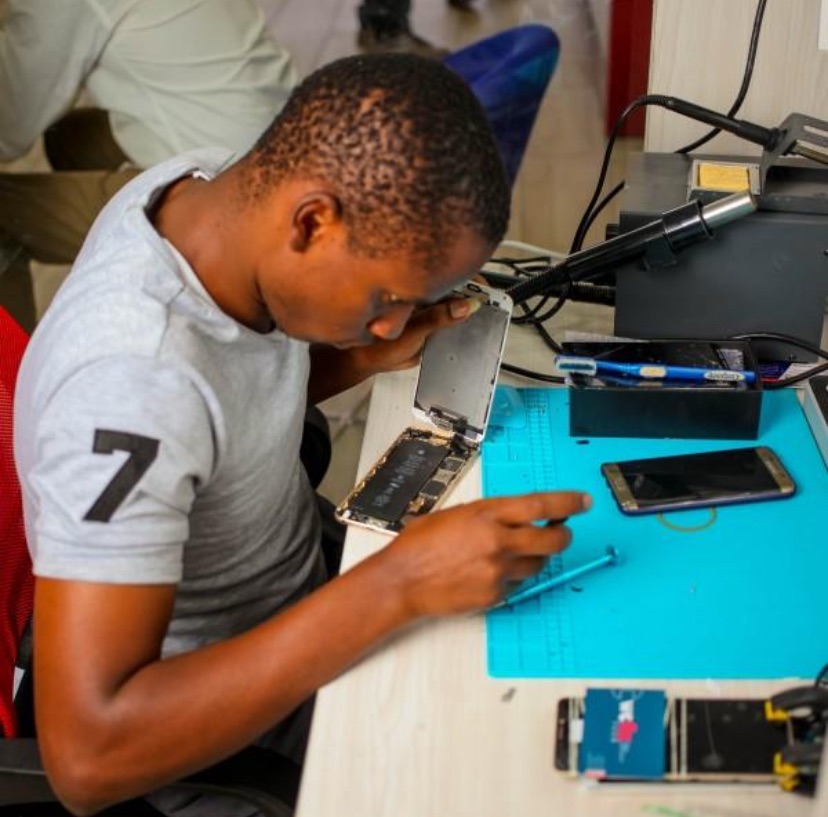

The rising cost of smartphones and the growing dependence on mobile devices are creating more opportunities for phone repair businesses in Nigeria, as consumers increasingly choose to fix damaged devices rather than replace them.
Nigeria’s mobile market alone provides a large customer base for repair technicians. Data from the Nigerian Communications Commission (NCC) show that active mobile subscriptions reached 189.4 million in May 2026, the highest level recorded in more than two years.
That large installed base means millions of phones are in daily use for banking, business, communication, education, transportation and entertainment — and every damaged screen, weak battery or faulty charging port creates potential demand for a repair shop.
The business is particularly visible in technology markets such as Lagos’ Computer Village, where phone technicians operate alongside sellers of new, used and refurbished devices. The United Nations Environment Programme (UNEP) has previously documented how engineers in the market repair mobile phones and computers using components recovered from electronic waste.
For many Nigerians, replacing a smartphone after a cracked screen or battery failure can be more expensive than repairing it.
Current prices advertised by Lagos repair businesses illustrate the range. One Lagos repair provider lists phone repairs from ₦10,000, while screen replacements for premium iPhone and Samsung models can reach ₦120,000, depending on the device. Another Lagos repair business advertises services from about ₦5,000. These are individual business prices, not an official industry-wide price list, and actual costs vary according to phone model, parts and damage.
For technicians, therefore, the opportunity is not limited to changing screens. Businesses now offer battery replacements, charging-port repairs, camera and speaker repairs, water-damage recovery, software troubleshooting and board-level repairs.
The expansion of services is important because the repair business can generate several revenue streams from the same customer.
A customer who comes in with a broken screen may also need a battery replacement, protective accessories or software support. Some repair businesses have also moved beyond traditional roadside shops by offering pickup and delivery services.
The economics of repairs are also linked to how deeply smartphones have become embedded in everyday Nigerian life.
The NCC reported 98.64 million active MTN subscriptions, 66.12 million Airtel subscriptions and 23.68 million Globacom subscriptions in June 2026, alongside more than 3.5 million 9mobile subscriptions.
These figures represent subscriptions rather than individual smartphones, since one person can have multiple lines. Nevertheless, they show the enormous scale of Nigeria’s mobile ecosystem.
For traders, delivery riders, freelancers, students and small business owners, a damaged phone can mean more than losing access to calls. It can interrupt mobile banking, WhatsApp sales, social media marketing, navigation and customer communication.
This gives repair technicians an advantage: they are selling the return of a working device, not simply a spare part.
The growing market also comes with challenges.
Repair businesses depend heavily on the quality and availability of replacement parts. A cheap screen or battery can reduce the customer’s bill, but poor-quality components can also lead to repeat failures and disputes.
Trust is therefore becoming an important competitive advantage. Customers increasingly want technicians who can diagnose a problem correctly, explain the cost before starting work and provide some form of warranty.
There is also a skills gap. Basic repairs such as screen and battery replacement are different from advanced motherboard and micro-soldering work. Technicians with more specialised skills can handle more complicated faults and potentially charge higher fees.
The growth of phone repairs has an environmental side.
UNEP has identified repair and reuse as important parts of a more circular electronics economy. Nigeria has also been the focus of programmes aimed at tackling the environmental and health risks associated with electronic waste.
Repairing a phone keeps the device in use for longer and can delay its journey into the waste stream.
However, the sector still operates largely through informal businesses, and not every technician follows the same standards for parts, data protection, warranties or disposal of damaged electronic components.
For customers, this makes choosing a repairer carefully important. For the industry, it creates room for businesses that can combine technical expertise, transparent pricing, reliable parts and customer guarantees.
As Nigeria’s mobile subscriber base continues to expand, the phone repair business is becoming more than a roadside service. It is developing into a wider consumer and technology market built around keeping the devices Nigerians increasingly depend on working for longer.